Canada at ProWein 2016 [30 and 50 Degrees North]

Canada’s area under vine measures 29,500 acres or 11,950 hectares, which includes 550 vintners who produce one million hectoliters of wine. Canada is no longer known for ice wine – They are producing award-winning expressive red wines, delicate whites, rosé and sparkling wines, despite their harsh climate and long winters.

For the third year this relatively young wine country will be represented at ProWein 2016.

Exports of Canadian wines are continuing to rise: in 2014 Canada exported 1.8 million liters of premium wine to 26 countries, including: U.S., China, Hong Kong, South Korea and Great Britain.

With 22 wineries, the “Wines of Canada” joint stand in Hall 9 at ProWein 2016 will be larger than the last two years. In addition, two Canadian exhibitors will showcase their products in their individual stands in Hall 12:  La Face Cachee de la Pomme (apple Eiswein from Quebec) and Kruger Wines & Spirits (whiskey).

In addition to the joint stand, “Wines of Canada” will also offer various events during ProWein 2016: the daily masterclass at the ProWein Forum at 11:30 am and a guided tasting session every afternoon at 3:00 pm at the stand. Both events will be hosted by the famous British wine blogger Jamie Goode.

Canada’s Wine Regions
The producers at the “Wines of Canada” stand will be representing three provinces: Ontario, British Columbia and Nova Scotia. Ontario is by far the largest winemaking region with 80% of Canadian vines cultivated here on some 6,000 hectares. As a result, half the 22 Canadian winemakers presented at the joint stand come from this province. Varieties featured will be: Riesling, Chardonnay, Ice Wine, along with Gamay, Pinot Noir, Cabernet Franc and Cabernet Sauvignon. Over the past few years Canadian Merlots have also gained ground with their convincing quality. This is surprising as Ontario is located on nearly the same geographical latitude as Tuscany in Italy.

Nine producers from British Columbia will be represented focusing on varieties such as: Pinot Gris, Chardonnay, Gewürztraminer, Riesling, Merlot, Pinot Noir, Cabernet Sauvignon and Syrah.
Two vitners will be represented from Nova Scotia. The cultivated area is relatively small and primarily features lesser known, frost-resistant grape varieties. Nova Scotia is increasingly making a name for itself with sparkling wines made according to the traditional méthode champenoise.

VQA Appellation System
To control the quality of the wine and also guarantee it long term, Canadian wine also follows a classification system. With VQA wines (Vintners Quality Alliance) 100% of the grapes come from each relevant growing area. In accordance with this alliance each wine must state its province or geographic origin. Over the past few years more and more new wine cultivation areas are being defined due to micro-climatic influences and specific soil properties.

ProWein will be held from March 13 – 15, 2016 at the fairgrounds in Düsseldorf, Germany www.prowein.com

Liz Palmer
www.liz-palmer.com

Champagne Sales Set for Record Year

Champagne sales are set for a record year, driven by solid demand from export markets, favorable currencies and stabilizing sales in France, the fizzy drink’s home market.

Industry estimates gathered by Reuters showed that about 312 million bottles of the prestige sparkling wine will have been dispatched in 2015, a rise of between 2 and 3 percent from 2014.

Revenue has risen 4.4 percent to 4.7 billion euros ($5.1 billion) in 2015.

In 2007, the record year so far, revenues reached 4.56 billion euros, before the global economic and financial crisis began weighing on the market a year later.

The 2015 sales estimates reflected efforts to promote higher-priced products such as special blends and fine vintages, as well as growing demand for Rose Champagnes in Japan and the United States, Champagne’s second export market after Britain.

In Britain, a solid economy underpinned buoyant demand while austerity-hit Italy and Spain were starting to see signs of an upturn.

Economic woes in Champagne’s home market of France have taken the fizz out of global sales since 2010, but sales were stabilizing in volume and value this year and could even show a slight rise.

“France is on a recovery path. Consumption stabilised,” said Bruno Paillard, CEO of Lanson BCC, the number two Champagne house behind luxury group LVMH.

Sales were improving in French hypermarkets as well as in specialized stores.

“Consumers need to enjoy life,” said Paillard, adding lower energy prices and interest rates may have helped improve consumer purchasing power.

The Champagne market is dominated by LVMH, which owns the Dom Perignon, Moet & Chandon, Veuve Clicquot, Ruinart and Krug brands. Specialist makers include Lanson-BCC, Vranken or Laurent Perrier as well as drinks group Pernod Ricard with its Mumm and Perrier-Jouet brands.

Official figures for 2015 will be published next month.

Champagne, which can be produced only in the region of the same name, is facing tougher competition from Spain’s cava and Italy’s prosecco, sold for as little as a third of the price.

Industry professionals say the Champagne sector is fighting back by stepping up efforts to enhance the quality of its own product.

Reuters

Anteprima Amarone 2012

The preview of Amarone 2012 commences this Saturday January 30 through to Sunday January 31 2016 and is being in Verona, Italy at the historical Gran Guardia Palace in Piazza Brà. This two-day event is open to international press and winelovers.
.
For any further information visit: http://anteprimaamarone.it/

Here is the list of all the participating wineries:

Albino Armani 1607
Cantine Aldegheri
Blessed court ancient
Winery Bennati
Cantine Bertani
Boscaini Carlo Azienda Agricola
Cantine-Bolla
Cantina Buglioni
Ca’botta Vini
Ca’ dei Frati
Azienda Agricola Cà La Bionda
Ca’ Rugate
Cantina Di Soave
Cantina Valpantena
Cantina Valpolicella Negrar
Cesari Winery
Azienda Vitivinicola Corte Archi
Corte Figaretto
Court lonardi
Corte Rugolin
Corte San Benedetto
Corte Sant’alda
Dal Bosco Giulietta Azienda Agricola Le Guaite
Damoli Vini-Amarone Winery in Valpolicella
Degani
Amarone & Ripasso Falezze_DE
Azienda Vinicola Farina
Fasoli Gino
Fidora Wines
Vini Flatio di Flavio Fraccaroli
Vini Gamba
Clementi-Vini Della Valpolicella
Cantina Giovanni Ederle
Latium Morini
La Collina dei Ciliegi
La Dama Vini Valpolicella
La Giuva La Giuva Fanpage
Le Bignele-Soc. Agr. Aldrighetti Luigi, Angelo e Nicola
Le Marognole Vini
Azienda Agricola Marco Mosconi
Massimago
Monte Del Frà
Montecariano
Monte Zovo
Cantine Giacomo Montresor Spa
Novaia
Pasqua Vigneti e Cantine
Recchia Vini
Vigneti Di Ettore
Cantine Riondo
Roccolo Grassi
Azienda Agricola RUBINELLI VAJOL
San Cassiano Azienda Agricola
Santa Sofia.: I Classici Vini Veronesi dal 1811 :.
Casa Vinicola Sartori
Saints
Scriani Vinicola
According to Marco
Tenuta Chiccheri
Tenute Falezza
Tenute Salvaterra
Tenuta Santa Maria Valverde
Tezza Viticoltori in Valpantena
Casa Vitivinicola Tinazzi-Italians Inside
Valentina Cubi
Villa Crine
Villa Canestrari, Museo del Vino
Viviani
Vini Zanoni
Zonin 1821
Zýmē

360° Champagne Experience

capture_campagne_unesco-1

The Comité Champagne has launched a global communications campaign which focuses on a 360° film. This immersive film offers the viewer a virtual reality tour of the Champagne hillsides, houses and cellars.

It was announced on July 4th 2015 that the Champagne region was granted world heritage status by UNESCO:

“hillsides, houses, and cellars” of the Champagne wine region in northeastern France deserve recognition. “The property encompasses sites where the method of producing sparkling wines was developed on the principle of secondary fermentation in the bottle since the early 17th century to its early industrialization in the 19th century.”

Enjoy this 360° or virtual reality experience by visiting www.360.champagne.fr.

Three ways to experience this 360° unique experience is by smartphone, tablet or PC, or 3D using Google Cardboard goggles or virtual reality headset.

Liz Palmer
www.liz-palmer.com

Rosé Champagne Report – Liz Palmer Wine Picker Magazine, Milan, Italy

images-1

The Champagne production zone (AOC) is defined and delimited by a law since 1927, stretching over 34,286 hectares of vineyards. It lies 150 kilometres East / North-East of Paris, and is made-up of plots from 320 villages in five departments: Marne (66%), Aube (23%), Aisne (10%) – also shared by Haute-Marne and Seine-et-Marne. The vineyards are also divided by “crus”, a qualitative division of the appellation. Of the 320 villages, 17 are Grand Cru and 42 are Premier Cru.

Champagne terroir has two major distinguishing features: northerly latitude and a dual climate that is subject to oceanic and continental influences. The Champagne region is located near the northern limits of the wine world along the 49th parallel, with the coordinates of 49°5 and 49° North – this means cold climate and harsh weather conditions. The oceanic influence brings steady rainfall and the continental influence ensures ideal levels of summer sunlight, but often causes devastating winter frosts.
The average annual temperature in Reims and Epernay) is 11°C. This complex weather pattern distinguishes the Champagne viticultural zone from the other terroirs in the same group.

The subsoil in Champagne is predominantly limestone –including the outcrops, which consist of sedimentary rock (75% limestone), chalk, marl and limestone proper. This type of subsoil provides good drainage and also imparts that particular mineral flavour found in certain Champagne wines.

These regional differences lead to different styles of wines, different and aromas developing in the fruits.

On 4 July 2015, in Bonn, Germany the UNESCO World Heritage Committee delivered a decision to include the “Champagne hillsides, houses and cellars” on its World Heritage list.
“The property encompasses sites where the method of producing sparkling wines was developed on the principle of secondary fermentation in the bottle since the early 17th century to its early industrialization in the 19th century. The property is made up of three distinct ensembles: the historic vineyards of Hautvilliers, Aÿ and Mareuil-sur-Aÿ, Saint-Nicaise Hill in Reims, and the Avenue de Champagne and Fort Chabrol in Epernay. These three components – the supply basin formed by the historic hillsides, the production sites (with their underground cellars) and the sales and distribution centres (the Champagne Houses) – illustrate the entire champagne production process. The property bears clear testimony to the development of a very specialized artisan activity that has become an agro-industrial enterprise.”

R O S É C H A M P A G N E

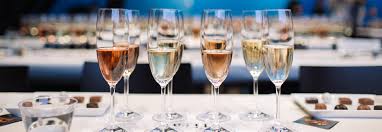
Rosé Champagnes are distinct from brut and blanc de noirs in that they are noticeably and intentionally colored, with hues that span from light pink to copper salmon. There are two main methods of creating this style:

Blended or Rosé d’assemblage

This method is most common – it allows the producer to obtain colour and density identical year to year. It consists of blending still white wine (before its second fermentation) with 5 – 20% of red wine, vinified to be non tannic.

Macerated or Rosé de saignée

This process consists of allowing the grape must to remain in contact with the skins of black grapes (Pinot noir and Pinot Meunier) for a few hours. The natural pigments in the skins begin to colour the juice and at the same time enrich the juice with their aromatic components. Rosé de saignée champagnes are generally richer in taste and have a vinous character, which makes them particularly suitable to be served with food.

Rosé Champagne is produced in both vintage/millesimé and non-vintage versions. Although there is variation in the sweetness levels, the wines are most often dry (brut or sec) in style.
Rosé Champagne account for 3-5% of Champagne’s yearly production. Most of the Champagne houses have this style their portfolios, including: Krug, Laurent-Perrier, Billecart-Salmon, Dom Pérignon, Cristal Veuve-Clicquot. With Billecart-Salmon and Laurent-Perrier’s leading the pack in making Rosé champagne a speciality.
UK is Champagne’s largest export market – sales increased by 6.1% in 2014 reaching 32,675,232 bottles. While US is the second largest export market – sales grew slightly, up 7.3% to 19,152,709 bottles, with rose up 14.4% to 2,758,364 bottles.

US figures 2010-2014

Total Export Rosés % export
2010 134,364,880 11,437,497 8.51%
2011 141,328,649 12,699,146 8.99%
2012 137,349,432 13,004,384 9.47%
2013 137,639,340 13,371,939 9.72%
2014 144,870,262 13,731,634 9.48%

Rosé Top Ten Markets 2014

2014 Country

1 ETATS-UNIS
2 ROYAUME-UNI
3 ALLEMAGNE
4 JAPON
5 SUISSE
6 ITALIE
7 BELGIQUE
8 ESPAGNE
9 NIGÉRIA
10 RUSSIE

Some salient characteristics of our favourite Rosé Champagnes:

IMG_4060

Dom Pérignon Metamorphosis Rose 2003
Exquisite soft rose-colour with nose of cherry and soft citrus; creamy textured and precise with flavours that are complex and rich; focused and elegant with subtlety and depth; graceful and well balanced with a long echoing finish.
96 Points

Roederer Cristal Rosé 2002
Medium pink hue with lively effervescence; soft aromas of strawberry, cherry and blood orange with some notes of butter and dried flowers; crisp Chardonnay -underlay pinot fruit on the palate with a very silky, long finish.
93 Points

Krug Rosé – NV
Pale salmon colour (with some subtle hint of pink) and fine bubbles; aromas of rose hips, ham, mulberries, redcurrant, peony, pepper & pink grapefruit; mouthfilling but refilled and elegant layers of honey, citrus and dried fruit with long finish.
96 Points

Delamotte Brut Rosé NV
Very pale, delicate rose hue; fresh berry fruit and blood orange come through on the nose and palate, with some chalky mineral notes – medium finish.
92 Points

Pascal Doquet Brut Rosé Premier Cru NV
Pale salmon colour; aromas of red fruit, flowers, and minerals lead to a palate with hints of strawberry, toast, and minerals – fresh and ample mouthfeel.
92 Points

Perrier-Jouet Rose Belle Epoque 2004
Light salmon pink; with delicate aromas of floral, strawberry, raspberry, orange and pink grapefruit; fresh, refined attack with subtly crisp notes of pomegranate and pink grapefruit; full-bodied with a long, silky finish.
94 Points

Charles Heidsieck, Brut Rosé Réserve
Very pale pink, rich toasty aromas with creamy texture; finely honed acidity lending a mouthwatering impression to flavors of crème de cassis, toasted brioche, lemon curd and roasted almond; long, spicey finish.
93 Points

Liz Palmer