Ruinart Unveils Blanc Singulier: A New Champagne Based on Climate Change

Frédéric Panaïotis, cellar master of Maison Ruinart, the oldest Champagne house founded in 1729, has introduced a new cuvée, Blanc Singulier. The label describes it as “A Singular Expression of Chardonnay, Revealed by a Changing Climate.”

Ruinart is renowned for its Chardonnay, and Blanc Singulier continues this tradition with a 100% Chardonnay composition. The Edition 19 comprises 80% fruit from the 2019 vintage and 20% reserve wine, with a portion aged in oak casks and zero dosage.

Edition 19
Edition 19 is the third release in this series, following Editions 17 and 18. Despite an early harvest in August, 2017 was not as challenging as recent years, making it an experimental prototype. Panaïotis chose zero dosage for this cuvée, he states “We decided to go for it, and this was our experimental cuvée, a prototype.” He recalls that he decided to go for Zero dosage, although in his words, “it probably needed one or two grams.”

The 2018 vintage set heat records in Champagne, with summer temperatures averaging two degrees above normal, necessitating greater selectivity in vineyard choice. Nonetheless, Panaïotis achieved a balanced wine without dosage.

Edition 19 underwent full malolactic fermentation, with 77% fruit from the 2019 vintage, some oak aging, 36 months on lees, and zero dosage. Panaïotis and other Champagne winemakers regard 2019 as an exceptional vintage. Panaïotis remarks, “I think everybody in Champagne agrees that 2019 is the greatest vintage we’ve had in a number of years. You talk to growers, to other houses, all winemakers are in love with 2019; it’s like a dream vintage.”

Sustainability
Ruinart’s new cuvée highlights adaptability to climate change and a commitment to sustainability. Panaïotis defines sustainability as a balance between environmental, social, and economic factors. Ruinart ceased airfreight shipping around 2013-2014 and prioritizes carbon footprint reduction, with a focus on packaging and transportation. In the vineyards, biodiversity protection is paramount in the face of climate change.

To sum up
Panaïotis reflects on future challenges posed by warmer temperatures, expressing confidence in Ruinart’s ability to craft quality Champagnes even under extreme conditions. He acknowledges uncertainty about potential future extremes but remains hopeful.

Source: The Drinks Business

EU Wine Consumption in 2023: A Marginal Decline Amid Industry Challenges

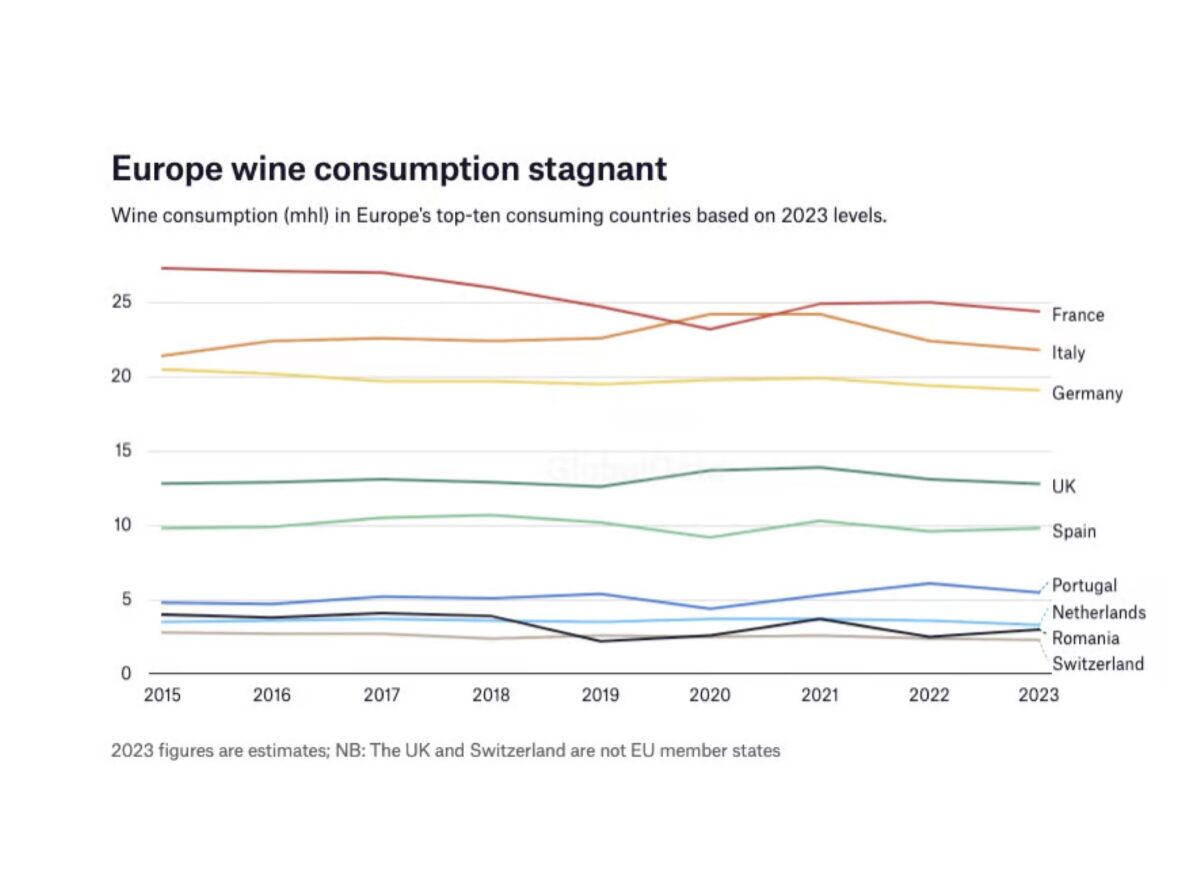
In 2023, EU member states represented 48% of global wine consumption – drinking 107 million hectolitres. This figure reflected a ‘marginal’ decrease of 1.8% compared to 2022. However, the number was more than 5% below its ten-year average as multiple headwinds buffeted the industry.

Source: oiv

Sweden Seeks to be Winemaking’s Next Frontier

Far north of iconic wine regions like Bordeaux and Tuscany, Sweden is seeing a burgeoning industry of vineyards and a first generation of winemakers trying to carve out a niche.

“There are millions of techniques, and I don’t have a grandfather or grandmother to ask. So we need to figure it out ourselves,” Lena Magnergard states as she walked through the short rows of grapevines at the Selaon vineyard an hour west of Stockholm.

The former communications professional started the vineyard, the most northern Swedish site to have produced its own wine according to Magnergard, together with her farmer husband Erik Bjorkman in 2019 on the family farm. They produced their first wine in 2021 but Magnegard, a trained sommelier, is quick to admit that as keepers of some 1,000 vines they are still learning.

“Of course you can read up in books, but that is nothing like generational knowledge,” she said, adding that they mostly look to France and its centuries of winemaking tradition as the gold standard.

According to Magnergard, the emergence of wineries this far north is largely thanks to the development of new breeds of grapes in the 1960s and 70s, such as Solaris — which was developed to be resistant to disease and is the main grape grown at Selaon.

Resistance to Cold

“What they then discovered about these grapes, by pure chance, was two things — they need less time between blooming and harvesting and they can handle cold very well,” Magnergard said.

That combination was perfect for the Nordic region, where summers are both shorter and colder.

In the south of Sweden, on the Bjare peninsula, Solaris also dominates the 11-hectare Thora Vineyard; started in 2015 by a Swedish-American couple.

But it also features more well-known grapes such as Pinot noir — which is less expected so far north due to it requiring more heat.

For French-born winemaker Romain Chichery, who started working on the vineyard together with colleague Emma Berto three years ago, Sweden is “a new playground”.

The 27-year-old wine specialist admitted to AFP that they “didn’t expect so many varieties to take.

“Once we had analysed the climatic data, we realised that there was potential for many varieties and not just hybrid varieties, which are interesting but not the only solution” for Swedish soils, he added.

As a warmer climate is disrupting harvests in traditional wine-growing areas, professional wine growers have begun to look further north.

However, the Scandinavian country is not exempt from the variations of the climate.

“We have extremes, just like everywhere else in Europe,” Chichery noted.

At the same time, exploring a new frontier of wine also frees winemakers from old established rules.

“We’re free to do what we want. If I want to make a red with a little residual sugar, so a slightly sweet red, I can do that,” he said.

In Sweden, the industry has picked up speed in recent years and the country is now home to some 50 commercial vineyards of varying sizes.

According to industry group Svenskt Vin, 200 hectares are now being cultivated, which while twice as many as five years ago is little compared to the 800,000 hectares devoted to viticulture in France.

For Murat “Murre” Sofrakis, the figure is still unimpressive, and the 56-year-old foresees much greater things in the future.

Sofrakis runs a small vineyard in the far south of Sweden but is a champion of Swedish winemaking.

Equal Terms

“There are two kinds of people. One is the entrepreneur that sees opportunity here… and for the other people, it’s like a lifestyle” he states.

For him, the aim is to invigorate the industry, and he believes a recent liberalisation of the Swedish strict alcohol monopoly should help.

In June, Sweden’s government announced it wanted to allow breweries, distilleries and winemakers to sell alcoholic beverages directly to customers visiting their operations.

Apart from bars and restaurants, Swedes can only buy beverages with an alcohol content above 3.5 percent at state-run outlets called Systembolaget, and some authorised retailers in rural areas.

The proposal to allow winemakers to sell three litres of wine to visitors is currently being reviewed but the government said it hopes to see it implemented in the first half of 2025.

“It’s the first time we’ve been able to compete on equal terms with the rest of the wine world, and that’s very important,” Sofrakis said.

He started in 2001, just two years after the European Union gave permission for vines to be grown commercially in Sweden. “If we’d had this 20 years ago, Swedish winegrowing would be much bigger,” he said.

Source: Camille BAS-WOHLERT

Wine Industry Data: 2023 Europe Wine Consumption

In 2023, EU member states accounted for 48% of global wine consumption, totalling 107 million hectolitres. This volume marked a slight decline of 1.8% compared to 2022. Nevertheless, this consumption level was over 5% below the decade-long average, as the industry faced several challenges.

Source: OIV

Campania Stories 2024 – A Memorable Experience

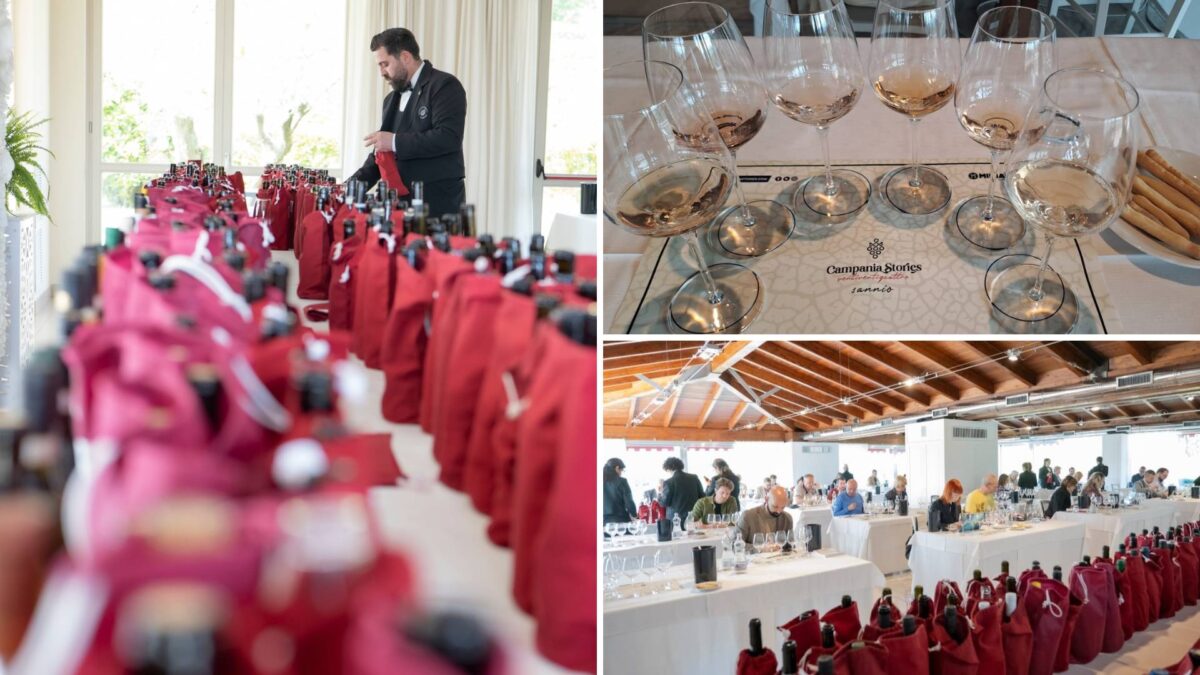
Campania Stories, one of the most significant wine events in southern Italy, took place this year in Sannio on the northern edge of Campania from May 21st to 25th. The 12th edition welcomed wine writers and other trade professionals.

This year was an incredible success with over 90 wineries who submitted their samples to a wide audience of international bloggers, journalists and wine critics. The setting could not be more beautiful as the event consists of a journey through the main wine areas of a region known by visitors for the beautiful Amalfi Coast and the vibrant city of Naples.

Sannio just north of the Naples, the town of Dugenta hosted the event at the luxury resort, Tenute del Gheppio. Producers had the opportunity to present their latest white wines along with their Riservas. Presentation of the 2023 vintage was led by Francesco Martusciello, one of the flying winemakers of the region, at Rocca dei Rettori di Benevento, in cooperation with Assoenologi. Francesco Martusciello emphasized the 2023 vintage trend which was an uneven year with limited production but of very high quality. The whites were a perfect example with their predominant fermentative aromas that will certainly dissipate with time to show the true character of the grape.

We also enjoyed an in-depth journey through Campania to see producers in their element visiting estates in Sannio and Irpinia where they discovered the landscapes of smooth hills, mainly of clay, with expansive vineyards divided by the main rivers of Calore in Irpinia, and Volturno in North Sannio. These visits were made possible in part by the close collaboration of Miriade & Partners headed by Diana Cataldo, Massimo Iannaccone and Serena Valerian.

This is an area known for is great viticulture, since the Roman times when it was known as Campania Felix. A place where Roman heritage is still evident with the discovery of several amphoras and tools for winemaking, but also marked by incredible buildings dating back the 18th century, such as the majestic Carolino aqueduct that dominates the valley as a Unesco Heritage site.

This beautiful corner of Campania shows history, art and culture that are only discovered by venturing off the beaten path, such as Vigna del Ventaglio near Caserta in San Leucio, another UNESCO World Heritage site. The place was already known in the past for high quality silk production, when the Bourbon King Ferdinando IV selected a vineyard in the shape of a fan and divided it into nine sectors, each cultivated with unique grape varieties he loved the most, like Piedimonte Rosso and Bianco, Procopio, Delfino Bianco and Siracusa Rosso, parental vines of the modern ones.

Modern winemaking equipment has been introduced in Campania. For instance, prominent estates have been using high -ech crushing machines and tanks with cooling jackets, and at the same time the wine estate are preserving certain traditional winemaking techniques like the use of amphoras where local grapes such as Greco, Fiano and also Coda di Volpe perform well.

The two-day tasting was a true pleasure for me, with sparkling, whites, reds and rosè from all over Campania, over 200 samples from 90 producers. I focused mostly on the sparkling wines which are showing interesting improvements. While at the beginning, most sparkling wine from Campania was Charmat method from some of the semi-aromatic grapes of the region, mainly Falanghina, but now several traditional method wines are becoming more and more popular with large improvements in terms of quality.

This was definitely a roadshow of the best expression of Campania viticulture and landscape. For a full immersion in this promising growing region, Campania Stories is wine not to be missed. And now I can only wait for the 2025 edition, which will be hosted by the Volcano Vesuvio.

Filippo Magnani