Spring has finally arrived and so has the arrival of Sperling Vineyards “Spring Releases”

This vintage marks the third year of certified organic wines from Sperling Vineyards. Sperling Vineyards is British Columbia’s oldest heritage vineyard, and home of Canada’s leading organic and biodynamic winegrower Ann Sperling.

Ann Sperling and her family are pioneers, first in the history of agriculture in the Kelowna region, and in both biodynamic and organic viticulture, and winemaking practice. The proof of their success is in the long lineup of awards. Taste for yourself!  Their wines are known to be wines of elegance, texture & authenticity.

Sperling Vineyards Blueprint

Location: Kelowna, British Columbia, Canada

Established: Four generations: 1860s – land was cleared, settled and the farm was officially established in the1920s

 First vintage: 2008

Winemaker:  Ann Sperling

Viticultural Practices: Organic and Biodynamic

Estate: 45 acres

This anticipated release includes the following wines, with tasting notes.

Organic Market White 2018

Aromas of peach and orange with hints of honeysuckle;
soft on the palate with flavours of apple, apricot, grapefruit and pear; nice long and fresh finish
89 Points

Organic Pinot Gris 2018

This lovely estate-bottled PG has a nice weight; aromas of white fruits, on the mouth beach and honey, lingering with clean mineral flavours; refreshing acidity.
89 Points

Organic Natural Amber Pinot Gris 2018

Aromatically this orange wine has hints of earl gray tea, jasmine, and stone fruits; while the palate is fresh and long with texture and finishes fresh.

From the Vision series, this lovely orange wine is made from 40% whole cluster, 40% whole berry and 20% pressed juice from hand-picked Pinot Gris. Natural yeast and malolactic fermented, this wine has had nothing added and nothing taken away (no sulfites, or additives, and no fining or filtration). Being unfiltered it is slightly cloudy.
90 points

 Organic Pinot Noir 2017

This light ruby wine has some notes of spicy strawberry on the nose;
I found it to be a medium-bodied wine that is dry with some strawberry flavours and fresh acidity; excellent length.
91 points

Organic Vision Chardonnay 2017

Beautiful bright gold; on the nose, aromas of fresh apples, pear, and quince; while tasting I found it had a good weight with flavours of baked fruit and some spic; well-balanced acid keeps it fresh with a long finish.
89 Points

Organic Old Vines Foch Reserve 2017

Deep ruby colour; with a nose of plum and hints of spice; I found the wine to be medium-bodied, dry, with plum and cherry flavours; fresh and lively in the mouth with a long finish.
91 Points

Sperling Vineyards is also offering FREE SHIPPING across Canada right now, with some other tempting promotions – Market Series wines: buy 5 get the 6th free or spend $75 and we’ll include a gift with purchase.

Check out their website for details https://sperlingvineyards.com/


Wine in a can is a robust trend and not a short-term fad

With the traditional wine market in the US growing at an increasingly slow pace, successful wineries 10 years from now will be those that have adapted to a different consumer with different values.  Wine in a can is no new thing; it was first seen in World War 1 when the French army had their wine rations delivered this way.

WICresearch.com has done an in-depth study of the drivers that are affecting the boom in the wine-in-can market and it is predicted that the trend will continue to grow as it has done exponentially in its infancy.  The most important factors to consumers when it comes to wine-in-can are taste, quality and value, followed by convenience, portability and fun.  From 2017-2108 the wine-in-can market grew by 43%.  It is a market that cannot be ignored as the industry needs new growth places.

There are 6 main drivers that are promoting the expansion of wine-in-can, as follows:

Convenience

This is the most obvious benefit and relates to the carrying, opening and finishing of the product.  One is able take a can where it is illegal or inconvenient to bring a bottle or any glass.  The single-serve size also allows for zero waste of the contents, and it removes the need for traditional wine paraphernalia: foil cutters, corks screws. Under the convenience banner, the wine vending machine is also a trend that is starting to gain traction, certainly opening new markets in terms of novelty and availability.

Occasion expansion

This is based on both location and event. Location involves places where taking a bottle of wine is not suitable nor practical: boats, beach, swimming pools.  Event expansion is where offering a single-serve beverage is desirable e.g.BBQ, picnic.

It is interesting that wine-in-can drivers such as these are not cannibalizing the existing market with its meagre growth of 1-4% but it is rather creating an extension of markets or even new markets and thus creating strong double-digit growth.

Sustainability and cost savings

Aluminum is 100% recyclable and so the environmental footprint is greatly reduced, and the product attracts an eco-friendly consumer who values sustainability.  Research has shown that 51% of Millennials check the packaging before purchase for sustainability claims.

 Facts:

  • Sustainable products grew 4x the rate of non-sustainable products (Nielsen)
  •  Consumers are willing to pay 15% more for sustainable packaging (McKinsey)
  • 66% of consumers will pay more for sustainable brands (Nielsen)

Packaging in aluminum cans also produces a saving of 15-20% with some manufacturers suggesting 40% due to efficiency of packing and transport, lack of breakage, and lighter weight.  Therefore, carbon emissions for transportation are also lower. Also, savings occur in establishments serving wine by the glass, as there is total accuracy over the serving size with no shrinkage.

Portion control and variety

Apart from the benefit of not having to open a whole bottle when you would like to enjoy a glass, there is also no issue of dealing with unfinished wine.  The wine-in-can movement is very popular with restaurants that have less waste and leftover wine, or the problem of customers wanting to cork their bottle to take it home which is illegal in many parts of the world.

Due to the small serving, wine drinkers can enjoy different varieties of wine with different courses, instead of a full bottle of the same wine.

Visual image and branding

An aluminum can has a 360-degree label rather than just a front and a back.  It gives the product a cooler, more photographable, Instagrammable look.

“With 64% of consumers trying a new [wine] product simply because the package catches their eye, packaging design is one of the most underappreciated marketing levers” (Freeman, 2016).

Designers can go so far as to make the packaging glow in the dark.

Quality

“You actually have a really stable environment in a can…There’s no UV penetration or oxygen exchange like there would be through a cork and glass bottle” (Drinks News, 2018).

For still and sparkling wine, the integrity of the product can easily be preserved.  The dark, oxygen-free environment for still wine is ideal while for sparkling, the effervescence is contained in a small space.

There is ongoing research for different types of cans, linings and filling systems to ensure further integrity of the product as well as preserving its future life which is, as yet, unproven.

It is interesting to note that the wine-in-can purchase is not affected by gender, education nor generational group.  There is also no difference in self-reported wine knowledge i.e. consumers with a high level of wine knowledge are just as likely to buy wine in cans.

In a 2019 a blind taste test of wine-in-can versus wine-in-bottle was conducted. The identical wine from the same winery in both packaging formats was poured.  There were 4 different varietals and the experiment was done in 2 different locations.  51.1% said they either preferred the wine-in-can or that they could tell no difference between the two.

Wine-in-can is a growing market and innovation and interesting marketing tools are emerging every day.  It will be a very interesting space to watch over the next decade.

WICresearch.com

Jenny Ratcliffe-Wright
Cape Wine Master


Wine in a Can.  I’m a Fan!

What’s wrong with selling wine in a can?  It was not too long ago when traditionalists thought screw caps on wine bottles were a total outrage to an industry cloaked in tradition. And look at us now; twisting that screw cap with glee and patting ourselves on the back that the screw cap invention protected the cork trees.

Wine in a can is no gimmick. It began in about 2004 with Francis Ford Coppola Winery producing “Sofia”, a blanc de blanc sparkling wine in a can.  It has been growing steadily since then and canned wine was a $50 million business in the US last year. It seems to be falling somewhere between the box wine of student days and elegant, gifting wine in bottles.  We accepted beer in a can, followed by other premium beverages in a can like cocktails, sake, and craft beer, what’s stopping us from embracing the wine in a can trend?

So why is this new format drawing so many consumers?  Firstly, it is mainly the millennial generation that is attracted to wine in a can.  This grouping of people is usually drawn to products of convenience, accessibility, approachability, especially when purchasing wine.

Canned wine ticks all those boxes and so many more:

  • Ease of use: simple to take anywhere, takes up little space, is practically a single-serve unit, no mess
  • Environmentally friendly: the product has a lower carbon footprint because of transporting its reduced weight as well as space efficiency. Aluminum cans are also far easier to recycle than glass
  • Faster chilling: making this product practically instant
  • Adaptability: canned wine can be used in places where glass is normally banned like in parks and swimming pools
  • Price: due to reduced costs of packaging and transport

It is now a question of premiumization.  Consumers, especially the millennials do not want lower quality products, in any format.  The challenge is to prove that canned wine can exceed the consumer’s expectations and deliver a quality wine, regardless of its format.  One way is to encourage the consumer to drink the wine out of a glass and not from the tin.  There is still the old myth: “won’t it taste like metal?”.

Age ability is the other difference.  Wine in a can is meant for immediate consumption.  There are currently no trials or stats to see what the aging process in a can might be, so for now, the wine in your cellar will remain in a bottle, but the wine in your picnic hamper may well be in a can.

Stel + Mar sent us some samples of their wine in a can. The Stel + Mar strap line is “premium wine in a can” and I was not disappointed.

The Premium White is a 250ml Californian Chardonnay at 14.5% alcohol.  It is quite delightful.  I tasted it, enjoyed it thoroughly and poured the rest of the can into my glass to enjoy as I wrote this piece.

Tasting Notes: Aromas of fresh nectarine, lemongrass and a refreshing honeysuckle note make it a very appealing everyday tipple.

The Premium Red is a Californian Zinfandel and has classic varietal typicity.

Tasting Notes: Blackberries and rose petals with dark cherries and cinnamon.  It’s heavy enough to satisfy but light enough to glug.

I am a fan of wine in a can.  It’s a growing business and is to be ignored at your peril.

Stel + Mar Website:  https://stelandmar.com/

Jenny Ratcliffe-Wright Cape Wine Master

The South African wine industry commits to sustainability

South African wines are known globally for many things: wide range of styles; diversity of climate and geography; unique varietals; transition between the old and the new world.  But not many people know the Cape Winelands are located in the Cape Floral Kingdom, a world heritage site, one of six plant kingdoms in the world, with more than 9500 plant species. This piece of natural significance, located on the most southern point of the African continent, in the area surrounding Cape Town is where 70% of the plant species found cannot be found anywhere else on earth.

With this unique biodiversity, preserving the natural heritage of the land has become a focus for the South African wine producers. With the boom in the export market, the area being planted to vines in South Africa in on the increase.  Farmers are identifying what is unique and rare on their farms and finding ways to preserve the natural fynbos and renosterveld (translated as rhino fields); local names for the indigenous vegetation, and to minimize further loss of the threatened natural habitat as their plantings increase.

The South African wine industry supports conservation, and special biodiversity guidelines have been written. A program in sustainable farming was initiated called the Integrated production of Wine (IPW).  It became compulsory for farmers in 1998 and it concentrates on every stage in the wine production process.  Environmental impact studies, soil preparation, use of recyclable packaging, as well as botanical audits to preserve endangered or sensitive species, and using indigenous plants as cover crops.  Farmers also are required to set aside undeveloped land on their farms to preserve the natural ecosystems.

South African wine bodies are working together to drive the industry’s commitment to sustainable, eco-friendly production of wine.  The Wine and Spirit board seal on the bottle guarantees this and has a unique seal number which can be verified online (www.sawis.co.za)

Consumers can now know that South African wine is the real deal when it comes to sustainability and not just a form of green rubber stamping to appease wine drinkers.  With that in mind, it is worth exploring the wonderful treasures that this little slice of Africa has to offer.  A recent tasting revealed some delightful wines, all found in the main section of the LCBO, hence, they are easy drinking value wines, and all on promotion for the month of January:

Vinologist Sauvignon Blanc $12.95 (currently $10.95) https://www.vinologist.co.za

  • Fresh, zingy, passionfruit and grapefruit notes

Fleur du Cap Chardonnay $12.95 (currently $10.95) https://www.fleurducap.co.za/wines/

  • Lovely lemon tones, no real sign of oakiness, just the softness and complexity of oak barrels

The Grinder Pinotage  $14.00  (currently selling for $12.00) https://www.grapegrinder.com/grinder-pinotage

  • A great expression of the South African Pinotage grape, loads of blackberry and plum fruit and coffee toastiness from the oak

Porcupine Ridge Syrah $15.95 (currently $12.95) https://www.boekenhoutskloof.co.za/porcupine-ridge/

  • A great value Syrah with notes of black pepper and black cherry

Jenny Ratcliffe-Wright
Cape Wine Master

Puglia’s Negroamaro – to be discovered

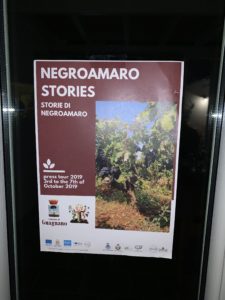
I traveled to Puglia, Italy early October 2019 to attend a four-day educational tour.  The Educational Tour Guagnano (Salento – Puglia – Italy) “Negroamaro Stories” was carried out with the support of the Comune di Guagnano, the Municipality of Trepuzzi, the Gal Terrad’Arneo, the Municipality of Porto Cesareo, of the National Association of AIS of Lecce, and  Solento Wine Shop.

Puglia is geographically located in the south-eastern tip of Italy, covering 7,469 sqm. It is bordered by the Adriatic Sea on the east, by the Ionian Sea on the southeast and the Gulf of Taranto in the south. Its climate is Mediterranean, with hot summer temperatures only partially mitigated with sea breezes.

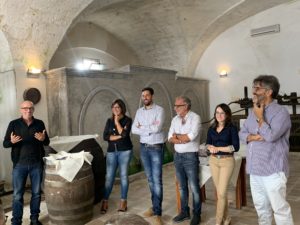
On my first day I attended the Museo del Negroamaro for a press conference, which kicked off the 2019 “Stories of Negroamaro” tour. In attendance were partner organizations, participating wineries, local politicians, and artist Arianna Greco.


Conference speeches and presentations were given (in Italian) by:

Antonio Rizzo – Ass. cultura e al marketing territoriale del Comune di Guagnano;

Claudio Maria Sorrento – Sindaco del Comune di Guagnano;

Chiara Tondo – Ass. all’Agricoltura del Comune di Guagnano;

Cosimo Durante – Presidente Gal Terra d’Arneo;

Viviana D’Amico – Presidente del Comitato Tecnico Organizzativo del Premio Terre del Negroamaro; and

Titolari e Rappresentanti – Aziende Vinicole Guagnano.

The conference introduced us to the Guagnano and Terra d’Arneo area and presented grape harvest data for 2018-2019.

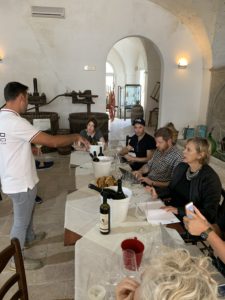
After the presentations and speeches, I met and mingled with Italian wine journalists, winegrowers and members of the local and regional associations, while tasting the delicious local cuisine.

After lunch, I participated in a tour of the Museo del Negroamaro.  I found out that the Museum was formerly a millstone from the 1800s. It now houses antiques and antiquities from yesteryear, such as traditional presses, barrels, fermenters, weighs, pressure switches, and other tools and equipment previously used in the processing of grapes and winemaking. The Museum also houses the Negroamaro Study Center.


Over the next four days, I will be visiting eight wineries or Cantinas in Puglia and tasting their DOC and IGT wines, with a focus on the indigenous varieties Primitivo and Negroamaro.  The participating wineries include: Cantele Cantele; Cantina Sociale Enotria; Vini Leuci; Feudi di Guagnano; Cantine Cosimo Taurino; Cantina Moros di Claudio Quarta; Taurino Francesco; and Tenuta Marano.

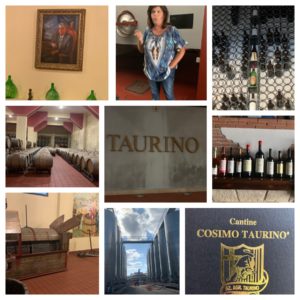
The first winery visit was Cosimo Taurino

The Taurino family have been growing grapes and making wines in Puglia for seven generations. This multi-award-winning estate owns 80 hectares of cultivated vineyards exclusively with Negroamaro and Malvasia Nera grapes, both indigenous to Salento.  The Taurino’s family respect for terroir and for native grapes is inspiring, and their impact on the vinous history of Puglia is unprecedented.


Two wines that really stood out for me were:

Cosimo Taurino, Notarpanaro Salento  2010

100% Negroamaro

Tasting Notes:  This wine offers complex aromas of cherries and raspberry, with some notes of wood and spice, which all come through on the palate;  this medium-bodied wine has fleshy tannins and a long finish.

Cosimo Taurino, Patriglione 2013

100% Negroamaro

Tasting Notes:  This wine has notes of red berries, leather, tobacco, and some traces of pepper. It’s a rich and full-bodied wine with a good balance.

Unfortunately, I could not complete the rest of the tour due to a family emergency.

 What I learned in Salento….

About  Negroamaro

Negroamaro is a deep, black-colored grape with taste characteristics of black currant, cherry, blackberry and cloves with some cinnamon undertones.  It is almost exclusive to the Salento region (Brindisi and Lecce) and is harvested in late September.

Negroamaro is used in 13 regional Dop labels (out of 28 in Puglia) and is produced in the provinces of: Brindisi, Lecce and Taranto: Alezio, Brindisi, Copertino, Galatina, Leverano, Lizzano, Matino, Nardò, Negroamaro in Terra d’Otranto, Salice Salentino, Squinzano, and Terra d’Otranto.

Negroamaro has a high alcohol content with some floral and fruity aromas; this makes it an ideal blending wine because the aroma does not distract from other grape varieties.

The Soil

It is worth mentioning that one of the secrets to the fabulous tasting Pugliese wine is the soil.  It’s dense red clay, high in iron-oxide – this provides a sweet, structured, full-bodied wine.

Over the last few years, the wines of Salento have been gaining tremendous success. The next-generation winemakers have both improved the taste and the image of the wines in this emerging wine region.

A special thank you to the municipal administrations, for organizing this wonderful trip.  I’m looking forward to going back to Puglia in the near future and learning more about this up-and-coming wine region.

Liz Palmer