Exploring the Diversity of the Rheinhessen Wine Region [Part 3 of 3] — VDP “Große Lage” Seminar and Tasting

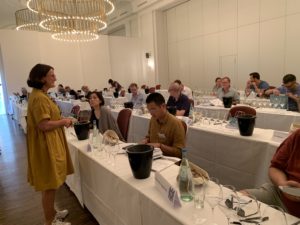
A special trade seminar was held the following morning with a specific focus on VDP “Große Lange.” The seminar was held in the beautiful Kurhaus Wiesbaden, which is unmistakable Wiesbaden’s landmark. This magnificent neoclassical building is the city’s convention center.
VDP stands for Verband Deutscher Prädikatsweingüter (or the Association of German Prädikat Wine Estates). It was founded as a regional association in the Rheingau over a hundred years ago with the goal of recognizing and encouraging quality producers of dry wines.

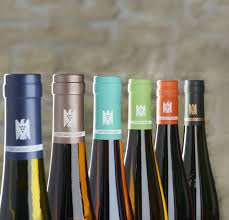
The VDP has selected and classified the best German vineyard sites coming from all 13 of the country’s wine-producing regions. In 2019, there are 200 members. The logo for VDP is an eagle with grapes on his chest. If you see this logo on a bottleneck, you know that it comes from one of the best vineyards in Germany and is a trustworthy guarantee for the quality within. VDP has four classifications:
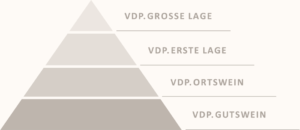
VDP Gutswein –  these are often the first wines of a wine year to be bottled and sold. They must come from estate-grown grapes and the producers are given freedom here to experiment and innovate.

VDP Ortsweine – these are wines that express regionality. The grapes must come from one village and offer a sense of expression of that particular place. Only regional grape varieties are used, and many come from the higher-classified Grosse Lage or Erste Lage sites.

VDP Erste Lage – these wines are Premier Cru from first-class vineyards where there are optimal growing conditions. These wines must also be grown with a view to sustainability and tradition.

VDP Grosse Lage – these wines come from the highest quality German vineyards. They are complex, express single vineyard sites, and are known for their long-aging. These wines also must also be grown and made with a view to sustainability and tradition.
Membership is by invitation only, and with producers known for long-standing quality and a commitment to excellence.  Members must also adhere to strict rules including low yields, higher starting must weights, selective hand harvesting, and five-yearly inspections.

Promotion remains a major aspect of its activities. The VDP has developed its own quality pyramid based on the official German system,  with a specific focus on dry wines. Recently, they introduced a new classification for Sekt, German sparkling wine.
5% of Germany’s vineyards are included in the VDP classification, accounting for 7.5% of the turnover of the German wine industry.

Riesling is the most important grape among VDP producers with 55% of all VDP vineyards planted with Riesling, compared to 23% across Germany as a whole.


Other grape varieties approved for VDP Grosse Lage certification include:

Chardonnay

Weissburgunder

Spätburgunder

Grauburgunder

Frühburgunder

Traminer

Drake Launches 2008 Vintage Champagne

Having unveiled his first Mod Sélection Champagne in January this year, Canadian rapper Drake is now ending the year by launching two 2008 vintage expressions.  Priced at US $480 and US $550 a bottle respectively is Mod Sélection Réserve Vintage 2008, and Mod Sélection Rosé Vintage 2008.

Mod Sélection Réserve is a blend of 10% Pinot Noir, 55% Meunier and 35% Chardonnay. According to the producer Maison Pierre Mignon, this wine has aromas of “rich, ripe fruit” with flavours of “orange peel, dried apricot, pineapple, brioche, nutmeg and clove” on the palate.

Mod Sélection Rosé Vintage 2008  is made using the saignée method and is a blend of 10% Pinot Noir, 50% Meunier and 40% Chardonnay. According to the producer it’s described as having a “deep-salmon hue” with “concentrated and complex fresh red fruit on the palate” with honey, ginger and sweet spice.

Commenting on the launch, founder and CEO of Mod Sélection Champagne, Brent Hocking, said: The attention to detail in every aspect of our production process is what sets this Champagne apart from all other 2008 vintages the industry has seen this year.

“We have purposely waited to release these special blends to ensure optimum quality and purity – and we believe they’re worth the wait.”

These releases mark the third and fourth product launches from the brand, following the launch of the Mod Réserve Champagne (US$300) and a Mod Rosé Champagne (US$400) earlier this year.

The new vintage Champagnes will be packaged in the brand’s brown metallic bottles and adorned with bronze detailing, made by craftsman from the Champagne region.

Champagne brand Mod Sélection operates in partnership with Champagne Pierre Mignon, a family-owned Champagne house based in Le Breuil in the Vallée de la Marne. The house has 16 hectares of vines, located in the Vallée de la Marne, Côte des Blancs, and Epernay.

Website: http://www.modselectionchampagne.com

Chubut – Argentina’s New Emerging Wine Region

With just 65 hectares of vines, the emerging wine region of Chubut in Patagonia is Argentina’s most southerly region.

Patagonia encompasses over 50% of the total landmass of Argentina, which is 5% of its population. The area consists of four main wine-producing provinces: La Pampa, Neuquén, Río Negro and Chubut. Despite its size, the region only has 1.88% of the country’s vineyards. While the first winery opened, in Río Negro, in 1909, much of the rest of the GI is relatively new, particularly Chubut.

Just 65 hectares of vines are planted in Chubut, 50ha of which are controlled by Bodega Otronia in Sarmiento. These are among the southernmost vineyards in the world, occupying a latitude of 45°. With winds as high as 110kmph and rainfall as low as 200mm per year, Maximo Rocca, commercial director of Otronia, describes it as a totally “new way of winemaking in a new world of wine production”.

“Our winemakers decided not to talk about terroir but micro-terroir,” he says, noting how from the start, the producer’s vineyards have been divided into blocks. Achieving just half a kilo of grapes per plant, Otronia has invested in a series of different-sized untoasted foudres, as well as concrete tanks and eggs in which to age its wines.

With two traditional method sparklers made from Chardonnay and Pinot Noir in the pipeline, Otronia has released just two wines: a white blend made from Gewürztraminer, Pinot Gris and Chardonnay; and a single varietal Chardonnay, made from a blend of two blocks.

“It’s going to be a word-of-mouth project,” says Rocca. “It’s difficult to explain what we’re doing in just one sentence.

Praising the support of the local government, he says the winery aims to work with sommeliers to create “a team of ambassadors to communicate what Chubut is doing and tell the story”.

Moving northwest, around the towns of Trevelen and El Bolsón, rainfall is higher and conditions are less blustery, but frost is a near-constant threat.

With the majority of producers having just a couple of vintages under their belts, this is a region still finding its feet, both in terms of the grapes that can be grown and the style it should produce.

Sparkling experiments

Like Otronia, Casa Yagüe is also experimenting with sparkling, having also released a Sauvignon Blanc and two single-varietal Chardonnays, one with oak, the other without. “We want to do a lot of things, but we’re going step by step,” explains Juli Yagüe, head of PR and trainee winemaker, who recounts how the winery has an automatic sprinkler- and frost-prevention system, which is triggered when the temperature drops below 0ºC. The winery has just planted Pinot Noir and has the potential to produce a maximum of 20,000 liters.

Moving further north, red varieties are more prevalent, with Pinot Noir and Merlot particularly finding favor.

At Nant y Fall, based on the curiously named Valle 16 de Octubre outside of Trevelen, Pinot Noir is the most planted variety. Having released two wines – a still red Pinot Noir and a rosé Pinot Noir – the producer hopes to launch a Riesling and a Gewürztraminer in December.

Family member and winemaker Emmanuel Rodriguez says: “Summer temperatures here range from -2ºC to 35ºC, and all four seasons are extreme.”

With the aim of producing 17,000 bottles once all 2.5ha are in production, Rodriguez is experimenting with his first oak barrels, as well as using different yeasts in his Pinot Noir to enhance both the structure and the aromatic profile.

Two hours’ drive further north, fellow family-owned producer Chacra Adamow has had its fair share of hardships. Having been assured that its site was frost-free, the producer lost 60% of its first crop in its first year. Proving resilient, it replanted its damaged vines and is aiming to hit the 10,000 mark in order to be “commercial”.

Overcoming problems

Planted with Pinot Noir and Sauvignon Blanc, Pedro Adamow, the owner of the estate, says: “We were excited by the result we achieved in 2015, but we know there are still many problems to overcome. The goal is to keep 10,000 vines alive then build our own winery. Our dream is to have an oenotourism business with a restaurant, hotel and tasting room.”

At such an early stage of proceedings, and without viticultural knowledge of the area, Adamow describes each vintage as “a silver bullet”.

“You only get one shot then you have to wait another year to correct any mistakes that you made,” he says. “It can be frustrating.”

Adamow’s wines are made by Camilo De Bernardi of Familia De Bernardi, just over the border into Río Negro by the town of El Bolsón.

Another producer that is overcoming challenging conditions and using them to its advantage is Familia Ayestarán, which produces wine under the Oriundo label. Winemaker Darío González Maldonado said that he’d made what he believes to be Argentina’s first ice wine. Made from 100% Gewürtztraminer, Maldonado explained that he harvested the grapes when temperatures hit -8 degrees Celsius and followed the regulations that govern ice wine production in Canada and Germany. Argentina has no guidelines for this type of wine.

The resulting 11% ABV wine contains 50g/l of residual sugar, with only 300 bottles made in total. Having taken control of an abandoned 17-year-old vineyard in El Hoyo back in 2014, Familia Ayestarán had its first proper vintage in 2017 and also produces a Merlot, white blend and sparkling wine.

Biodynamic hopes

With two hectares of vines, including Pinot Noir, Merlot, Gewürztraminer and Sauvignon Blanc, De Bernardi hopes to one day become biodynamic.

“I’m focusing on getting the acid balance right at the moment,” he says, confessing that he is still not completely satisfied with the style of his wines.

However, despite struggling with frost, he noted that his reds were able to achieve almost 14% ABV – much higher than other wines in the area.

Plans are afoot to help local restaurants stock wines from Chubut, while the government is organizing a press trip to the region for journalists based in Buenos Aires.

As things stand, Otronia’s Rocca notes: “Chubut’s wines need to be consumed with knowledge. There’s a trend for wine production in cool and extreme areas, but we’re all still learning because it’s all so different from how they do things in Mendoza. You’ve got to bear in mind that we’re 2,000km further south,” he says.

That distance, however, is also a blessing. Argentina now has a new region capable of producing aromatic white varieties and fresher, light reds, while the acidity achieved in grapes provides an ideal base wine for sparkling. Chubut’s potential, therefore, is far-reaching.

Source: Drinks Business

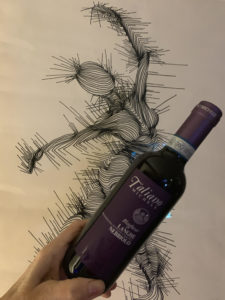
Wine Review: 2016 Taliano Michele Blagheur Nebbiolo, Langhe DOC, Piedmont, Italy

2016 Taliano Michele Blagheur Nebbiolo, Langhe DOC, Piedmont, Italy
Beautiful ruby-red colour; it reveals perfumes of white flowers, raspberries, and cherries, which carry through to the palate; well-balanced tannins; Approachable now, this will also age well.
Best decanted.

VINE: Nebbiolo 100%
SOIL: calcareous
ALTITUDE: 300m above sea level
EXPOSURE: south
SYSTEM OF VINE GROWTH: Guyot
NR. OF VINESTOCKS PER HECTARE: 4000
RETURN IN WINE PER HECTARE: 63 hl
VINTAGE: first half of October
VINIFICATION: traditional with maceration
REFINEMENT: wood for 12 months
REFINEMENT IN BOTTLE: 2 months
ALCOHOLIC CONTENT: 13,5-14%

PAIRINGS:
Blagheur prefers mushroom dishes, ripe cheeses, second courses which include chicken, rabbit, and game.

93.5/100

Liz Palmer

Wine Review: Champagne Gosset Grand Reserve Brut NV

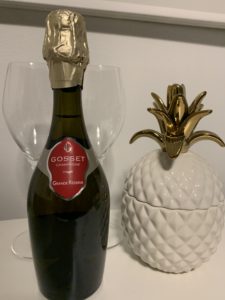
The “Grande Reserve” is a mix of three vintages, with a blend of the three standard grape varieties: Chardonnay 45%, Pinot Noir 45%, and Pinot Meunier.

Vineyard Sources: Aÿ, Bouzy, Ambonnay, Le Mesnil-sur-Oger, Villers-Marmery

The wine does not go through a malolactic fermentation, which is typical of the house style.

Tasting Notes

This cuvée sums up the Gosset style in its decisive texture and crisp with firm acidity; it shows enticing maturity; it’s well-balance and expressive; great fruitiness and mineral tension.
This is a Champagne to drink now.

92/100