
Bubble Love

CHAMPAGNE has launched thousands of ships, toasted billions of weddings, special occasions, and special moments between two people – Champagne is the wine of celebration. No other wine is associated with joy and festivity. Its meaning is truly universal.
TAKE TIME IN 2010 to share with people you care about in the celebrations of your life with this historically powerful glass of “bubbly love” we call Champagne!
Champagne is a sparking wine produced by inducing the in-bottle secondary fermentation of the wine to effect carbonation; this is the most important stage of the process. Méthode Champenoise is the traditional method by which Champagne is produced. After primary fermentation and bottling, a second alcoholic fermentation occurs in the bottle. This second fermentation is induced by adding several grams of yeast and several grams of rock sugar. For years where the harvest is exceptional, a millesimé is declared which means it matures for at least 3 years. During this time the Champagne bottle is sealed with a crown cap similar to that used on beer bottles.

The Region
Champagne is produced exclusively within the Champagne region of France, from which it takes its name. This region has the chalky soil and the overabundance of sun needed to grow the three varieties of grapes, which are: Chardonnay which provides the freshness and elegance; Pinot Meunier brings fruitiness and aromas; and Pinot Noir gives the body and structure. There are five main regions within Champagne where these varieties are grown, and where the houses source these varieties that will influence the quality and style of the final product. The most northerly region Montagne de Reims Pinot Noir is mainly planted. Wines produced here are firm and austere. The Côte des Blancs is the mostly east-facing region and is south of Epernay. Chardonnay is mostly planted here, and produces a wine much less harsh than the Montagne de Reims. The Vallée de la Marne region runs west-east, and is planted with all three grape varieties. Further south is the Côte des Sézanne which is primarily Chardonnay country, and finally the Aube, the southernmost of all five regions where Pinot Noir is mostly planted.
The Champagne Cycle

From winter until August, the gardeners are actively pruning, disbudding, paling-up and trimming. At spring time, gardeners fear late frosts. The grapes are gathered by hand to preserve them. Vintage takes place between June and September, depending on the climate, the Champagne and the vintage.

History and Celebration

Champagne first gained world recognition with the anointment of French kings. Royalty from throughout Europe spread the message of the unique sparkling wine from Champagne and its association with luxury and power. The leading manufacturers devoted considerable energy to creating a history and identity for their wine, associating it and themselves with nobility and royalty. Through advertising and packaging they sought to associate Champagne with high-luxury, festivities and rites of passage. Their efforts coincided with an emerging middle class that was looking for ways to spend its money on symbols of upward mobility. Nowadays, Champagne remains the celebration drink. For special ceremonies, a sabre can be used to open the bottle. Champagne is also associated to sport events such as Tour de France, Formula One, even Sailing, wherein the Champagne bottle is broken to inaugurate or at the end of a race.

Four Varieties

They each have their own unique character and each pair with different foods.

Les Champagnes de corps, intense and powerful with some of spices and red fruits. It goes with foie gras, osso- buco or fowl.

Les Champagnes d’esprit, delicate and light, has vegetable and citrus fruits notes. It goes with fish, shellfish, cheese, ice cream and sorbet. It is usually served as an aperitif.

Les Champagnes d’âme, mature and rich contain hints of delicate spices. It goes well with lamb, pies, desserts and also at tea time !

Les Champagnes de coeur, contains scents of cinnamon honey and brioche. They are often rosé or half neat.

Health Benefits

Research from the University of Cagliari has shown that moderate consumptions of Champagne will help the brain cope with the trauma of stroke, Alzheimer’s, and Parkinson’s disease. The research further noted that the high amount of the antioxidant polyphenols in sparkling wine can help prevent deterioration of brain cells due to oxidative stress. Good news, isn’t it? Warning: Be careful, Champagne should be consumed in a reasonable manner.

Champagne Etiquette
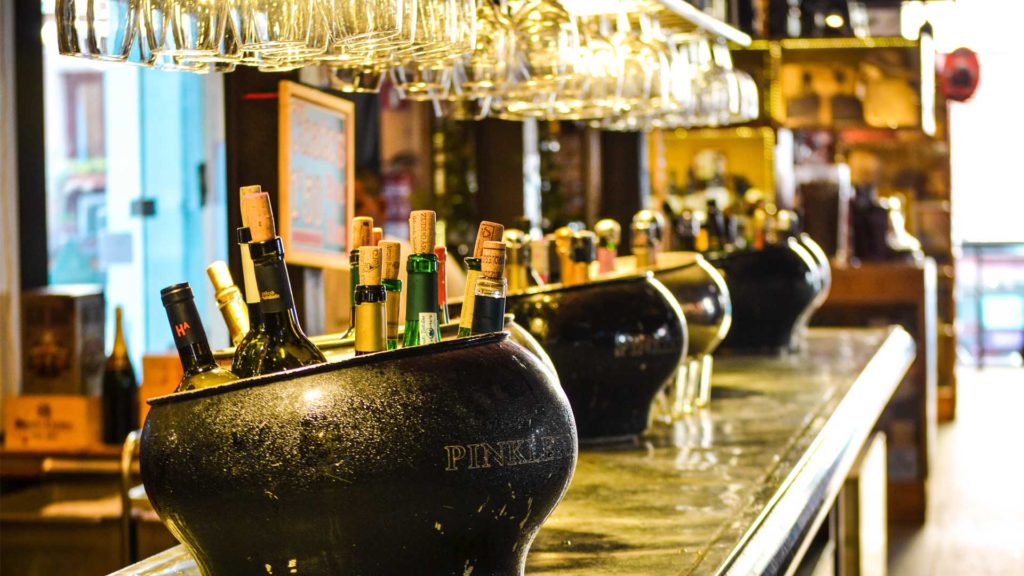
Champagne must be served in a Champagne flute. It is always served cold with drinking temperatures of 7 to 9 °C (43 to 48 °F). Often the bottle is chilled in a bucket of ice before opening for about 20 minutes.

Ontario Prices

LCBO Champagne prices range from $50.00 to $3,995.00 (1995 Clos D’Ambonnay Champagne from Krug 750 mL).

Why don’t you write us with your 2009 Champagne experiences in how you “indulged in bubbly love”? (published in a future issue).

Champagne Cocktails
Champagne Mimosa
1oz Orange Juice
3oz Champagne
In a tall flute glass, first pour the orange juice, then the Champagne. The Champagne is thicker and will mix down into the OJ. The key is not to stir – you don’t want to lose the bubbles.

Champagne Bellinis
6oz Champagne
1 peach, pureed
Puree one fresh peach, and put into a tall flute glass. Note: you can use 3 shots of peach nectar add in Champagne. The key is not to stir – you don’t want to lose the bubbles.

Liz Palmer, wine writer and soon to be author of:
Unique Boutique Champagne Houses
liz@boutiquechampagnehouses.com
www.boutiquechampagnehouses.com
clip_image002

Air France “l’Espace Affaires”- Crossing the Ocean in Style

April 9th2009 and I am beginning my ten-day journey to Paris, the Champagne Region ofFrance andBelgium. I am flying “l’Espace Affaires” (business class) fromToronto toParis, and looking forward to the “business class  travel” experience with Air France.AF Dinner

Settling into a large comfortable seat with a welcoming glass of Champagne, a copy of the Air France in-flight magazine gets me into a “Parisian” mood. The magazine consists of Paris spring fashion trends, locations of the best restaurants as well as comments on what is going on in the art scene. This in-flight mag is a fashionista’sdream come true; lots of French-styled shoes, dresses, purses…. In between sips of Deutz Brut Classic, I’m handed a dinner menu by one of the coiffed, well-mannered staff. I am pleased see that that the flight attendants speak both French and English without hesitation.

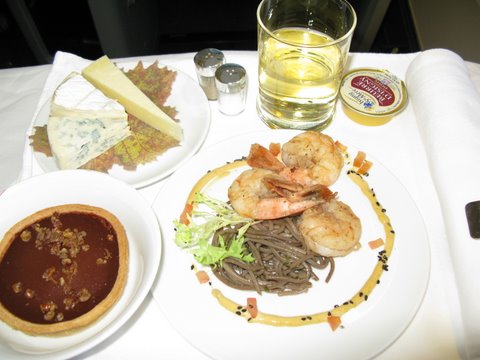
The wine offerings are superior. What a nice surprise to see more space on the dining menu devoted to the wine list than to the food. There is also a note on the menu that the wines have been chosen by Olivier Poussier, World’s Best Sommelier in 2000. This is an added bonus. The attendants place white linen table cloths on our tables, immediately followed by fresh and delicious baguettes with creamy butter. I choose Saint-Veran Chateau de Fuisse 06 a niceBurgundy, to pair with the seafood hors d’oeuvre of marinated shrimp served with miso and ginger sauce and serving of soba noodles.

The main course of grilled tournedos of beef with scallion butter, potatoes au grain, broccoli and tomato truly melts in my mouth, particularly paired with a glass of Clos Triguedina Cuvee Prince Probus 05. This is another perfect match and an excellent choice with meat and game-nice intensity and refinement.

Fine chinasilver and an impressive wine list coupled with first class service, make me feel like I am in an exclusive restaurant, not on an airplane. I skip coffee and chocolate torte, and decide to get a few hours of sleep. I found sleeping a delightful restful experience due to the tilted seats that turn into a perfect horizontal position and pillows and quilts are quite abundant. Within a few hours I awaken to the smell of fresh coffee brewing…Y E S I’m almost in Paris.The French-style breakfast consisted of juice, yogurt, fresh fruits with pastries and lots of coffee – so perfect!

My Air France Business Class experience has truly proven to be crossing the ocean in style!

Liz Palmer

Summer Wine Temperatures With Tips & Suggestions

We are in the depths of summer – the sweltering heat and heavy air does something to our palates.  During these months we tend to crave a colder, lighter, more refreshing high-acid white or rosé than the full-bodied red.  I set out below an ideal wine-serving temperature chart, along with some suggestions and tips on temperature control:

Champagne &
Sparkling Wines

42-52 °F or  6-11 °C
Rosés45-55 °F or 7-13 °C

Whites45-50 °F or 7-10 °C

Tips:

When cooling wine in a bucket use both ice and water this will cool the wine faster.

If you serve wine too cold it will lose its flavour.

Reds50-65 °F or 10-18 °C

Tips:

Keep all wines out of the sun, off the patio, off the boat deck and in a cool place inside especially reds. If you pour a big glass of red outside in the heat, chances are you’ll be drinking tepid wine by the time you get to the bottom of the glass and the wine will loose its aromas and flavours.

Keeping red wine at a good drinking temperature during the summer months is a balancing act – If it’s too cold, it will lose its flavour; If it’s too warm, it will taste rough and the alcohol will show through.

You might want to chill some light reds down a bit in the fridge to 15° C to 18° C – the bottle should be cool to the touch.

Note:

Beaujolais and other light reds are not harmed by this – It is common in the south of France during the summer months to put a bottle of light red in the fridge for half-an-hour before serving.

Do not get too obsessive about serving temperatures – just be sure you can taste the fruit in the whites and rosés, and the reds taste cool, not warm in your mouth.


by Liz Palmer
Apprentissage Sommelier


Summer Wine and Cheese Pairings

Wine and Cheese are a classic combination – both are products of fermentation. Both may be consumed fresh and young, or in their more abstruse forms when they have aged and matured.  Here are basic pairing guidelines that have been proven favorable:

1.Pair wine and cheese of the same region together, i.e., Chianti with Parmesan;
2.Pair salty cheese with sweet wines – a good pairing is Stilton with Port;
3.Pair creamy, soft-ripening cheeses with full-bodied, tannic red wines such as Red Bordeaux with Brie;
4Pair acid with acid – this may not be obvious, but acids in food usually cancel out acids in wine. A famous pairing is Sauvignon Blanc with goat cheese;
5My Favorite: Pairing rich cheese with Champagne  or sparkling wines, such as French port de salut or chevre;
6When offering several cheese choices, whites fair better than reds. Particularly soft and creamy cheeses leave a layer of fat on the palate and this interferes with the flavor in reds, rendering them monotonical;
7.Most of the sweeter whites complement a full range of cheeses. The spicy zing of Gewürztraminer or the peachy zip of Riesling is ideal if you’re going for wide-reaching appeal;

8.Parmigianino or Romano cheeses pair well with most wines; and
9.If you’re a cheese adventurist and you like to eat the stinkiest of cheeses, indulge in a big red like a Bordeaux or Cabernet Sauvignon.

Liz Palmer
Food and Wine Writer
June 23, 2009

In Memory of  Ken