
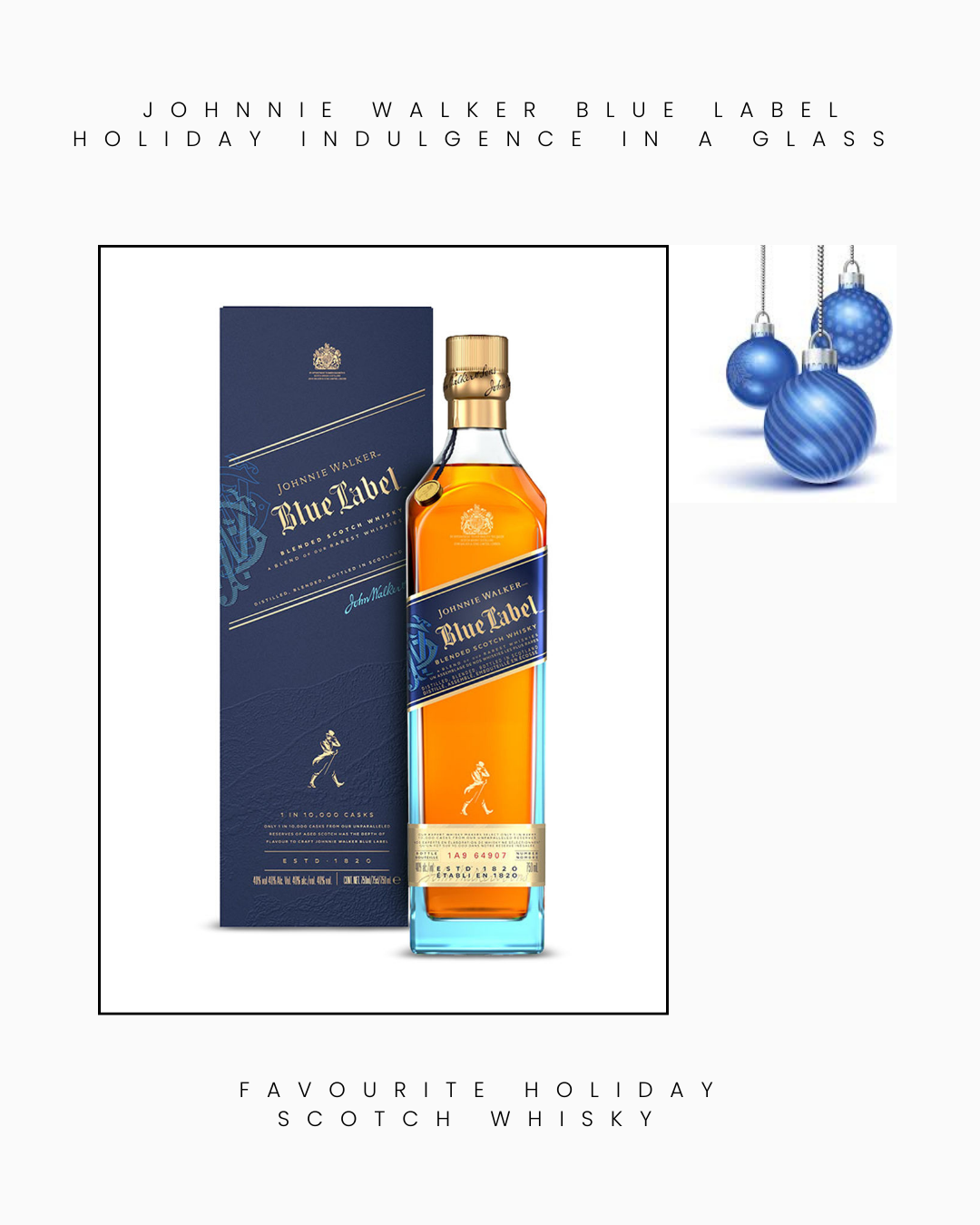
Johnnie Walker Blue Label: 1 in 10,000 Casks – Holiday Indulgence in a Glass

 Few luxury spirits occupy the cultural and commercial space that Johnnie Walker does – instantly recognizable, rigorously consistent, and deeply rooted in Scotch whisky tradition. Johnnie Walker stands as a case study in how heritage and innovation can move in step. Within its portfolio, Johnnie Walker Blue Label represents the pinnacle: a deliberately rare, meticulously blended Scotch whisky designed not for haste, but for contemplation. During the holiday season, it offers both academic intrigue and unapologetic pleasure – this remains one of my favourite whiskies for this time of year!

Johnnie Walker Blue Label: Rarity by Design

Johnnie Walker Blue Label is not defined by age statements, but by selection. It is composed of some of the rarest and most exceptional Scotch whiskies from the house’s extensive reserves. Only one in 10,000 casks – including selections from long-closed “ghost” distilleries is deemed suitable for Blue Label, underscoring its intentional scarcity. The result is a whisky engineered for harmony and depth, with a lingering sense of quiet luxury.

Johnnie Walker Blue Label: Tasting Notes (Neat)

Blue Label opens with a restrained aromatic profile of soft dried fruits, honey, gentle floral notes, and hints of spice. On the palate, layers unfold gradually: dark chocolate, hazelnut, toffee, orange peel, and subtle touches of chilli and smoke. The texture is notably velvety, with seamless integration between sweetness and peat. The finish is long, warming, and elegantly smoky, with echoes of spice and cocoa that linger well beyond the final sip.

Johnnie Walker Blue Label: Pairing Exploration – Lindt Dark Chocolate & Hazelnut

When paired with Lindt Dark Chocolate, the whisky’s natural cocoa and dried fruit notes are amplified, while the chocolate’s bitterness sharpens Blue Label’s underlying sweetness and spice. The interaction is linear and refined – an ideal pairing for purists.

Paired with Lindt Dark Chocolate with Hazelnuts, the experience becomes more playful and textural. The nutty richness mirrors Blue Label’s hazelnut and toffee nuances, creating a rounder, more indulgent mouthfeel. This pairing feels particularly well-suited to festive occasions.

Whisky Tourism and Place

Johnnie Walker’s whisky tourism footprint is anchored in Scotland, with immersive visitor experiences in Edinburgh’s Princes Street, Kilmarnock, its spiritual home, with distilleries dispersed across the Highlands, Speyside, and Islay. The Johnnie Walker Princes Street experience in Edinburgh serves as a contemporary gateway to Scotch whisky culture, blending education, sensory exploration, and panoramic city views. For travellers, it reinforces the idea that Scotch whisky is not merely a drink, but a destination, rooted in landscape, history, and community.

Final Thoughts

Johnnie Walker Blue Label occupies a rare intersection of scholarship and celebration. It is a whisky that rewards analytical tasting while remaining deeply accessible as a symbol of holiday generosity and shared ritual. In a season defined by gathering and reflection, Blue Label offers a moment of stillness, proof that sometimes the most meaningful luxury is time well spent.

The 10 most-consumed alcoholic drinks have been identified

Insider Monkey’s list of the 10 most-consumed alcoholic drinks have been identified in a new list that outlines which tipples we favour most.

The analysts at the investment advisors Insider Monkey drew from their deeper dive report of the ‘20 Most Consumed Alcohols in the World’. Here is a list of the top 10, for your review.

1. Beer
Global market size in 2022: US$793.74 billion

Beer is the most consumed alcohol in the world. In fact, after water and tea, beer is the most popular drink in the world. According to reports, in the 2022 brewing year, global beer production ended up increasing slightly year-on-year by 1.3% to 1.89 billion hectolitres. However, the market is yet to return to its pre-pandemic levels when production peaked at 1.91 billion hectolitres in 2019. The category has also evolved with consumer tastes as brewers look to satisfy the thirst of their audience. Plus, the overall demand for premium and low-calorie beers, the rising popularity of craft beer, and the continued expansion of distribution networks in emerging countries are all expected to continue driving growth in the global beer sector over the next few years.

2. Wine
Global market size in 2022: US$441.6 billion

The rising demand for premium and luxury wines has been reported alongside the growing popularity of wine tourism which have become key factors driving growth. According to the analysts, global wine consumption in 2022 was estimated to be at 232 million hectolitres, marking a decrease of 1% compared to the previous year. Year-on-year, wine consumption around the world has decreased at a regular rate and yet this can be mainly attributed to the decline in China’s consumption, which has lost an average 2 million hectolitres per year since 2018.

3. Liqueurs
Global market size in 2022: US$128.9 billion

Liqueurs, which are essentially distilled spirits that are sweetened with sugar or syrup, and often also contain fruit, herbs, and oils, can be sweet or bitter depending on the flavours used.

4. Baijiu
Global market size in 2022: US$95.21 billion

Baiju plays a prominent role in China’s drinking culture and has done so ever since the Ming Dynasty. It is most distilled from sorghum, although other grains – including rice, wheat, corn, and millet – are also available in blends throughout the country. Last year, consumers in China consumed US$91 billion worth of baijiu, yet it remains less well-known outside the nation.

5. Whisky
Global market size in 2022: US$64 billion

As millennials are increasingly beginning to experiment with different drinks and assisting in the rise of ‘cocktail culture’, the use of whisky as a premium ingredient has increased in bars. 2022 was hinted to be a great year for Scotch whisky and exports of Scotland’s native spirit hit US$7.5 billion last year, the highest figures ever. Whisky exports by volume also rose, with the number of 700ml bottles shipped overseas up by 21%, to 1.67 billion.

6. Vodka
Global market size in 2022: US$25.98 billion

Vodka continues to be the most consumed spirit in the US and has been since 1970. Around 78.1 million cases of the spirit were sold in America in 2021 and by 2022, 28.1 million 9L cases were sold globally.

7. Cider
Global market size in 2022: US$17.9 billion

Cider has risen in popularity significantly over the last decade and can also flex with the seasons. In the UK, Insider Monkey outlines how cider continues to be a popular alcoholic drinks category with an off-trade value sales growth in the UK of 5.2% over the past year. Some 47.8% of all British households now regularly buy cider – up from 45.5% last year.

8. Rum
Global market size in 2022: US$17.4 billion

While rum sales are still dominated by major producers, many consumer preferences are said to be moving away from value options and towards an appreciation for craft and aged rums instead. Made from fermented sugar cane juice, rum also provides a key function in cocktail culture.

9. Gin
Global market size in 2022: US$15.3 billion

There are, reportedly, three main reasons for gin’s continued popularity – taste, versatility, and the variety now available. The UK is the largest exporter of gin in the world and, according to His Majesty’s Revenue and Customs (HMRC) data, gin exports from Britain hit US$879 million last year, up from US$651 million in 2021.

10. Tequila
Global market size in 2022: US$14.7 billion

Tequila’s popularity has been on the rise for years, and in 2021 it surpassed whisky in retail sales. The analysts found that the growth in popularity of Tequila can primarily be attributed to several factors, including the expansion of the premium spirits sector as well as the introduction of new flavours, and a greater social media presence.

Whisky Partners launches app for whisky cask ownership

Cask specialists, Whisky Partners, has recently announced the launch of their new app for whisky cask ownership.

It has been designed to make cask ownership simple and accessible to everyone. The new app will also enable collectors to manage their cask portfolios on the move, something Whisky Partners claims to be “the first of its kind”.

The app allows users to buy, sell, and manage current holdings whilst on the go, with users able to securely download ownership documents straight to their mobile devices.

Louise Robinson, CEO at Whisky Partners, said: “In the Information Age, convenience and readily available data is of utmost importance. As such, our new app is a huge leap in the world of cask ownership, aiming to simplify the appreciation period for collectors by enabling them to track the progress of their portfolios anywhere, anytime.”

“The new portal provides a solution to increasing demand for easy-to-use portfolio management formats, making cask ownership all the more attractive to young, tech-savvy individuals, who prefer to manage their finances, banking and alternative investments on the go”.

“Ensuring all our investors’ funds are secure and protected is of huge importance to us. That’s why we’re proud to be working with internationally recognized and trusted payment platform, Eco-spend, to offer secure checkouts, ensuring users can perform bank transfers within the app without any security concerns. In that vein, we have also partnered with American Express, providing further choice and ease for secure payments.”

#singlemalt #scotchwhisky #whiskylover #whisky #whiskygram #bourbon #rye #scotch #whiskymaking #loverofwhisky #whiskypartners #dram #whiskycollector #barrels#womeninwhisky #ourwhisky #whiskypic #instadram #instawhisky


Johnnie Walker opens eight-storey visitor centre in Edinburgh

Diageo has recently opened its Johnnie Walker visitor centre on Princes Street in the centre of Edinburgh. The eight-floor experience has been four years in the making and is the centrepiece of Diageo’s £185million investment in scotch whisky tourism in Scotland.

“This is a proud day for everyone,” said Diageo chief executive Ivan Menezes. “Johnnie Walker Princes Street is a landmark investment in scotch whisky and into Scotland and it sets a new standard for immersive visitor attractions.”

The visitor centre has taken on more than 150 employees speaking 23 languages and guests on the Journey of Flavour tour will have their personal flavour preferences mapped with drinks tailored to their palate.

The Johnnie Walker Visitor Centre has two rooftop bars and a terrace with views of the Edinburgh skyline and its Learning for Life academy will also host a hospitality training programme.

The centre will open its doors to the public September 6th. Tickets for tours start from £25 per person, including a 90-minute tour and three personalized scotch whisky samples.

#travelling #whiskytourism #scotland #diageo #johnniewalker #scotlandtourism #scotch #whiskytasting #drams #weedrams #whiskylover #scotland #whiskylife #dramgram #wateroflife #instawhisky

A Scientific Journal Proves Terroir’s Influence on Whisky  

A recent scientific study conducted by Foods, a scientific journal of food science has provided “conclusive proof” of terroir’s influence on whisky. The researchers say that this paves the way for an “Appellation Controlée System” of provenance similar to that used for wine.

The whisky industry has long been debating the influence of terroir on whisky, with some claiming that any effect would not ‘survive’ the distillation process. However, the authors of this academic paper say they have found proof of terroir’s existence in whisky.

The paper, entitled ‘The Impact of Terroir on the Flavour of Single Malt Whisk(e)y New Make Spirit’, was published February 18th, 2021 by the Whisky Terroir Project, a joint venture between Waterford Distillery in Ireland, Oregon State University, Teagasc Food Research Centre, Enterprise Ireland, Minch Malt and the Irish Department of Agriculture, Food and the Marine.

The study explores the differences found in spirits made from two barley varieties: Olympus and Laureate, which are grown on two farms in different environments in 2017 and 2018. One sample was grown in Athy in County Kildare, while another was cultivated in Bunclody, County Wexford.

Each sample was micro-malted and distilled under laboratory conditions to produce 32 whisky distillate samples. These samples were then tested using gas chromatography–mass spectrometry–olfactometry (GC/MS-O) technology as well as by a panel of sensory experts.

The tests isolated over 42 different flavour compounds, half of which researchers said were “directly influenced by the barley’s terroir”.

Eight of these compounds – (E)-2-nonenal, β-damascenone, 3-methyl-1-butanol, furfural, ethyl hexanoate and 1 unidentified compound (unknown 10 with a herbal/grass character) – were deemed the most influential, with a further 15 having an impact on the aroma, but to a lesser extent.

Barley grown in the sheltered inland Athy site had higher pH levels and increased calcium, magnesium and molybdenum in its limestone-based soil. Temperatures were higher and more consistent than the more exposed Bunclody site, with lower rainfall. The new make spirit produced from barley grown in Athy had flavours of toasted almond, with a malty, biscuity and oily finish.

Bunclody’s barley, which was grown on shale-based soil with increased amounts of iron, copper and manganese, produced a spirit that was lighter and more floral with fresh fruit flavours. The site was closer to the coast and experienced more changeable weather conditions.

Dr. Dustin Herb, the lead researcher, and post-doctoral research at Oregon State University, states: “This interdisciplinary study investigated the basis of terroir by examining the genetic, physiological, and metabolic mechanisms of barley contributing to whisky flavour. Using standardised malting and distillation protocols, we preserved distinct flavours associated with the testing environments and observed year-to-year variations, indicating that terroir is a significant contributor to whisky flavour.”

“Critics claimed any terroir effect would be destroyed by the whisky-making process, saying there is no scientific evidence to prove that terroir even exists. Well, there is now.”

The paper concluded: “This study has clearly demonstrated variations in the contribution of the aroma active volatiles and sensory attributes in these new make spirits and reflects changes in barley growth in relation to environmental elements including soil nutrients and prevailing seasonal weather patterns, and therefore reveals a “terroir” effect.

“This has not been previously determined and creates the possibility of producing whisk(e)y from different “vintage” with new make spirit that encompass the factors impacting on the growth of the barley variety as well as the subsequent processing parameters.

“Further research is required to better understand the specific environmental impact on barley growth and the management and processing thereof with respect to the genetic, physiological, and metabolic mechanisms contributing to the terroir expression of new make spirit and whisk(e)y.”

Source:  Foods, www.mdpi.com