
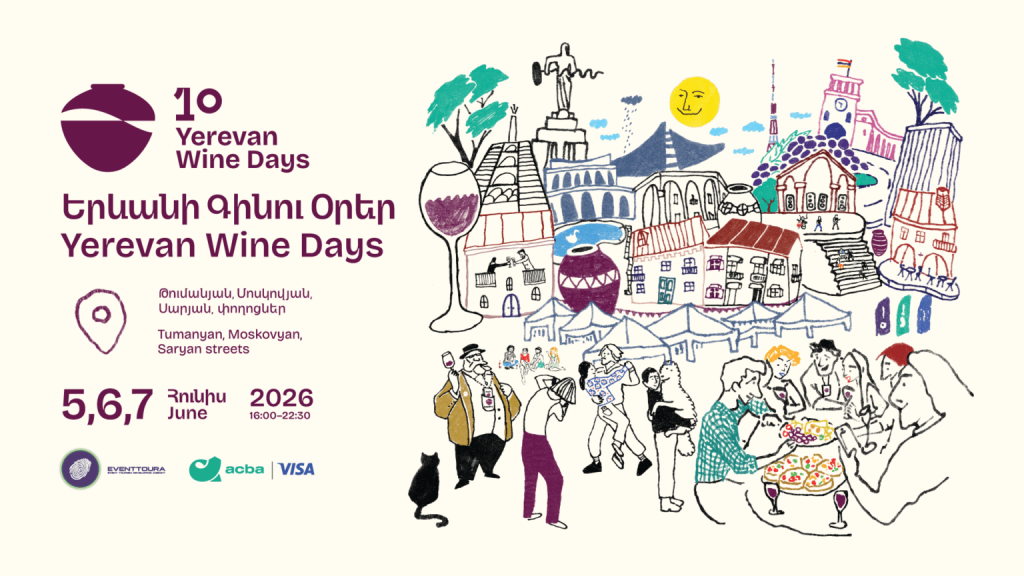
In the evolving hierarchy of global wine destinations, few cities have managed to translate heritage into contemporary relevance with the precision, and flair, of Yerevan. This from June 5 to June 7, 2026, Armenia’s capital will host the 10th anniversary of Yerevan Wine Days, a three-day urban immersion that has quietly, and now decisively, positioned itself among the most compelling wine events in the world.
What began in 2017 as a modest gathering of 25 winemakers along Saryan Street has matured into a calibrated expression of modern wine culture. By 2025, the festival had drawn more than 180,000 attendees, with an impressive 40 percent arriving from abroad. For a city often associated with ancient winemaking traditions, Armenia is widely considered one of the oldest wine-producing regions globally, this contemporary articulation feels both deliberate and inevitable.
For three evenings, Saryan, Moskovyan, and Tumanyan streets are closed to traffic and reimagined as a refined open-air promenade. The result is less a festival and more a living, breathing wine district—one where architecture, gastronomy, music, and design converge into a singular experience.
At the heart of the event is an expansive portfolio: over 1,000 wines presented by approximately 100 Armenian producers. The scope alone is notable, but what distinguishes Yerevan Wine Days is its curation. Visitors are not simply tasting; they are navigating a structured narrative of Armenia’s evolving wine identity, supported by culinary offerings from leading local restaurants and an increasingly sophisticated hospitality framework.
Access to this experience is thoughtfully tiered. While entry to the streets remains open, the Wine Enjoyment Package, priced at 14,000 AMD, provides a more integrated engagement. A commemorative 10th-anniversary glass, a discreetly designed neck-pouch, 12 tasting coupons, and a raffle ticket transform the visitor from observer to participant. It is a subtle but effective mechanism that balances accessibility with exclusivity.
The intellectual dimension of the festival is equally considered. The Wine Talks platform offers masterclasses led by winemakers and sommeliers, introducing a level of discourse more commonly associated with formal industry gatherings. Alongside this, interactive art installations and live painting sessions underscore the festival’s broader cultural ambition. This is not merely about wine; it is about positioning wine within a wider creative and social context.
To mark its tenth edition, the festival will also debut a limited collection of high-design streetwear and accessories. While at first glance this may seem ancillary, it reflects a growing trend among leading global events: the integration of lifestyle branding as an extension of identity. In Yerevan, even the merchandise feels intentional.
Sustainability, often treated as an afterthought in large-scale events, is embedded into the operational model. A reusable glass system eliminates the need for approximately 100,000 plastic cups annually, while in 2025 alone, more than 1,500 kilograms of paper materials were successfully recycled. These are not symbolic gestures but measurable interventions.
The festival is orchestrated by EventToura, the foundation established by Mary Badalyan and Nune Manukyan to advance event tourism in Armenia. Their vision has been consistent: to position Yerevan not only as a destination with history, but as one capable of delivering contemporary, globally competitive experiences.
“This tenth year is an open invitation to rediscover Armenia through its people, its energy, and its world-class hospitality,” the organizing team notes. “Our anniversary is a three-day immersion into the soul of a city that is quickly becoming a must-visit destination on the global map.”
There is, perhaps, a broader lesson embedded in Yerevan Wine Days. Traditional wine regions have long relied on terroir and legacy to define their appeal. Yerevan suggests a different model, one where the city itself becomes the stage, and wine is both the anchor and the catalyst.
In this sense, the festival is not simply celebrating ten years. It is articulating a future: one in which wine tourism is no longer confined to vineyards, but unfolds dynamically within the cultural fabric of a place.
For those accustomed to the world’s established wine capitals, Yerevan offers something increasingly rare, authenticity, scaled with intention, and delivered with style.
For further details: https://www.yerewinedays.am/en/