
Standing in the quiet streets of Torquemada, in Spain’s Cerrato Palentino region, it was difficult to imagine that an extraordinary underground world lay hidden beneath my feet. A few weeks ago, I joined a group of international journalists to explore one of Spain’s most remarkable, yet still largely undiscovered, wine heritage sites: the historic Bodegas of Torquemada.
Located in the province of Palencia, within the autonomous community of Castilla y León, the Bodegas of Torquemada comprise one of Spain’s largest networks of traditional underground wine cellars. Recognizing their exceptional historical, architectural, and cultural significance, the regional government designated the site a Bien de Interés Cultural (BIC) in the Conjunto Etnológico (Ethnological Ensemble) category.
From the surface, the village appears deceptively simple. Yet beneath its quiet streets lies a remarkable testament to centuries of winemaking tradition, rural ingenuity, and a community whose identity has long been shaped by wine.
The origins of Torquemada’s underground bodegas date back several centuries, with many of the cellars constructed between the 16th and 19th centuries as the region’s wine industry flourished. Some historians believe that earlier underground storage spaces may have existed even before this period, gradually expanding into the extensive network seen today. Excavated by hand beneath the village, these subterranean cellars provided naturally stable temperatures and humidity, creating ideal conditions for fermenting, ageing, and storing wine long before mechanical refrigeration existed. Together, they reflect generations of local craftsmanship and the enduring importance of viticulture to Torquemada’s cultural and economic identity.
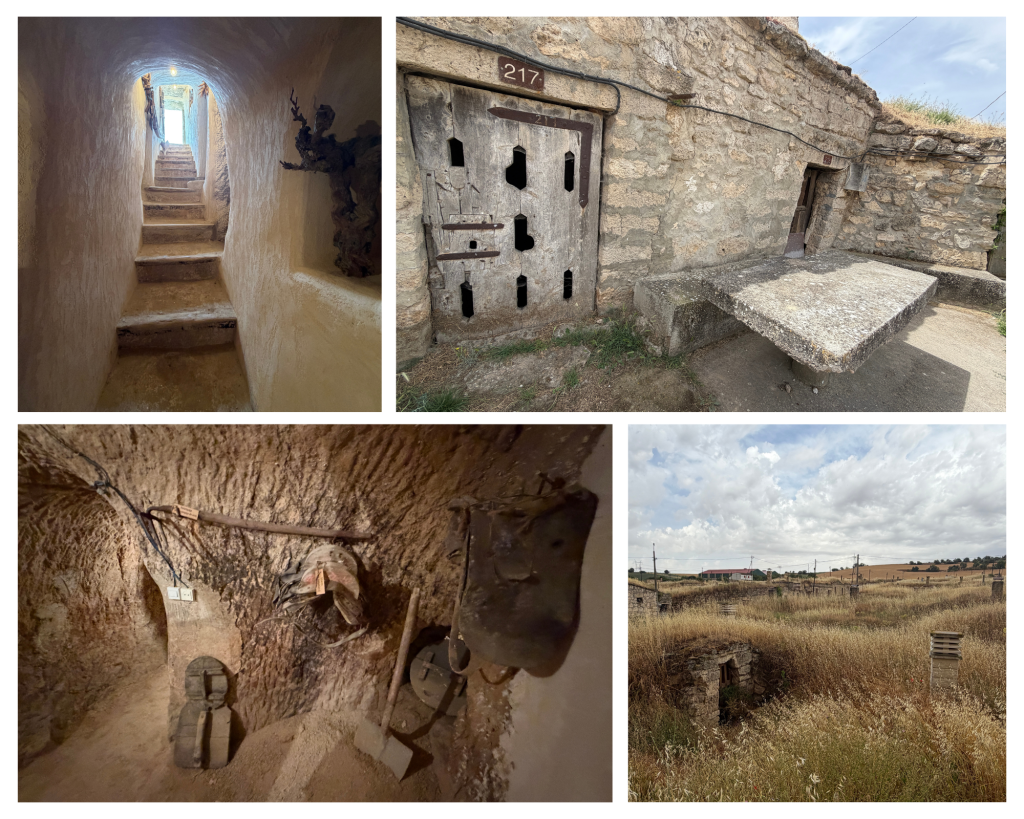
Low stone buildings, white conical ventilation chimneys (zarceras), and orderly lanes offer few clues that 477 underground wine cellars extend beneath the village. Only after descending a narrow flight of worn stone steps through a heavy wooden doorway does the true character of Torquemada reveal itself.
The temperature immediately drops to a naturally cool environment. The bustle of the village disappears, replaced by silence broken only by footsteps echoing through vaulted tunnels. Thick stone walls, ancient oak barrels, traditional wine presses, handcrafted tools, fermentation vessels, and winding galleries create an atmosphere unlike any modern winery. It feels less like entering a cellar and more like discovering an underground village built entirely around wine.
As we moved slowly through the passages, our group instinctively lowered our voices. The experience invited quiet reflection. Every chamber revealed another reminder that generations of families had relied on these underground spaces not only for winemaking and storage, but also as an integral part of community life.
Those first impressions help explain why destinations such as Torquemada matter in today’s wine tourism landscape. Increasingly, travellers are seeking authenticity rather than spectacle. They want stories rooted in place, landscapes shaped by tradition, and experiences that connect wine with history, architecture, gastronomy, and local identity.
Torquemada is home to one of Spain’s largest surviving collections of traditional underground bodegas. Unlike many historic cellars excavated into hillsides, these were carved beneath relatively flat terrain using remarkable vernacular engineering that naturally maintains temperatures of approximately 12°C throughout the year. This passive climate control made the cellars ideal for fermentation and ageing centuries before the advent of modern refrigeration.
Historically, Torquemada was an important commercial wine centre whose wines supplied taverns throughout Castile and reached markets as far as Santander. At its peak, the town reportedly contained more than 1,000 working cellars, reflecting the strength of its rural wine economy and the central role wine once played in local life.
Walking above ground between the parallel rows of cellar entrances, the district feels surprisingly modest. Nothing immediately announces its historical importance. Instead, the site rewards curiosity and invites discovery, a quality that has become increasingly valuable in modern cultural tourism.
From a wine tourism perspective, Torquemada demonstrates how cultural landscapes can become compelling destinations in their own right. Rather than relying on iconic architecture or purpose-built visitor centres, it offers something increasingly rare: authenticity preserved through generations of community stewardship.
This evolution is supported by academic research. Hall, Sharples, Cambourne, and Macionis argue that successful wine tourism increasingly integrates wine, heritage, gastronomy, and cultural identity into holistic visitor experiences rather than treating winery visits as isolated attractions. Torquemada represents this philosophy remarkably well.
To Be Continued in Part 2
Part 2 explores how Torquemada’s underground bodegas provide a model for sustainable wine tourism, destination branding, cultural heritage preservation, and international best practices—demonstrating why this remarkable Spanish village deserves recognition as one of Europe’s most significant wine tourism destinations.