
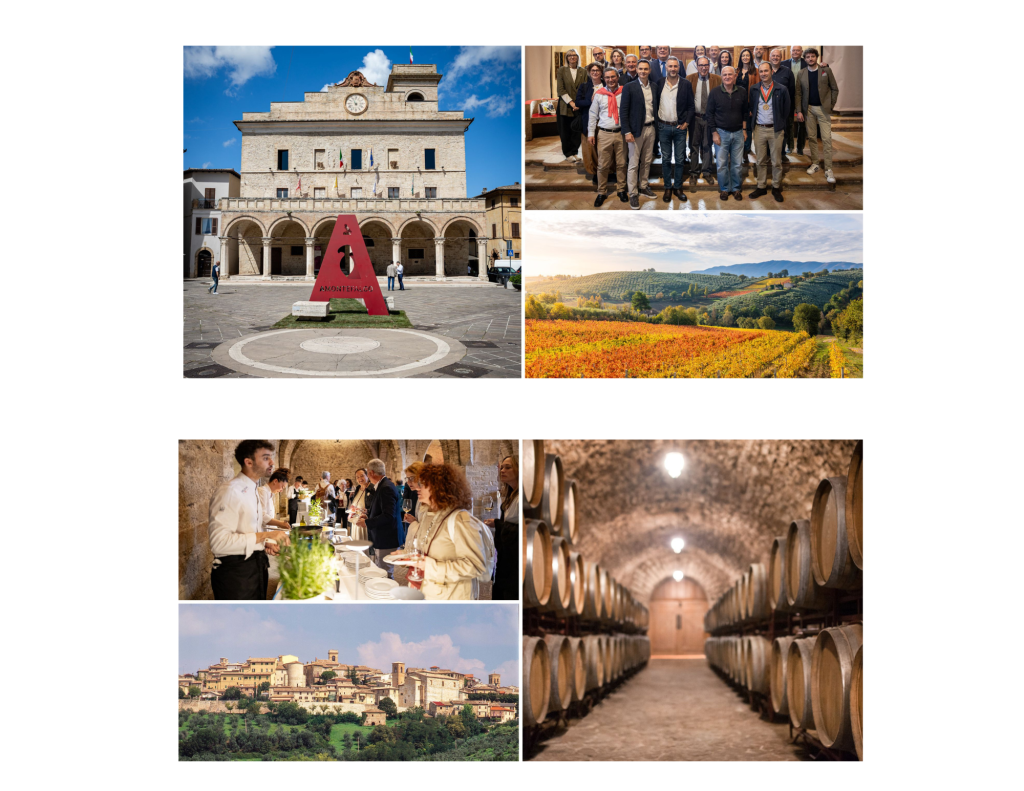
The fourth edition of A Montefalco ran from April 26 to 28, bringing national and international press and trade professionals to the medieval hilltop town for three days of tastings, masterclasses, and winery visits. Thirty-one wineries participated, presenting the full range of Montefalco and Spoleto denominations alongside the newly released 2022 vintage of Montefalco Sagrantino DOCG.
Organized by the Consorzio Tutela Vini Montefalco with the support of CSR Umbria SRG10, and held under the patronage of the municipalities of Montefalco and Bevagna, the event has grown from a single-variety preview into a three-day immersion in the region’s wine culture. The Strada del Sagrantino collaborated on the program’s winery-visit component, routing guests across the denomination’s five producing communes.
The 2022 Vintage
The formal presentation of the 2022 Montefalco Sagrantino DOCG took place on the morning of April 28 at the San Francesco Museum Complex. The Consorzio rated 2022 at four stars and 92/100, placing it in the excellent category. It follows a strong run of vintages: 2019 at 95/100, 2020 at 96/100, and 2021 at 94/100. The four-year gap between harvest and release reflects the denomination’s mandatory 37-month aging requirement, which includes 12 months in wood and a final four months in bottle.
Program Highlights
The masterclass on the evening of April 27 was led by Master of Wine Cristina Mercuri, focusing on the contemporary interpretation of Montefalco wines and their position in international gastronomy. The session offered trade professionals a structured framework for approaching the denomination’s range, from Sagrantino’s tannic architecture to Trebbiano Spoletino’s high-acid, late-ripening profile.
The Gran Premio del Sagrantino, the national sommelier competition, returned as one of the program’s centerpieces. Competitors from across Italy were assessed on tastings, food pairings, service technique, and wine-list construction.
The Etichetta d’Autore was also unveiled: the commissioned artwork created each year to mark the new Sagrantino release. The 2026 label celebrates the 2022 vintage and continues the Consorzio’s tradition of connecting wine, territory, and visual art.
The Wines
The tasting room presented the full denominational spectrum: Montefalco Sagrantino DOCG in both dry and passito versions, Montefalco Rosso DOC and Riserva DOC, Montefalco Bianco DOC, Montefalco Grechetto DOC, and the Spoleto DOC wines, including still, Superiore, Spumante, and Passito expressions of Trebbiano Spoletino.
Sagrantino’s case for international attention rests partly on science. Research commissioned by the Consorzio in 2008 from the Agricultural Institute of San Michele all’Adige found the variety ranks among world leaders in polyphenol content. Its tannins, despite their concentration, are less astringent than those of other red wine grapes.
The variety is grown exclusively across Montefalco and parts of Bevagna, Castel Ritaldi, Giano dell’Umbria, and Gualdo Cattaneo.
Trebbiano Spoletino drew sustained attention in the tasting room. Harvest runs from late September through early November, depending on altitude and exposition, making it one of the latest-ripening white varieties in central Italy. The grape’s natural acidity and thick skin give it unusual resilience in warm years. Across the Superiore, Spumante, and Passito versions, the variety demonstrated a versatility rare among indigenous Italian whites.
The Grapes
Sagrantino
Sagrantino grows only in Montefalco and four neighboring communes, and nowhere else in the world. Its thick skins produce wines with exceptionally high polyphenol levels. Research commissioned by the Consorzio in 2008 found that, despite this concentration, the tannins are less astringent than those of any other red wine grape. They possess a structural quality that allows them to integrate and refine over decades rather than simply softening.
The DOCG requires 37 months of aging before release, including 12 months in wood. That timeline is not arbitrary. Sagrantino genuinely needs time.
Sangiovese
Sangiovese is the primary grape in Montefalco Rosso DOC, making up 60 to 80 percent of the blend. In this territory, the variety takes on more color and body than it does farther north, without losing the acidity and freshness that make it food-friendly.
The addition of Sagrantino (10 to 25 percent) gives the blend structure and depth. Montefalco Rosso is the denomination’s most approachable wine and, for many visitors, the natural starting point.
Trebbiano Spoletino
Trebbiano Spoletino ripens later than almost any other white variety grown in central Italy, often extending into November for valley-floor plots. High natural acidity and thick skins make it resilient in both wet and drought years.
The wines combine citrus and tropical fruit with a smoky mineral character that intensifies with age. The 2026 event confirmed its range across four distinct styles: still DOC, Superiore, ancestral-method Spumante, and Passito. No other indigenous white variety in the region covers that range.
Grechetto
Grechetto is the most widely planted white grape in Umbria. The variety produces full-bodied wines with stone-fruit character, noticeable structure, and enough acidity to hold their shape at the table.
In Montefalco, it appears both as a single-variety DOC and as a blending component with Trebbiano Spoletino. The style is unambiguously Mediterranean: weight and generosity over delicacy.
Visiting Montefalco
Montefalco sits at 472 meters above the Umbrian plain, 50 kilometers from Perugia and 25 kilometers from Spoleto. The town is compact enough to explore on foot in an hour.
The church-museum of San Francesco, which houses frescoes by Benozzo Gozzoli and Perugino, anchors the historic center and doubles as one of the event’s institutional venues.
The Strada del Sagrantino connects Montefalco with Bevagna, Gualdo Cattaneo, Castel Ritaldi, and Giano dell’Umbria. Most participating estates accept visits by appointment outside the event period.
Several estates offer accommodation: Antonelli’s restored Casale Satriano farmhouse has six apartments and a pool; Tenuta Bellafonte near Bevagna has seven rooms, an indoor pool, and 2,500 olive trees; Arnaldo Caprai offers tastings on a panoramic terrace overlooking the vineyards.
Spring and autumn are the best seasons to visit. Harvest begins in late September and can extend through November for Trebbiano Spoletino.
The Consorzio Tutela Vini Montefalco, now in its 45th year, represents 118 members, including 66 winery members. Full program details and winery listings are available at consorziomontefalco.it.
Winery Visits
Thirty-one estates opened their doors across the three days, ranging from historic cooperatives to small family producers.
Antonelli San Marco
One of Montefalco’s most respected family estates, Antonelli San Marco has been a benchmark producer in the region for generations. The winery is known for both innovation and respect for tradition, particularly in its work with indigenous varieties.
Rather than a traditional cellar tour, Antonelli hosted an elegant dinner paired with its wines, showcasing both current releases and older vintages. This format allowed for a more relaxed exploration of the portfolio while demonstrating how the wines pair with local cuisine.
Arnaldo Caprai
Founded in 1971 by Arnaldo Caprai, a textile entrepreneur, the winery was passed to his son Marco in 1988, when Marco was only 21 years old. Marco expanded the estate from just 12 acres to a thriving 370-acre vineyard.
Early on, he chose to drastically reduce grape yields to focus on quality. Believing in Sagrantino’s full potential, he began exporting dry Montefalco Sagrantino to the United States even before it achieved DOCG status, paving the way for the international revival of Sagrantino.
The state-of-the-art winery in Montefalco offers multiple tours and tastings on its panoramic terrace and throughout the vineyards.
Le Cimate
The winery represents the culmination of more than 200 years of agricultural dedication by the Bartolini family. Beginning with farming in the 1800s, transitioning to viticulture in the 1960s, and strategically purchasing land in 1992, the family finally began building the winery in 2011.
Located at 400 meters and nestled against the Martani Mountains, the winery benefits from excellent diurnal temperature shifts and regular winds that help keep the vines healthy. Surrounding the 23 hectares of vineyards are 33 hectares of olive groves and 15 hectares of hazelnut orchards.
Utilizing the latest technology, the winery produces wines from an impressive array of grapes, including native varieties and international favorites such as Chardonnay, Viognier, Vermentino, Merlot, and Cabernet Sauvignon.
Lungarotti
Founded in the 1960s by Giorgio Lungarotti, the family estate is located in Montefalco and Torgiano, just 30 minutes northwest of Montefalco toward Perugia.
The winery is a family affair, now run by Giorgio’s two daughters, Chiara and Teresa. Their mother, Maria Grazia, was a pioneer in wine tourism, creating the region’s first wine museum in the 1970s and, more recently, an olive and olive oil museum.
Teresa was one of Italy’s first female oenologists, and her children, Francesco and Gemma, manage the estate’s sales and events. All of the winery’s wines have been organic since 2010.
Pardi
The three Pardi brothers — Alfredo, Francesco, and Alberto — began making wine in 1919 at the local hospital in Montefalco. Eventually, their wines were distributed throughout Italy, including to the Vatican.
Today, their great-grandsons, Gianluca Rio and Alberto Mario, continue the family tradition. With 11 hectares of vines, they grow local varieties including Sagrantino, Sangiovese, Grechetto, and Trebbiano Spoletino, as well as international grapes such as Merlot, Cabernet Sauvignon, and Chardonnay.
Romanelli
Originally owned by the Bishop of Spoleto for more than 600 years, the property was purchased by Francesco Antonelli in 1883. Today, the Antonelli estate spans 430 acres in the heart of the Montefalco territory.
The diversity of the terrain, from rich clay deposits to rocky limestone, creates several microclimates, with each plot expressing its own nuances. The cellars are completely underground, allowing for the use of gravity flow during production.
The grapes — primarily Sagrantino and Sangiovese for reds, and Grechetto and Trebbiano Spoletino for whites — are all organically grown. Visitors are welcomed at the beautifully restored farmhouse, Casale Satriano, which includes six apartments and a swimming pool.
Tabarrini
Giampaolo Tabarrini, the fourth generation of his family, took control of the agricultural estate in the late 1990s and transformed it into the winery it is today.
His vision focuses on terroir expression, with three bottlings selected from distinct vineyard parcels to highlight their unique characteristics. In addition to 15 hectares of vineyards, the estate includes olive groves and wheat fields, from which they produce their own stone-ground flour for pizza, pasta, and desserts.
Terre de Trinci
Terre de Trinci holds a unique place in Sagrantino history as the cooperative that pioneered dry Sagrantino production. Founded in 1968, this cooperative of 100 members farms 120 hectares, plus an additional 50 hectares of estate-owned vineyards.
In 1972, they released the first bottles of dry (non-passito) Sagrantino di Montefalco, helping establish what would later become a DOCG in 1992.
Located in Foligno rather than within Montefalco’s borders, they are the only consortium members authorized to vinify outside the denomination’s territorial boundaries due to their historical significance. The cooperative transitioned to member ownership in 1992 after initially being managed by the local agricultural consortium.
Valdangius
Valdangius represents the new generation of Montefalco family wineries. Owner Danilo Antonelli works alongside winemaker Alessandro Meniconi, while daughter Jessica is already participating in operations as she pursues her degree in enology.
This multi-generational approach reflects the estate’s commitment to both tradition and innovation.
Filippo Magnani