
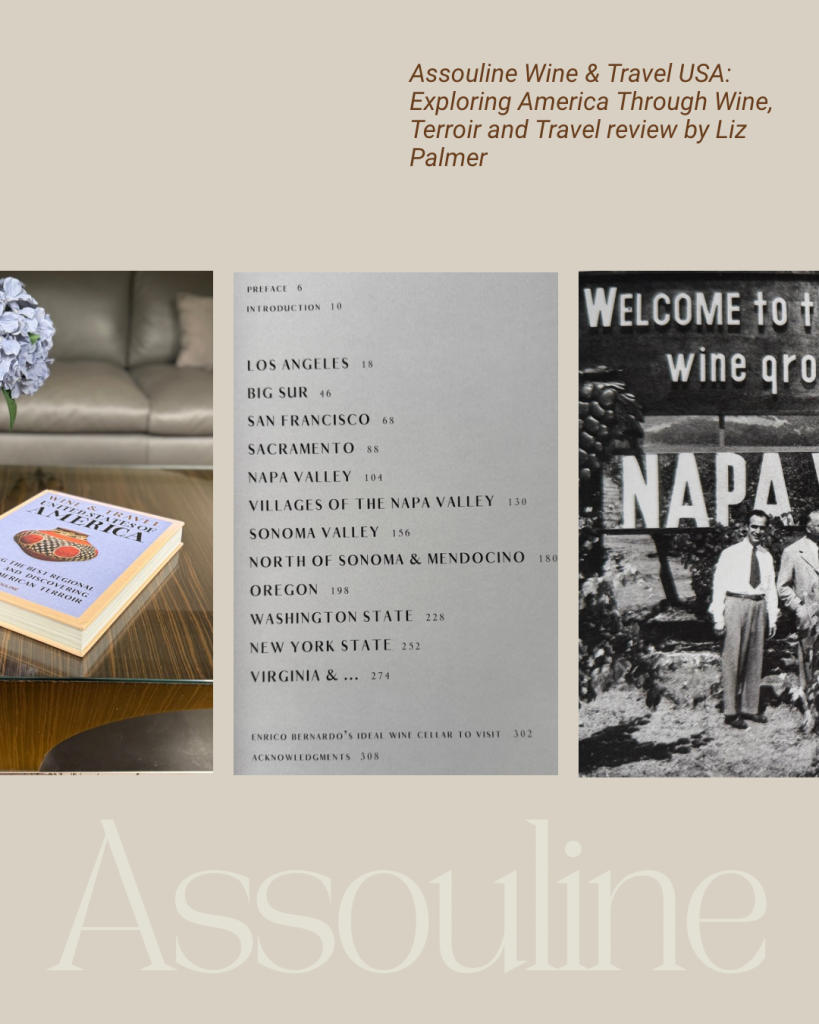
A review of Assouline’s Wine & Travel: United States of America by Enrico Bernardo, exploring American wine through terroir, gastronomy, hospitality, culture and sense of place.
Wine tells us far more about a destination than what is poured into the glass. It tells us about its landscape, climate, food, people and culture – and increasingly, it gives travellers a reason to experience a place for themselves.
That relationship between wine and destination lies at the heart of Assouline’s Wine & Travel: United States of America.
Written by Enrico Bernardo, named Best Sommelier in the World in 2004, the substantial linen-bound volume takes readers on a visual journey through America’s remarkably diverse wine landscape.
Published in September 2025, the book comprises 312 pages and more than 400 illustrations, combining wine, travel, photography and storytelling in Assouline’s distinctive visual style.
But this is much more than a beautifully produced coffee-table book.
It offers an important perspective on the evolution of American wine tourism – and on the growing importance of terroir, gastronomy, hospitality and sense of place in defining a successful wine destination.
A Wine Country of Many Identities
One of the book’s strengths is its geographical diversity.
The journey stretches from Santa Barbara, where Rhône varieties flourish under Pacific influence, through Napa Valley, Sonoma and Mendocino, north to Oregon’s Willamette Valley, across to Walla Walla, and east to New York’s Finger Lakes.
What emerges is not one American wine identity, but many.
Climate, soils, elevation, geography and human influence have produced distinctive regional wine cultures – and Bernardo allows those differences to become part of the story.
This is important because today’s wine traveller is increasingly interested not simply in what a region produces, but why it tastes, looks and feels different from somewhere else.
That is terroir translated into travel.
Beyond the Tasting Room
Perhaps the book’s most interesting dimension is the way it places wine within a much broader visitor experience.
Wine is presented alongside landscape, gastronomy, architecture, hospitality and people.
This reflects one of the most significant developments in international wine tourism.
The traditional cellar-door model – visit a winery, tour the cellar, taste several wines – is evolving.
Today’s leading wine destinations are creating more immersive experiences in which the vineyard becomes the starting point for discovering the wider destination.
In Napa, that relationship extends into sophisticated hospitality and Michelin-recognised gastronomy. In the Finger Lakes, vineyards and lakes create a very different sense of place. In Sonoma and Mendocino, sustainability, agricultural heritage and landscape contribute another dimension to the visitor experience.
Each region tells its own story.
Gastronomy, Hospitality and Place
Bernardo’s background as both sommelier and restaurateur gives gastronomy a natural place within the narrative.
Wine and food are not treated as separate experiences but as interconnected expressions of destination.
This matters for wine tourism.
The world’s strongest wine regions increasingly understand that the visitor economy extends far beyond the winery. Restaurants, hotels, chefs, farmers, cultural attractions and local producers collectively shape how travellers experience a region.
Hospitality is equally important.
Across American wine country, tasting rooms have evolved into sophisticated environments where architecture, design, vineyard views, personalised tastings and food pairings communicate both the winery’s identity and the character of the destination.
A tasting explains a wine.
A great wine tourism experience explains a place.
The People Behind the Landscape
The book also recognizes the human dimension of terroir.
Winemakers, growers and the personalities behind individual estates are central to the American wine story.
This is particularly relevant in a country where many wine regions have established international identities relatively recently compared with Europe’s historic appellations.
Innovation, entrepreneurship and experimentation have therefore played an important role in shaping American wine.
The result is a wine culture that continues to evolve – confident enough to draw inspiration from the Old World while increasingly defining itself through its own landscapes and regional identities.
More Than a Coffee-Table Book
Visually, Wine & Travel: United States of America is unmistakably Assouline.
Its photography transports the reader through vineyards, wineries, landscapes and hospitality experiences, reinforcing the fundamental relationship between wine and geography.
But beneath the visual appeal is a larger message about contemporary wine tourism.
The strongest wine destinations are no longer defined solely by the quality of their wines.
They are defined by their ability to connect wine + terroir + gastronomy + hospitality + culture + landscape + people into one coherent visitor experience.
And that is ultimately what makes this book particularly relevant.
Wine & Travel: United States of America is both an invitation to discover American wine country and a reminder of what successful wine tourism can achieve.
Wine & Travel: United States of America
Author: Enrico Bernardo
Publisher: Assouline
Published: September 2025
Format: Linen hardcover | 312 pages | 400+ illustrations