
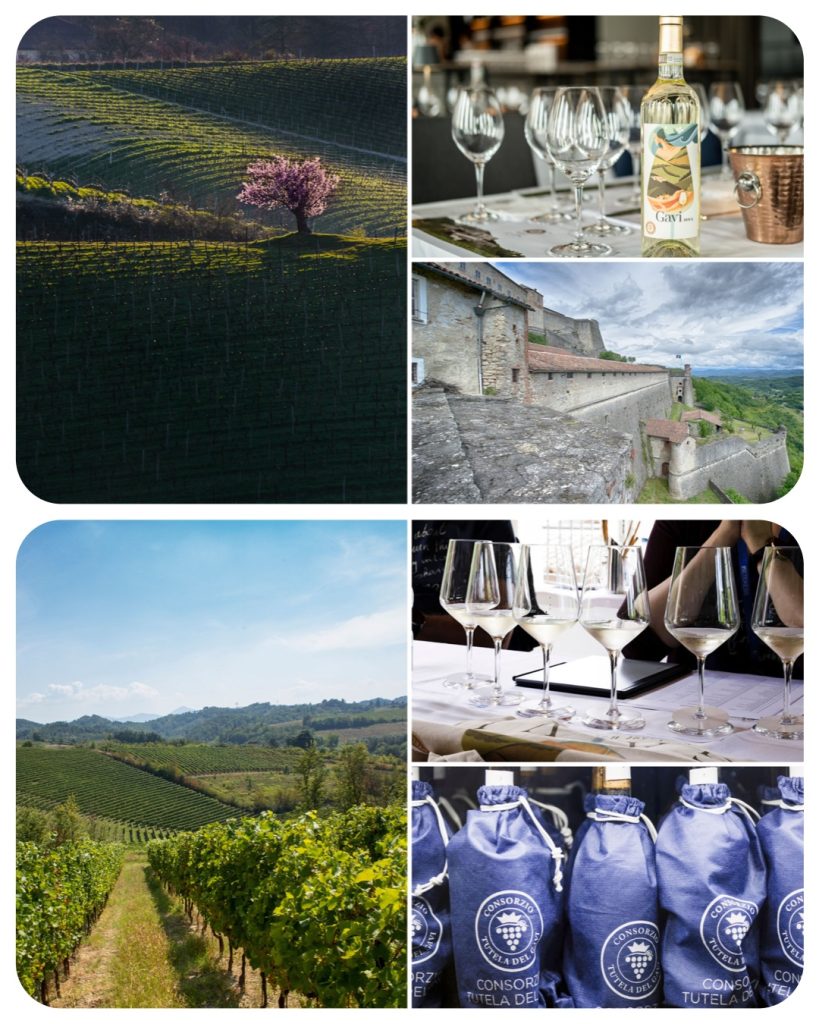
The Denomination
Gavi DOCG sits in the southeastern corner of Piedmont, where the hills begin their long climb toward the Ligurian Apennines. Less than an hour from Milan, Genoa, and Turin, the territory occupies a geographic position that has shaped both its history and its wine for over a thousand years.
The denomination covers eleven municipalities in the province of Alessandria: Bosio, Carrosio, Capriata d’Orba, Francavilla Bisio, Gavi, Novi Ligure, Parodi Ligure, Pasturana, San Cristoforo, Serravalle Scrivia, and Tassarolo. Within those eleven municipalities, 1,580 hectares of vineyards sit at altitudes between 180 and 450 metres above sea level, across soils divided into three broad geological types: iron-rich red clays in the north, a central strip of alternating marl and sandstone, and white tuffaceous soils in the south where altitude and Apennine winds produce wines with marked minerality.
The presence of a great white wine in Piedmont, a region famous for its outstanding reds, reveals the strong bond between Gavi and the Republic of Genoa. Genoese families who had country houses in these lands brought local dishes of fish, lean meats, and vegetables, ingredients that paired well with the native Cortese grape. That culinary identity survives intact. The first written evidence of viticulture dates to 3 June 972: a document preserved in the State Archives of Genoa records the leasing of vineyards and chestnut groves to two citizens of Gavi by the Archbishop of Genoa.
The Consorzio Tutela del Gavi, founded in 1993 and commissioned by the Ministry of Agriculture to protect and promote the denomination, oversees 190 member companies and the 13 million bottles produced annually. Over 500 local families work across the supply chain, predominantly on small and medium-sized estates that maintain a traditional approach to viticulture.
The Wine
Gavi DOCG is made exclusively from Cortese, a white grape native to the province of Alessandria. Cortese is a vigorous variety with medium-large bunches that turn golden yellow at ripeness, showing green or amber reflections in the sun. The grapes ripen in the second half of September. In the vineyard, the variety requires careful green pruning, shoot positioning, and selective thinning to maintain the low yields the denomination demands: 95 quintals per hectare for Tranquillo, Frizzante, and Spumante; 65 quintals per hectare for the Riserva. Maximum wine grape yield must never exceed 70%.
Cortese has thin skins and naturally high acidity. Those two characteristics define the Gavi style. The acidity keeps young wines vivid and direct, and it is the same acidity that allows the wine to age far longer than most Italian whites. In the glass, Gavi shows pale straw yellow with greenish reflections, fresh fruit, white flowers, citrus, and a characteristic bitter almond finish. The aromatic profile becomes more mineral and complex with time, and the Consorzio annually organizes vertical tastings for press and trade that regularly demonstrate Cortese’s ability to develop well over eight to ten years.
The denomination comprises four styles of Gavi: Tranquillo, Frizzante, Spumante, and Riserva. Tranquillo accounts for 99% of production: a dry, still wine with a minimum alcohol of 10.5%, typically consumed young but increasingly vinified for aging. Frizzante is produced by only a handful of estates. Spumante is made by the Metodo Classico with a minimum of six months on the lees. The Riserva is released after a minimum of one year’s refinement, including at least six months in bottle, and reveals tertiary aromas and a fuller, richer structure at a minimum 11% alcohol. With extended aging, the aromatic profile opens toward candied fruit, honey, and balsamic notes, making it suitable for pairings with red meats, stuffed pastas, and blue cheeses.
Since 2013, the Consorzio has entrusted the Associazione Italiana Sommelier with the blind tasting of Gavi DOCG samples from member wineries each year, selecting the most representative wine of the vintage as the institutional label. The label is commissioned from a different artist each year, making it both a technical benchmark and a cultural document of the denomination.
The Territory
The Forte di Gavi dominates the town from above. Built at intervals from the twelfth century, first as a castle and then as a fortress, it was reinforced in 1540 when Genoa commissioned architect Giovanni Maria Olgiati to adapt the medieval structure for the new power of firearms. After that structure fell to the Franco-Savoyard army of Carlo Emanuele I in 1625, Genoa commissioned architect Vincenzo da Fiorenzuola to rebuild it as the powerful Forte still visible today. The views from the ramparts cover the full sweep of the denomination.
The remains of the Roman city of Libarna at Serravalle Scrivia attest to its status as an important trading centre along the Via Postumia, Via Francigena, and Via del Sale as early as the second century BC. The ruins of the ancient theatre and the street grid of the Roman domus are visible on site. Other destinations in the territory include the Geosite of Carrosio, the Pinacoteca di Voltaggio, and the Abbey of San Remigio in Parodi Ligure.
For those who prefer to be outdoors, the territory offers walking and mountain-bike trails into the Val Borbera and Val Lemme, trekking routes that reach the peak of Monte Tobbio at 1,092 metres, with views across to the Ligurian Sea, and fishing on the rivers Scrivia, Lemme, and Orba. The Parco delle Capanne di Marcarolo and the Laghi del Gorzente and Lavagnina are natural destinations further into the hills. Three golf clubs operate in the zone, alongside the McArthurGlen Serravalle Outlet for those combining wine tourism with a different kind of shopping.
The local food culture is inseparable from the wine. The most celebrated product is the Raviolo Gaviese De.Co. (Denominazione Comunale). Traditionally prepared with beef and pork, eggs, cheese, borage, and escarole, its recipe has been protected by the Ordine Obertengo dei Cavalieri del Raviolo e del Gavi for more than 45 years. Each of the eleven municipalities brings its own specialty to the table: torta di riso from Bosio, focaccia from Parodi Ligure, farinata from Serravalle Scrivia, canestrelli biscuits from Francavilla Bisio, chocolate from Novi Ligure, honey from Carrosio, and the amaretti of Gavi, whose patented recipe dates to 1780 and uses almonds, sugar, egg white, and honey. The testa in cassetta, a cured head cheese, holds Slow Food presidium status.
Where to Stay and What to Do
The Gavi territory is designed for a slow, multi-day visit. The wine road that traces the denomination, starting from Gavi and following the Strada Lomellina north toward Novi Ligure before curving back through Serravalle Scrivia, Bosio, Parodi Ligure, and Capriata d’Orba, passes through all eleven municipalities. Most producers along this route receive visitors by appointment for cellar tours and tastings.
The accommodation options range from exclusive resort hotels to agritourism stays directly on working wine estates. Several producers have invested in hospitality structures that combine winery visits with rooms, restaurants, and grounds for walking or relaxing among the vines. The territory also has three golf clubs, making it one of the few Italian wine zones where a round of golf and a cellar visit fit naturally into the same day.
Novi Ligure is worth a specific stop. Beyond its chocolate-making tradition, the city is home to the Museo dei Campionissimi, dedicated to the great cycling champions born in this corner of Piedmont, including Fausto Coppi and Costante Girardengo. The museum draws a distinct visitor profile and pairs well with the denomination’s broader offer.
The Belvedere della Madonna della Guardia, high on the Apennine ridge, gives a panorama that takes in the full range from the hills of the denomination to the Po plain below. On clear days, the view extends to the Alps. It is one of those specific points in Italy where the geography of a wine region suddenly becomes understandable.
The area is easily accessible from three directions. The nearest airport is Genoa Cristoforo Colombo. Milan and Turin are both within 100 kilometres. From the A7 motorway, the Serravalle exit leads directly into the heart of the zone.
The Producers
Cantina Produttori del Gavi | www.produttoridelgavi.com
On 23 September 1951, 83 founders gathered at Gavi’s town hall and established the Cantina Sociale Cooperativa di Gavi, the first cooperative in the Terre del Gavi, committing to bring in high-quality Cortese grapes for collective vinification and sale. When Gavi received its DOC recognition in 1974, the cooperative changed its name to Cantina Produttori del Gavi and produced its first labeled wines. Today the cooperative has grown to 95 member growers and vinifies grapes from 200 hectares across all eleven municipalities, from Tassarolo to Bosio. The range runs from the entry-level Gavi DOCG to the Mille951 and Maddalena, single-commune wines from the municipality of Gavi itself. The winery wine shop in Gavi is open year round and the cellar receives visits and guided tastings by appointment.
Broglia (Tenuta La Meirana) | www.broglia.it
The estate’s name first appeared in a rental contract dated to 972 AD, preserved in the State Archives of Genoa, making it one of the oldest documented connections to the Gavi territory. Bruno Broglia purchased Tenuta La Meirana in 1972, two years before the region received its DOC designation, and released the first vintage in 1974. Today the estate is managed by the third generation of the family, Roberto and Filippo Broglia, across 65 hectares of vineyards planted exclusively around the municipality of Gavi. The flagship La Meirana Gavi del Comune di Gavi ferments in temperature-controlled stainless steel and ages for six months on its lees, preserving the fresh fruit and the variety’s characteristic almond finish. The estate also offers agriturismo accommodation, with views across the Meirana hills toward the medieval village of Gavi.
Il Rocchin | www.ilrocchin.it
Il Rocchin was founded by the Zerbo family, and the estate today spans over 100 hectares, 44 of which are planted with vines dedicated to producing Cortese and Barbera. The first bottling line opened in 1992. The winery produces three Gavi wines: a standard Gavi DOCG from vineyards in San Cristoforo at 232 metres above sea level; the Gavi del Comune di Gavi from 30 to 40-year-old vines in the municipality of Gavi; and the single-parcel Zerbo label from the oldest vines on the estate. The wines are noted for their orange blossom character on the nose and a clean citrus-almond palate with a persistent bitter finish. Angelo and Fra Rocchina Zerbo receive visitors by reservation on Fridays and Saturdays, with tastings paired with focaccia di Gavi, local cheeses, and cold cuts.
La Raia | www.la-raia.it
The Rossi Cairo family purchased La Raia in 2002 with the aim of recovering and restoring the original ecosystem through biodynamic principles. The biodynamic approach was first introduced in the vineyards, followed by the renovation of the winery using the Pisé ancient rammed-earth building technique, a traditional construction method of the Novi Ligure district. The estate became organic in 2005 and received Demeter biodynamic certification in 2007. La Raia spans 180 hectares, with 48 hectares of vines, 90% Cortese and 10% Barbera. Yields are kept between 60 and 70 quintals per hectare, below the appellation maximum. The wine range includes the standard Gavi DOCG, the single-vineyard Riserva Vigna della Madonnina, and the Pisé, produced only in exceptional vintages from the estate’s oldest vines and aged for at least 20 months on the lees. The La Raia Foundation, established in 2013, promotes critical reflection on the landscape through permanent artworks installed across the estate, including works by Remo Salvadori and Koo Jeong A. The 12-room Locanda La Raia offers accommodation, a restaurant, a pool, and guided vineyard walks.
La Scolca | www.lascolca.net
Founded in 1919 by the Soldati family, La Scolca is now led by Chiara Soldati, the fifth generation to carry the estate forward. The family planted Cortese on land in the Rovereto commune at a time when the zone was considered red-wine country. In 1966, Vittorio Soldati created the Gavi dei Gavi “Etichetta Nera,” the wine that first brought international attention to the denomination. La Scolca also played a central role in founding the Consorzio Tutela del Gavi in 1993. The estate’s two main labels remain the White Label, from approximately 20-year-old vines, and the Black Label Gavi dei Gavi, sourced from 60-year-old vines in Rovereto, a site that in concentration and mineral definition reads as the denomination’s reference point for old-vine Cortese. Tastings and cellar visits are available directly at the estate in Gavi.
Villa Sparina | www.villasparinaresort.it
The history of Villa Sparina begins in the early 1970s, when Mario Moccagatta and his wife Bruna purchased the 18th-century estate in Monterotondo and established the farm. The estate is now run by their three children, Stefano, Tiziana, and Massimo, each with a defined role across wine production, hospitality, and restaurant operations. The Monterotondo district sits at the heart of the denomination and the estate’s vineyards, predominantly Cortese, benefit from the Ligurian maritime influence. The wine range spans the classic Gavi del Comune di Gavi, the single-vineyard Monterotondo cru from vines dating to 1945, and the Villa Sparina 10 Anni, aged in wood and steel before a decade in the historic cellar. Villa Sparina was named European Winery of the Year by Wine Enthusiast in their 2021 Wine Star Awards. In 2004, the family opened the four-star Ostelliere hotel and La Gallina restaurant, and the resort now offers cellar tours, vineyard walks with an agronomist, and multi-night stays.
Il Poggio di Gavi | www.ilpoggiodigavi.com
The estate was purchased in 1919 as a family hunting reserve and passed down through the generations until wine production began in 1976. In 2003, Francesca took over from her mother Franca Odone and redirected the property toward winemaking and hospitality. The following year, the winery produced its first 4,000 bottles. Today, output exceeds 33,000 bottles annually. The estate extends across five hectares on the Rovereto hills in the heart of the Gavi DOCG, with clay and marl soils at an elevation of around 330 metres above sea level. Farming is organic, harvesting is by hand, and fermentation takes place in stainless steel with natural yeast. The range includes four still Gavi wines: Nuvole sul Poggio, Luna sul Poggio, Sole sul Poggio, and Etichetta Nera. Francesca runs the property as a family operation alongside her sister Alessandra, her daughter Giorgia, and her husband Angelo. The estate also operates as a bed and breakfast, with tastings, outdoor events, and weekend food evenings paired with local products from the territory.
Cinzia Bergaglio Vini | www.cinziabergagliovini.it
Cinzia Bergaglio runs this three-generation family estate in Tassarolo, in the southernmost part of the denomination, where altitude and limestone-clay soils give the wines a distinct mineral character. The vineyards are split between Rovereto di Gavi and Tassarolo, two of the areas historically associated with the finest Cortese production. Vineyard management follows low-intervention principles: pruning with few sprouts, a green harvest at the end of July, and soft, horizontal pressing to preserve the grape’s delicate aromatic profile. The wines are vinified in stainless steel. The signature label is La Fornace, a Gavi del Comune di Tassarolo that draws on some of the estate’s oldest vines. The Bergaglio family has been growing Cortese in this part of the denomination for several generations, and Cinzia’s son is now increasingly involved in the winery’s day-to-day management. Visits and tastings can be arranged directly at the estate.
Filippo Magnani