
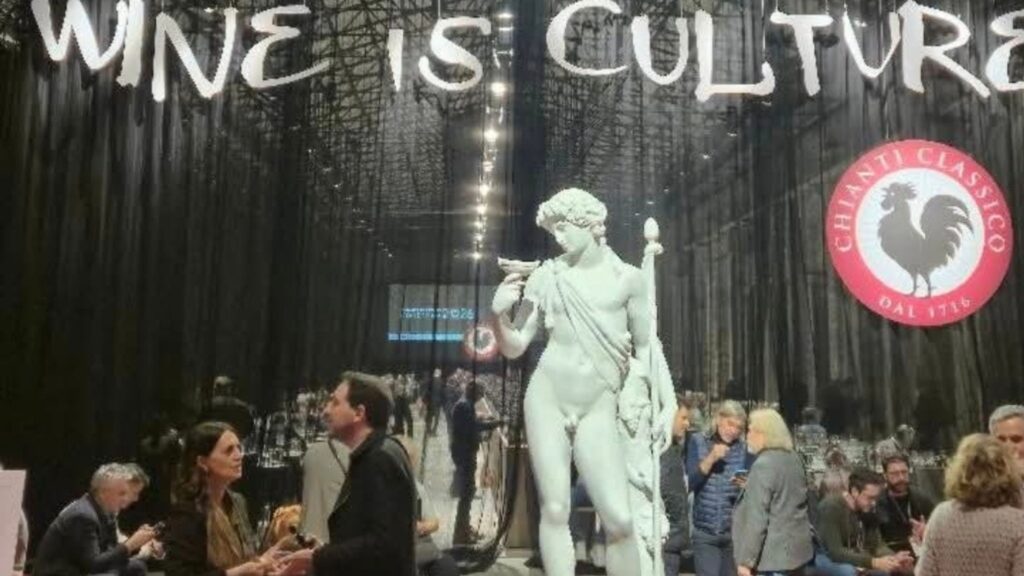
The annual wine-tasting event returned to Florence this February with a powerful message: wine is culture. On February 16 and 17, 2026, the 33rd Chianti Classico Collection opened its doors at the historic Stazione Leopolda, bringing together 223 wineries presenting their latest vintages to the press, industry professionals, and wine enthusiasts.
The tastings focused on three key tiers of Chianti Classico DOCG, each corresponding to its required aging period:
• Chianti Classico Annata 2024
• Chianti Classico Riserva 2023 and 2022
• Gran Selezione wines from multiple vintages
This year’s theme, “Wine Is Culture,” is grounded in historical reality rather than philosophy. Since 1716, when the denomination’s official boundaries were first defined, Chianti Classico has been a region where wine directly expresses centuries of cultural evolution.
Medieval disputes between Florence and Siena – followed by the flourishing Renaissance beginning in the 14th century – left this territory with an extraordinary architectural and cultural legacy. Defensive fortresses gradually evolved into elegant villas and noble residences, while more than 150 historic farmhouses continue to dot the countryside.
Precious artifacts, archival documents, agricultural structures, and curated tree collections offer further insight into the region’s long-standing agricultural traditions. From medieval Siena to Renaissance Florence, the Chianti hills connect two symbolic capitals through a landscape rich in protected heritage sites. Today, more than 300 cultural landmarks populate the region and its surrounding countryside.
This cultural wealth has been cultivated and safeguarded over centuries, creating a rare sense of belonging and custodianship within an agricultural area that remains economically vital. The commitment to conserving and transmitting this heritage continues today, with winegrowers serving not only as agricultural producers but also as environmental stewards and custodians of collective cultural assets.
In Chianti Classico, wine represents far more than an agricultural product. It is the result of a complex network of history, landscape, rural architecture, inherited knowledge, and shared vision. Few wine regions embody this relationship more clearly. Here, wine is not separate from culture – it is an integral, living part of everyday life.
The Collection’s Numbers
The scale of the Chianti Classico Collection illustrates the denomination’s vitality. The event featured 551 labels, including 165 Chianti Classico Riserva wines and 163 Gran Selezione wines.
These premium categories now represent 43% of production volume and 55.2% of value, highlighting the denomination’s continued movement toward higher-value wines.
The event also celebrated the region’s “green gold” – Chianti Classico DOP olive oil.
Visitors sampled 32 different olive oils at a dedicated tasting counter, while six producers hosted their own stands throughout the exhibition hall.
The Collection partnered with prominent Italian food and wine producers through Associazione Origin, bringing together several of Italy’s most iconic gastronomic products, including:
• Aceto Balsamico di Modena IGP
• Aceto Balsamico Tradizionale di Modena DOP
• Arancia Rossa di Sicilia IGP
• Burrata di Andria IGP
• Lenticchia di Altamura IGP
• Oliva La Bella della Daunia DOP
• Pane di Altamura DOP
• Parmigiano Reggiano DOP
• Pesca di Verona IGP
• Pomodoro di Pachino IGP
• Riso Delta del Po IGP
Despite an increasingly complex global market environment, the Chianti Classico denomination continued to grow in 2025, gaining more than one percentage point in production volume compared with the previous year. This confirms a positive growth trajectory sustained over the past three years.
The denomination has also seen steady increases in turnover and value, characterized by stable, continuous advancement rather than sudden spikes.
North America continues to lead exports, with the United States and Canada accounting for 49% of export volume.
• The United States increased from 36% to 37% of export volume.
• Canada grew from 10% to 12%, representing a 33% increase.
Both markets demonstrated strong interest in premium styles. In the United States, Chianti Classico Riserva sales grew by 14%, while Gran Selezione increased by 20%. In Canada, consumption of both categories rose by nearly 30%.
European markets also performed strongly. Germany and Scandinavia recorded increases in value terms, aligning with Italy’s approach to more quality-focused consumption.
Sweden stood out in particular, showing growth of nearly 7%, primarily driven by the base Chianti Classico category.
In France, appreciation for Gran Selezione wines increased notably, with both volumes and average prices rising significantly.
Further east, markets such as China, Singapore, and Hong Kong showed growth primarily through increased turnover rather than large volume gains. Nevertheless, the Consorzio’s targeted promotional efforts are establishing a solid foundation for future expansion.
Overall, the Chianti Classico Collection once again served as a vibrant celebration of the passion, craftsmanship, and diversity that define this iconic Italian wine territory.
Discovering Chianti Classico: A Traveler’s Paradise
The Chianti Classico territory offers wine lovers and travelers one of Italy’s most captivating landscapes.
Rolling hills dotted with medieval villages, ancient cypress trees, and weathered stone farmhouses create a setting that has inspired artists and writers for centuries.
Hilltop towns such as Greve, Radda, Gaiole, and Castellina preserve centuries of history through fortified walls, Renaissance palazzos, and cobblestone piazzas where local life unfolds much as it has for generations.
Located between Florence and Siena, the region ranges in elevation from 200 to 800 meters, creating a diverse microclimate ideal for cultivating Sangiovese, the signature grape of Chianti Classico.
The same landscape that produces exceptional wines also creates some of Italy’s most scenic drives. Winding roads pass through oak forests, chestnut groves, and carefully tended vineyards, offering spectacular views throughout the year.
• Spring brings wildflowers and vibrant green vineyards.
• Summer offers long golden evenings perfect for outdoor tastings.
• Autumn transforms the hills into warm tones during harvest season.
• Winter reveals the region’s essential character without the crowds.
Wine tourism in Chianti Classico is highly developed. Visitors can explore restored medieval castles with historic wine cellars, stay at wine estates converted into boutique hotels, or enjoy private tastings with multi-generational family producers.
Many wineries extend their experiences beyond the tasting room, offering:
• vineyard walks with winemakers
• cooking classes featuring local ingredients
• olive oil mill visits
• estate-to-table dining prepared by regional chefs
Whether planning a short tasting visit or a week-long stay, Chianti Classico offers experiences for every level of wine enthusiast – from curious beginners to collectors seeking rare bottles.
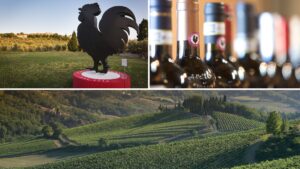
The Black Rooster symbol, which marks every bottle of Chianti Classico, serves as an invitation to discover not just a wine but an entire cultural landscape.
Events such as the Chianti Classico Collection in Florence provide an excellent introduction to the denomination’s diversity. Yet the territory itself remains the true destination – where wine and culture exist inseparably, and every glass reflects centuries of history while remaining vibrantly alive today.
Filippo Magnani