
A New Chapter in Porto’s Wine Tourism Evolution
The Factory House in Porto has opened its doors to visitors for the first time in its 236-year history. Long regarded as one of Europe’s most exclusive wine institutions, the opening represents a rare convergence of heritage preservation and experiential tourism, offering access not simply to a historic building, but to the living infrastructure of the Port wine trade.
Completed in 1790 and overlooking the Douro River, The Factory House has served for more than two centuries as the ceremonial and operational nucleus of the British Port community. Built by British merchants established in Porto since the 17th century, it became the headquarters of what is now the British Association (formally constituted in 1811), an organization that continues to shape the traditions and global positioning of Port wine.
From Closed Institution to Curated Experience
Unlike many historic wine sites that have transitioned fully into museum spaces, The Factory House remains an active institution. It continues to host formal dinners, tastings, and strategic gatherings among its member companies, including Symington Family Estates, ensuring that its opening to the public does not dilute its authenticity.
For wine tourism, this distinction is critical.
Visitors are not entering a reconstructed narrative; they are stepping into a functioning ecosystem where tradition, commerce, and culture continue to intersect. This positions The Factory House within a growing category of “living heritage tourism,” where access is granted without compromising institutional integrity.
Inside the Experience: Architecture, Archives, and Access
The visitor journey is carefully structured to balance exclusivity with accessibility.
Guests can explore:
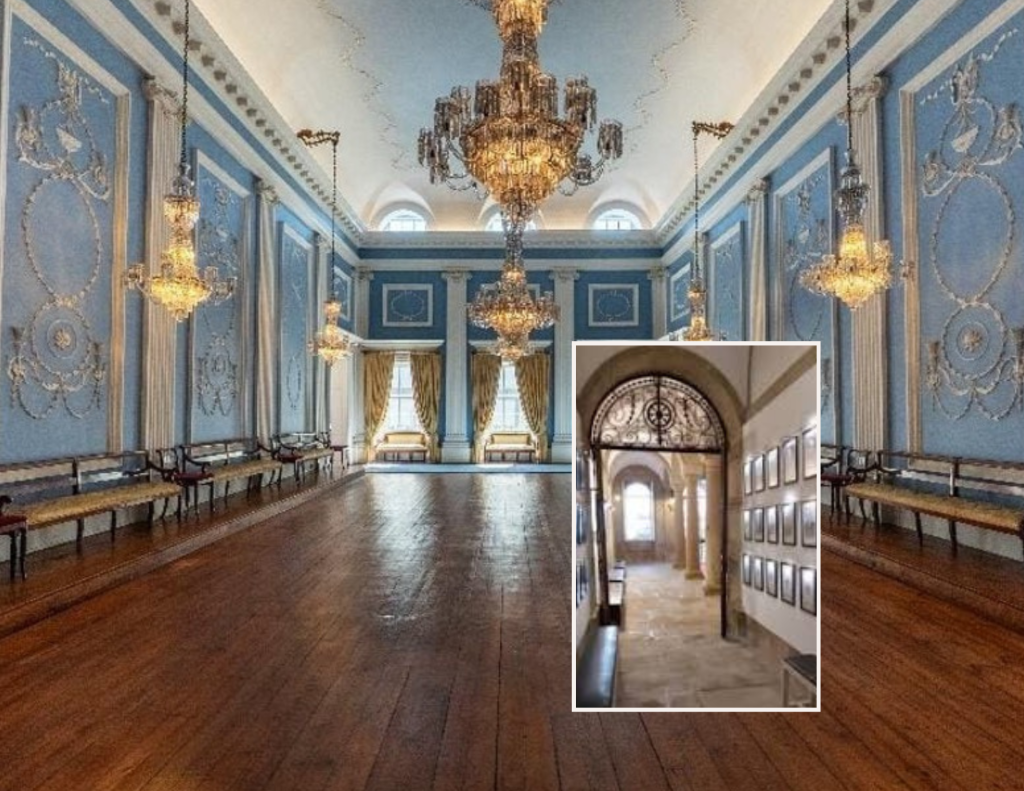
- The Adam-style Ballroom, a refined example of 18th-century neoclassical design
- Historic double dining rooms, still used for formal Port trade gatherings
- An underground cellar that reinforces the House’s connection to production and storage traditions
- A private library containing rare books, maps, and archival documents tracing Portugal’s maritime and commercial history
Among the most notable artifacts is a visitors’ book signed by officers of the Duke of Wellington’s Anglo-Portuguese army following the liberation of Porto in 1809, underscoring the House’s role not only in wine history, but in broader European geopolitical narratives.
Two-Tiered Visitor Model: Scarcity Meets Accessibility
The Factory House offers a dual-format tourism model:
- Guided Morning Experience (Premium Tier)
- Small-group, pre-booked tours
- Tasting of two Vintage Ports drawn from private member stocks
- Wines that are rarely available outside official House events
- Self-Guided Afternoon Visits (Accessible Tier)
- Multimedia storytelling and interpretive displays
- Flexible access to the building’s historic spaces
- Contextual understanding of the Port trade’s commercial and diplomatic frameworks
This tiered approach reflects a broader trend in luxury wine tourism: balancing exclusivity with scalability, allowing destinations to maintain prestige while expanding visitor engagement.
Wine Tourism Significance: Authenticity as Luxury
In a destination increasingly shaped by high-volume tourism and contemporary visitor experiences, The Factory House offers something notably scarce: authentic institutional access.
Rather than focusing on spectacle or modern reinterpretation, the experience is rooted in:
- Continuity of tradition
- Restricted access (historically invitation-only)
- Intellectual and cultural depth
For wine tourism strategists and destination developers, this opening provides a compelling case study in how heritage assets can be activated without being commodified.
A Benchmark for Experiential Wine Tourism
The opening of The Factory House marks a pivotal shift, not only for Porto but for the global wine tourism landscape.
It demonstrates that the future of wine tourism does not necessarily lie in reinvention, but in curated access to authenticity. By allowing visitors into one of the most historically significant institutions of the Port trade, Porto strengthens its position as a destination where wine, history, and culture are inseparable.
Visitor Information
Location: Rua do Infante D. Henrique, 8, Porto
Opening Days: Sunday, Monday, Tuesday, Friday, Saturday
Closed: Wednesday, Thursday
Website: thefactoryhouseoporto.com