
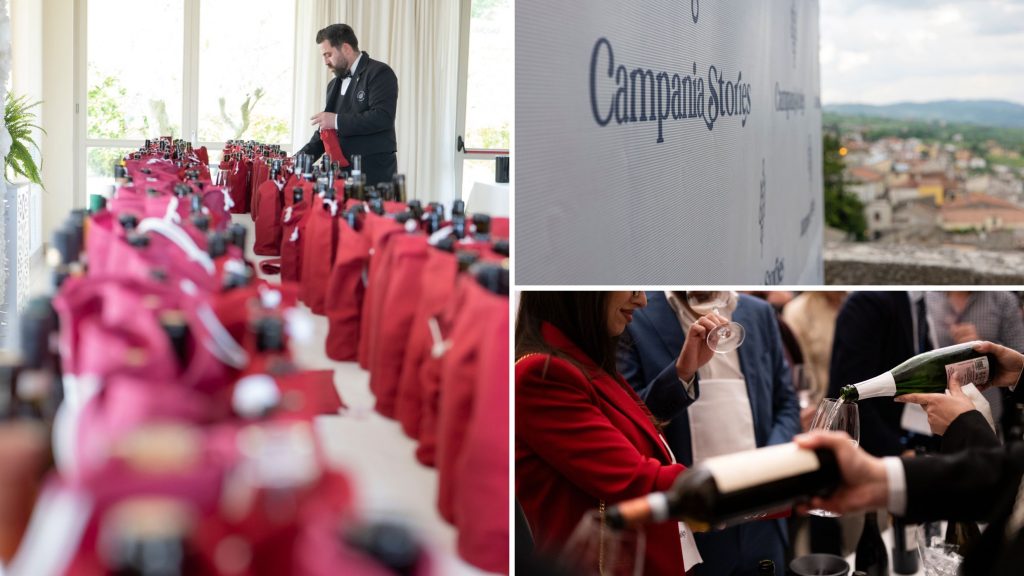
The 2026 edition of Campania Stories ran from 23 to 27 April in Caserta, presenting new vintages from the region’s main appellations to the national and international press. The program opened on 23 April with a guided visit to the Royal Palace of Caserta and an inaugural conference in the Sala Romanelli, followed by two full days of technical tastings at the Vega Palace in Carinaro. Winery visits filled the Sunday, and the week closed on Monday 27 April with Campania Stories Day, a session open to trade professionals and wine enthusiasts by reservation.
The sixteenth edition of the traveling event is organized by Miriade & Partners in collaboration with the participating wineries, with support from Regione Campania, in partnership with AIS Campania and the Consorzio Tutela Vini Caserta VITICA. Tastings were organized by wine type: white, rosé, red and sparkling, giving the press a structured view of each denomination’s new releases.
The Royal Palace of Caserta, commissioned by Charles of Bourbon and designed by Luigi Vanvitelli, covers 47,000 square meters across four inner courtyards and five floors. It is an autonomous museum of the Italian Ministry of Culture and a UNESCO World Heritage Site. Its contemporary art collection, Terrae Motus, was assembled by Lucio Amelio. The Vanvitelli Rooms opened in 2023, marking 250 years since the architect’s death. The Grand Gallery, opened in 2024 by President Sergio Mattarella, currently holds the exhibition “Queens. Threads of culture and diplomacy between Naples and Europe,” featuring over 200 works from across the continent. The Royal Park spans 123 hectares and is fed by the 38-kilometer-long Carolino Aqueduct.
TEN ZONES, ONE REGION
Campania’s wine-growing territory is divided into ten areas, running from north to south across five provinces: Massico-Roccamonfina and Alto Casertano-Terre del Volturno in the province of Caserta; Sannio in the province of Benevento; Irpinia in the province of Avellino; Campi Flegrei and the Campanian Archipelago Islands, Vesuvio and the Sorrento Peninsula in the metropolitan city of Naples; and the Amalfi Coast, Colli Salernitani and Picentini, and Cilento and Vallo di Diano in the province of Salerno.
Irpinia holds three DOCGs: Fiano di Avellino, Greco di Tufo and Taurasi, alongside the Irpinia DOC. The Sannio carries a DOCG for Aglianico del Taburno, a DOC for Falanghina del Sannio, and a broader Sannio DOC. The Campi Flegrei zone groups the DOCs for Campi Flegrei, Ischia and Capri. The Caserta zones cover Falerno del Massico DOC and Galluccio DOC in the Massico belt, and Casavecchia di Pontelatone DOC and Aversa-Asprinio d’Aversa DOC in the Alto Casertano. The south of the region includes Costa d’Amalfi DOC and, in the Cilento, the Cilento DOC and Castel San Lorenzo DOC.
The VITICA Consortium, the territorial partner for 2026, represents Aversa, Falerno del Massico and Galluccio DOCs and the Terre del Volturno and Roccamonfina IGTs. The Consortium describes its mission as protecting native varieties, including Vitis Hellenica, Aminea Gemina and Vitis Apiana, which it states are found exclusively in this area of Caserta.
THE 2025 VINTAGE
The Assoenologi Campania section reported that 2025 saw a return to more regular seasonal patterns after several years of greater variability. Production reached 696,000 hectolitres, up 13% on 2024 and above the five-year average of approximately 582,000 hectolitres.
The winter was mild with limited rainfall. Spring conditions led to early budbreak in parts of Irpinia and Sannio, while Campi Flegrei and Vesuvio developed more gradually. Abundant May rainfall supported even flowering and fruit set. Summer storms brought localized hail to parts of Benevento, Avellino and Salerno, though damage was geographically contained. Disease pressure across the region was low.
Whites — Fiano, Greco and Falanghina — produced wines with regular ripening, sustained acidity and strong aromatic profiles. The reds, including Aglianico and Taurasi, show good color concentration, evolved tannins and a structure the Assoenologi report describes as well suited to aging.
WINE TOURISM IN CAMPANIA
Campania rewards visitors who move beyond Naples and the coast. The five provinces offer distinct wine landscapes, and most producers listed in the 2026 Campania Stories booklet accept visitors, the majority by appointment.
The province of Avellino is the most established wine-travel destination. Irpinia’s hill towns, including Lapio, Tufo, Montefredane and Castelfranci, sit between 300 and 650 meters, and the drives between them pass through vines on steep clay and volcanic soils. The three Irpinia DOCGs (Fiano di Avellino, Greco di Tufo and Taurasi) make for a natural itinerary: whites in the morning, a Taurasi cellar in the afternoon. The town of Tufo, built partly over sulfurous ground, has a character found nowhere else in the region.
The province of Benevento is less visited and offers a different pace. The Taburno massif, which rises to over 1,000 meters, frames the vineyards of the Sannio. Falanghina thrives on the clay-limestone soils at 300 to 600 meters, and Aglianico del Taburno DOCG makes structured reds from grapes harvested in October. Guardia Sanframondi, a hill town in the heart of the zone, makes a useful base.
In Caserta, the two wine zones each have their own pull. The Aversa plain, just north of Naples, is where Asprinio d’Aversa grows on century-old vines trained up trees in the alberata aversana system. The Monti Trebulani, in the Alto Casertano, sit at up to 350 meters and produce Pallagrello Bianco, Pallagrello Nero and Casavecchia. The Royal Palace of Caserta, the English Garden and the Le Serre di Graefer restoration project give the province strong non-wine anchors for a longer stay.
The metropolitan city of Naples encompasses three distinct wine regions: the Campi Flegrei volcanic zone west of the city, the islands of Ischia and Capri, and the slopes of Mount Vesuvius. The Campi Flegrei offers the unusual experience of tasting Falanghina and Piedirosso grown on volcanic sand, within the city boundary. Ischia’s steep terraced vineyards above the sea produce Biancolella from vines listed at up to 30 years old in the tasting booklet. Winery visits in this province often easily combine with the other reasons most visitors already have for being in Naples.
The province of Salerno stretches from the Amalfi Coast to the Cilento. The Costa d’Amalfi DOC covers vineyards grown at up to 550 meters on coastal terraces, with harvests running into late October. Furore and Ravello are the main communes for wine visits on the coast. Further south, the Cilento and Vallo di Diano offer a slower form of wine tourism, with fewer visitors and a deeply rural landscape.
CASERTA AND THE PROVINCE
The Royal Palace and its gardens are the starting point for any visit to Caserta. The English Garden, commissioned by Maria Carolina of Austria, sits within the park and combines artificial ruins, the Cryptoporticus and exotic plant species. Since 2024, the Le Serre di Graefer project has restored the palace’s historic production spaces, turning them into a hub for cultural production and botanical sustainability.
The province has a long wine history. Asprinio d’Aversa is produced from vines trained in the alberata aversana system, with some vineyards listed at one hundred years of age in the tasting booklet. The Monti Trebulani, referenced by several Caserta producers as the source of their fruit, sit in the Alta Campania at elevations between 150 and 350 meters. Winery visits are available across the province, with most participating Caserta producers receiving guests by appointment.
PRODUCER PROFILES
ALOIS www.vinialois.it
Founded in 1992 by Michele Alois, this estate in Pontelatone sits at an elevation of 148 meters on pozzolanic and ignimbrite soils in the Alto Casertano. Ten hectares produce around 160,000 bottles a year, with Pallagrello Bianco and Casavecchia as the core varieties. The Caiatì, a Pallagrello Bianco fermented in stainless steel, comes from 25-year-old vines on the Audelino hill. The Morrone, sourced from higher Monti Trebulani vineyards at 350 meters, spends part of its aging on fine lees in wood. The Trebulanum is a Casavecchia di Pontelatone DOC Riserva aged 24 months in large Italian oak, then a further 24 in bottle. Visits are available by appointment.
CAPUTO 1890 www.caputo1890.it
The Caputo family has produced wine in Teverola, in the Aversa plain, since 1890. Thirteen hectares of Asprinio vines, some listed as over a century old, grow on volcanic tufa-yellow soil at sea level in the alberata aversana training system. The estate produces around 145,000 bottles annually and makes two distinct expressions of the grape: the Fescine, a still Aversa DOC Asprinio vinified in stainless steel; and the Caputo, a Metodo Classico sparkling wine that spends 48 months on its lees, with the 2026 release drawn from the 2021 tiraggio. Winemaker Fabio Mecca oversees production. The estate accepts visitors and sells direct.
AIA DEI COLOMBI www.aiadeicolombi.it
Marcellino Pascale founded this estate in Guardia Sanframondi in 2002. Twelve hectares of vines sit at 250 to 300 meters on clay-loam soils in the Sannio, producing around 60,000 bottles a year. The focus is on Falanghina and Barbera, both grown in the Guardia Sanframondi subzone. The Vignasuprema is a Falanghina del Sannio DOC, Guardia Sanframondi, aged for 10 months in stainless steel with bâtonnage. The Sannio Barbera is a single-variety red from eight-year-old vines, macerated for 15 days and aged in steel. Winemaker Marco Giulioli oversees production. The estate receives visitors by reservation and sells direct.
FONTANAVECCHIA www.fontanavecchia.info
Libero Rillo established Fontanavecchia in Torrecuso in 1980. The estate works 21 hectares, 18 of which are owned, in the Taburno subzone of the Sannio. Annual production averages 180,000 bottles. Winemaker Emiliano Falsini oversees a range built around Falanghina del Sannio, Coda di Volpe, Piedirosso and the three tiers of Aglianico del Taburno DOCG. The TabaRosso and Orazio are the entry-level and mid-range Aglianicos, aged respectively in large wood and steel before extended bottle rest. The Riserva Vigna Cataratte, from a single vineyard in Torrecuso at 300 meters, spends 18 months in French oak barriques and a minimum of two years in bottle before release. The estate visits by appointment and sells direct.
ROCCA DEL PRINCIPE www.roccadelprincipe.it
Aurelia Fabrizio founded this small estate in Lapio in 2004. Nine hectares of vines, farmed across 18 hectares of owned land, grow at 550 to 580 meters on clay-limestone and volcanic ash soils in the Fiano di Avellino zone. Production averages 45,000 bottles, exclusively from Fiano. Winemaker Simona Zarrella produces two expressions: the Versante d’Ercole, a standard Fiano di Avellino DOCG from the Arianiello hillside, aged 11 months in stainless steel; and the Tognano Riserva, from a 35-year-old single vineyard at 580 meters in the Tognano contrada, aged 15 months in steel and 15 months in bottle.
TENUTE CAPALDO / FEUDI DI SAN GREGORIO www.feudi.it
Founded in 1986 by Antonio Capaldo, Feudi di San Gregorio is based in Sorbo Serpico and works 350 hectares across Irpinia. Annual production reaches approximately 3,500,000 bottles. Winemaker Pierpaolo Sirch oversees a full range of Irpinia DOCGs. The Cutizzi is a Greco di Tufo DOCG Riserva from 30-year-old vines in Santa Paolina at 430 meters, aged 12 months in steel. The Goleto, a single-vineyard Greco di Tufo Riserva from the Tufo contrade, is vinified in a combination of steel, barrique and amphora, then aged 12 months in bottle. The Taurasi Vallicelli comes from 60-year-old vines in Castelfranci at 600 to 630 meters. The estate accepts visits and sells direct.
AGNANUM www.agnanum.it
Raffaele Moccia founded Agnanum in 2002. The estate covers 20 hectares, 17 of which are owned, on volcanic sandy soils in Napoli and Pozzuoli, within the Campi Flegrei DOC zone. Vines exceed 100 years of age. Annual production is around 30,000 bottles. Winemaker Carmine Valentino produces Falanghina and Piedirosso under the Campi Flegrei DOC, as well as a Campania IGT blend called Sabbia Vulcanica, which combines Falanghina with Catalanesca, Caprettone and Moscato in the white version, and Piedirosso with Barbera Classico Napoletano and Marsigliese in the red. All wines are vinified and aged in stainless steel.
CANTINE ASTRONI www.cantineastroni.com
The Varchetta family founded Cantine Astroni in 1999. The estate covers 25 hectares, 13 of which are owned and 12 under management, on volcanic sandy soils in Naples. Annual production averages 150,000 bottles. Winemakers Gerardo Vernazzaro and Vincenzo Varchetta produce Falanghina and Piedirosso under the Campi Flegrei DOC across several vineyard sites. The Colle Imperatrice Falanghina comes from a 2.8-hectare plot at 150 meters, farmed on ungrafted vines at 4,000 plants per hectare. The Cru Vigna Astroni, grown adjacent to the 18th-century Bourbon hunting reserve wall, is one of the estate’s flagship wines. The Tenuta Jossa is a Campi Flegrei Bianco from Falanghina grown at 200 to 290 meters on the Camaldoli hill. The estate accepts visits and sells direct.
ETTORE SAMMARCO www.ettoresammarco.it
Ettore Sammarco established this family estate in Ravello in 1962. Twelve hectares of vines, four of them owned, grow at up to 500 meters on sandy-clay soils of volcanic origin along the Costa d’Amalfi. Annual production averages 70,000 bottles. Winemaker Bartolo Sammarco works with local varieties including Biancolella, Biancazita, Ginestrella, Falanghina, Aglianico and Piedirosso across the Costa d’Amalfi DOC Ravello subzone. The Selva delle Monache Bianco, a blend of Biancolella, Biancazita and Falanghina, is fermented in steel. The Vigna Grotta Piana Bianco, from century-old vines in a single Ravello vineyard at 500 meters, is split between steel and barrique for fermentation. The Selva delle Monache Rosso Riserva, from century-old Aglianico and Piedirosso, ages 20 months in 500-liter tonneaux. The estate accepts visitors and sells direct.
MARISA CUOMO www.marisacuomo.com
Founded in 1980, Marisa Cuomo is based in Furore on the Amalfi Coast. The estate works 20 hectares, 8 of them owned, on coastal terraces at 200 to 550 meters. Vineyards are planted with century-old vines on dolomitic limestone rock. Annual production reaches 200,000 bottles. Winemaker Andrea Ferraioli, working with consultant Luigi Moio, produces wines exclusively under the Costa d’Amalfi DOC Furore subzone. The Fiorduva Bianco is a blend of Ripoli, Ginestra and Fenile, fermented in French oak barriques and aged a further six months in wood before 12 months in bottle. The Furore Rosso Riserva blends 50% Aglianico and 50% Piedirosso from century-old terraced vines. Harvest runs into the third week of October. The estate accepts visits and sells direct.
Filippo Magnani