Champagne Telmont: Where Heritage Meets the Future of Sustainable Champagne + Wine Review

 Champagne is a region built on centuries of tradition, but every so often, a house emerges that doesn’t just update the rule book; it edits the whole document. Telmont, the organically driven, sustainability-obsessed house from Damery, is one of the most compelling modern narratives in Champagne today. With a history that stretches back more than a century and a present that leans confidently into ecological transformation, Telmont stands at the crossroads of heritage and next‑generation innovation.

A Champagne House Born in 1912 and Reborn in the 21st Century

Telmont was founded in 1912, when winegrower Henri Lhôpital established a small estate rooted in traditional Champagne viticulture. For much of the 20th century, the family-built maison remained a local, agriculture‑focused producer, known for meticulous vineyard work and precise blending.

The plot twist arrived in 2020, when Telmont received significant support from partners aligned with its environmental mission, including an investment from actor and environmental advocate Leonardo DiCaprio in 2022. Rather than pivot toward celebrity gloss, Telmont doubled down on its ecological commitments. By 2025, the house had emerged as one of Champagne’s most resolute voices in sustainability, championing:

  • Organic certification for 100% of its vines (a multi‑year transition nearing completion)
  • Zero unnecessary packaging
  • Full transparency in labelling
  • Renewable energy integration
  • A “leave no trace” approach across production and the supply chain

This ethos has earned Telmont a devoted following among sommeliers, collectors, and environmentally conscious drinkers, including the sustainably minded Gen Z audience, who treat vineyard biodiversity with the same reverence earlier generations reserved for luxury labels.

Location

Telmont’s home village of Damery sits in the Vallée de la Marne, west of Épernay. Historically dominated by Meunier, the region benefits from clay‑rich soils and cooler ripening conditions that allow the grape to express freshness and aromatic precision.

The estate farms vineyards in Damery as well as parcels in nearby villages, including Cumières, Hautvillers, and Boursault, creating a diverse mosaic of chalk, clay, sand, limestone, and flint soils. This range enables Telmont to craft blends that emphasize finesse, lift, and orchard‑fruit purity.

Damery itself offers a humble, pastoral counterpoint to Champagne’s grander tourism hubs. It is a village where winemakers still know their neighbours, tractors hum through the early morning light, and the Marne River glints softly between vineyard slopes.

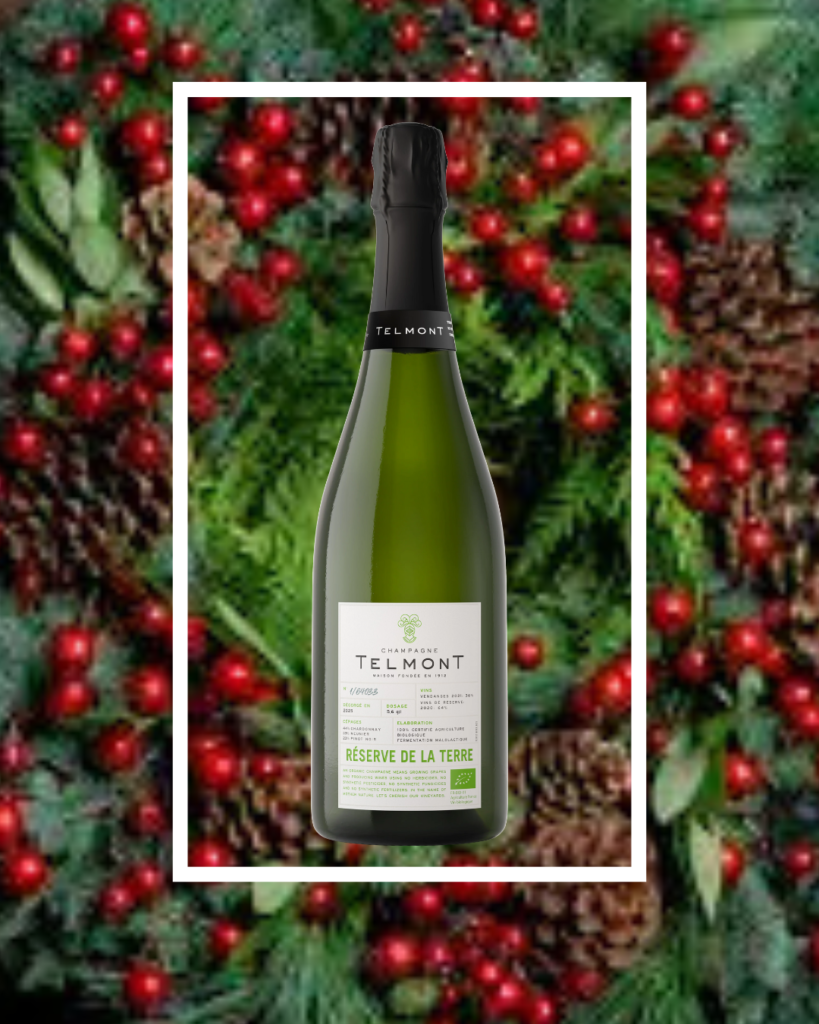
Telmont Réserve Brut – Wine Review

No. 145037/312589
Disgorged in 2024
Dosage 3.4 g/l
40% Chardonnay
29%Meunier
31% Pinot Noir
Extra Brut

The Réserve Brut is Telmont’s thesis statement: a Champagne that foregrounds orchard fruit, chalk‑driven minerality, and winemaking restraint.

Appearance: A luminous golden hue with fine, persistent bubbles and an elegant mousse.

Aromas: Pear, apple, and peach, layered with hints of honeysuckle and almond.

Palate: Crisp apple and citrus notes intertwine with delicate brioche, supported by precise, refreshing acidity. The mousse is refined and persistent, carrying a mineral thread from start to finish.

Finish: Long, harmonious, and mineral‑driven, with lingering notes of candied fruit and citrus that echo the Vallée de la Marne’s signature finesse.

This is a Champagne that feels effortlessly composed, akin to a minimalist painting where every brushstroke matters.

92 Points
Liz Palmer

There are many reasons why I chose Champagne Telmont as one of my holiday favourites, including their wines’ favouring clarity over artifice, vineyard truth over marketing gloss, and ecological health over short-term convenience. In 2025, that stance resonates with a global audience seeking luxury aligned with values.

This house bridges Champagne’s agricultural past with its environmentally conscious future, proving that sustainability is not a trend, but a pathway to deeper, more authentic expression.

European Wine Tourism Index 2025: Ranking Europe’s Leading Wine Destinations

Wine tourism represents one of the fastest-growing segments of global cultural and experiential travel. According to a recent survey by TUI Musement, more than 91% of respondents expressed interest in wine-related travel, with the highest engagement among travellers aged 18 to 44. Responding to this demand, and coinciding with Europe’s harvest season, TUI Musement has introduced the inaugural “European Wine Tourism Index 2025,” the first data-driven ranking of Europe’s most attractive destinations for wine tourism.

Unlike perception-based surveys, the Index employs quantitative data and official registries to assess both viticultural heritage and tourism potential. By combining traditional measures of production with indicators of cultural recognition and international prestige, the Index provides a comparative framework for understanding the evolving dynamics of Europe’s wine tourism map.

Methodology

The Index evaluates European Union member states (with a minimum vineyard area of 500 hectares) across five weighted categories:

Vineyard surface area (20%)

Vineyard land dedicated to PDO and PGI wines (30%)

Number of registered PDO/PGI wines (20%)

Total wine production volume (10%)

International awards received (20%)

Data sources include Eurostat, the International Organisation of Vine and Wine (OIV), official EU registries, and the Decanter World Wine Awards 2025. Scores were calculated using a weighted average, providing an objective reflection of both wine heritage and global recognition.

The Results – Europe’s Top 10 Wine-Producing Countries

  1. France (Score: 85.2/100)

France secures first place with unparalleled prestige, the highest number of international awards, and a vast network of PDO regions.

Key regions: Bordeaux, Burgundy, Champagne

Highlights: Bordeaux’s château tours, Burgundy’s 1,000+ climats (vineyard plots) inscribed by UNESCO, Champagne’s historic underground cellars.

Experiences: Private vintage tastings, vineyard drives through Bordeaux in classic cars, cellar tours beneath Épernay’s Avenue de Champagne.

  1. Italy

Italy ranks second as Europe’s largest wine producer and the continent’s leader in PDO/PGI registrations.

Key regions: Tuscany, Piedmont, Veneto

Highlights: Tuscany’s Chianti and Brunello di Montalcino; Piedmont’s UNESCO-listed Langhe-Roero vineyards; Veneto’s iconic Prosecco hills.

Experiences: Chianti tasting with artisanal oils and balsamic vinegar, Prosecco tours in Veneto, vineyard walks in Monferrato.

  1. Spain

Spain, home to the largest vineyard area in Europe (909,367 hectares), ranks third, with 97% dedicated to PDO/PGI wines.

Key regions: La Rioja, Ribera del Duero, Rías Baixas, Jerez

Highlights: Ribera del Duero’s bold reds, volcanic viticulture in Lanzarote’s La Geria, and cava production in Penedès.

Experiences: La Rioja winery tours, sherry tasting in Jerez, vineyard hikes across volcanic landscapes.

  1. Portugal

Portugal earns fourth place through its internationally awarded wines and unique terroirs.

Key regions: Douro Valley, Alentejo, Vinho Verde

Highlights: UNESCO-listed Douro terraces, Alentejo’s bold red wines, crisp whites of Vinho Verde.

Experiences: River cruises with quinta tastings, traditional Algarve wine trails, and immersive tours of fortified Port cellars.

  1. Greece

Greece combines millennia-old heritage with an extraordinary diversity of indigenous grape varieties.

Key regions: Macedonia, Peloponnese, Santorini

Highlights: Assyrtiko from Santorini’s volcanic soils, Agiorgitiko from Nemea, and Xinómavro from northern Macedonia.

Experiences: Sunset tastings in Santorini, Peloponnesian winery tours, Crete’s wine-and-food pairings.

  1. Germany

Germany places sixth, globally celebrated for its Rieslings and scenic river-valley vineyards.

Key regions: Mosel, Rheingau, Pfalz

Highlights: Steep Mosel slopes, Rheingau’s historic Spätlese birthplace, Palatinate’s iconic Bad Dürkheim wine barrel.

Experiences: Vineyard cycling tours, river cruises with Riesling tastings, heritage wine festivals.

  1. Romania

Romania ranks seventh, drawing on deep winemaking traditions dating to antiquity.

Key regions: Transylvania, Muntenia (Dealu Mare), Dobrogea

Highlights: Fetească varietals of Transylvania, powerful reds from Dealu Mare (“Romania’s Tuscany”), and sweet wines from Dobrogea.

Experiences: Castle-linked vineyard visits, Black Sea coastal tastings, immersive food-and-wine tours from Bucharest.

  1. Hungary

Hungary, in eighth place, is synonymous with sweet wines of global renown and increasingly recognized reds.

Key regions: Tokaj, Eger, Villány

Highlights: Tokaji Aszú (UNESCO World Heritage), Eger’s “Bull’s Blood” (Bikavér), Villány’s full-bodied reds.

Experiences: Cellar visits in Tokaj, historic vineyard tours, and urban wine tastings in Budapest.

  1. Austria

Austria’s 46,000 hectares of PDO vineyards demonstrate exceptional quality control.

Key regions: Wachau Valley, Burgenland, Vienna

Highlights: Wachau’s UNESCO terraced landscapes, Grüner Veltliner and Riesling, and Vienna as Europe’s only capital city with significant vineyards.

Experiences: Danube wine cruises, half-day vineyard tours from Vienna, Burgenland’s botrytized dessert wines.

  1. Bulgaria

Bulgaria completes the top 10 with a wine history dating to ancient Thrace.

Key regions: Thracian Valley, Struma Valley, Danube Plain

Highlights: Mavrud-based reds, Mediterranean-influenced wines of Struma, and fresh Danubian whites.

Experiences: Vineyard tours of Nessebar, tastings in the Thracian Valley, and Black Sea wine routes.

The inaugural European Wine Tourism Index 2025 reaffirms Europe’s enduring role as the global centre of wine tourism. While traditional powers such as France, Italy, and Spain remain dominant, the emergence of destinations like Romania, Hungary, Austria, and Bulgaria signals an expanding and diversifying wine tourism map.

This Index provides both travellers and industry stakeholders with an authoritative framework for understanding Europe’s viticultural landscape, linking heritage with tourism potential, and mapping future opportunities for sustainable growth.