The Michelin Guide Expands Its Expertise in Recommendations and Introduces a New Distinction in the World of Wine

For 125 years, the MICHELIN Guide has celebrated places and talents that embody excellence in gastronomy and hospitality, with the MICHELIN Stars introduced in 1926 and the MICHELIN Keys launched in 2024. This expertise now naturally extends to wine, a key reference in the gastronomic experience. The MICHELIN Guide has long highlighted exceptional wine lists and sommeliers, notably through the ‘wine’ pictogram created in 2004 to distinguish outstanding food and wine pairings. In 2019, the MICHELIN Sommelier Award was introduced to honour professionals whose expertise enhances the guest experience through exemplary mastery of wine selection and service.

The MICHELIN Grape, MICHELIN Guide’s new distinction, will now spotlight wine estates across different regions of the world. It will assess their overall excellence based on five universal criteria applied consistently.

Gwendal Poullennec, International Director for the MICHELIN Guide, explains:

” After having oriented wine-lovers towards the finest tables in more than 70 destinations and to the world’s most elegant hotels, the MICHELIN Guide is delighted to open a new chapter with the world of wine. This new reference is designed for both the curious amateur and the most ardent expert – it rewards the men and women who are building the most demanding vineyards around the world.” 

The MICHELIN Grapes: a new reference for discovering and showcasing wine-growing talent

In the world of wine, the MICHELIN Guide rewards not only the vineyards but also the men and women who personify them. With this new distinction, the Guide will be using a strict and independent methodology – it will also provide wine-lovers with a trusted benchmark: Grapes 1, 2 or 3 and, additionally, a selection of recommended vineyards.

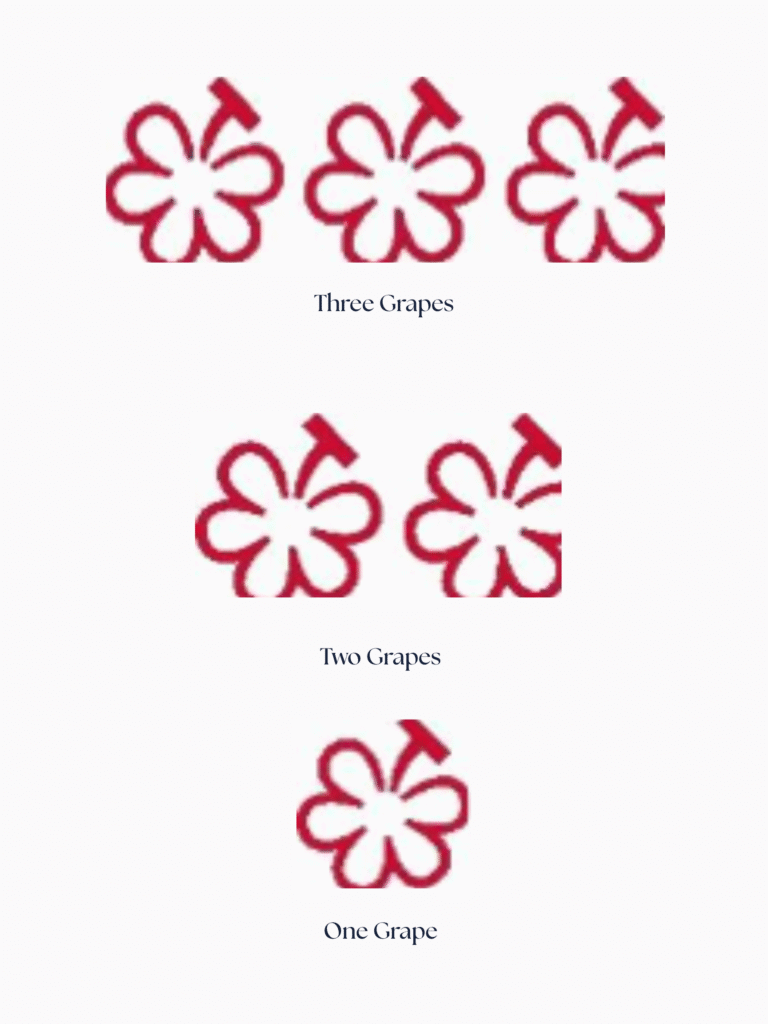
  Three Grapes

Exceptional producers. Whatever the vintage, wine lovers can turn to the estate’s creations with complete confidence.

  Two Grapes

Excellent producers who stand out as exceptional within their peer group and region for both quality and consistency.

One Grape

Very good producers who craft wines of character and style, especially in the best vintages.

Selected 

Dependable producers who have been chosen for regular review, producing well-made wines that deliver a quality experience.

Here is the methodology based on 5 criteria: 

For its new distinction, true to its fundamental values of excellence and independence, the MICHELIN Guide applies five criteria uniformly and wherever it may be.

  1. The quality of agronomy
    The assessment evaluates the vitality of the soil, the balance of the vine stocks, as well as the care provided for the vines. All essential factors that directly influence wine quality.
  2. Technical mastery
    The evaluation focuses on the technical skills in the wine-making process. Our inspectors are seeking precise and rigorous wine-making processes producing well-developed wines which reflect the terroir and the vine types, without any distracting flaws.
  3. Identity
    The Guide will highlight winemakers who craft wines that express the personality, the sense of place, and the culture behind them.
  4. Balance
    Evaluation of the harmony between acidity, tannins, oak, alcohol, and sweetness.
  5. Consistency 
    Wines will be evaluated across multiple vintages to ensure unwavering consistency in quality, even in the most challenging years. The Guide celebrates wines that reveal greater depth and excellence as time goes by.

    Expertise at the heart of the assessments 

Future selections will rely on the expertise of dedicated wine inspectors, all professionals employed by the Michelin Group. This team, which makes its recommendations collectively and with complete independence, will bring together seasoned wine specialists and newly recruited inspectors.

All team members have been selected not only based on their qualifications, but also on their ability to assess a vineyard with rigour and integrity. They are all seasoned professionals in the sector, i.e., former sommeliers, specialized critics or production experts, all bringing concrete and in-depth experience of the wine-producing world to the team.

Their assessments follow a rigorous methodology, including a panel review process and editorial supervision.

In 2026, the MICHELIN Grapes adventure will be writing its initial chapter in the heart of two mythical French wine-producing areas: Burgundy and the Bordeaux region

The MICHELIN Grapes project will start with two regions among the most emblematic in the worldwide wine-producing landscape: Burgundy and the region around Bordeaux. A compelling choice, celebrating the diversity, the historical intensity and the cultural richness of wine à la française.

Over the centuries, Bordeaux has established itself as a historic force in the world of wine. Its distinguished vineyards and their reputation go far beyond our borders.  The entire prestigious Bordeaux region is renowned throughout the world for its innovations and its traditions.

Burgundy, for its part, differentiates itself by its approach, deeply rooted in the local heritage. Its human-sized, family-owned vineyards reflect rigorous traditions and care imposed at each stage in the production process. From generation to generation, legacies have curated the local identity and forged the worldwide reputation of Burgundy.

Stay tuned in 2026 for the very first selections of the MICHELIN Grapes.

The Best Hotel Wine Cellars in North America according to MICHELIN Guide

Wine has long been intertwined with the art of hospitality, yet a select number of hotels elevate the experience to the highest level by curating world-class cellars that rival esteemed restaurants and private collections. According to MICHELIN Guide, these properties redefine the concept of luxury lodging, offering immersive oenological journeys that appeal to both seasoned connoisseurs and aspiring enthusiasts.

At these destinations, wine is not simply an accompaniment to a fine meal; it is the foundation of the entire stay. Guests may encounter sommeliers who serve as personal guides, expansive cellars that read like encyclopedias of viticulture, and opportunities to pair rest with rare vintages.

From California’s iconic Cabernet Sauvignon estates to the refined lakeside retreats of Québec, these hotels embody the essence of wine tourism in North America. They serve as cultural crossroads, blending terroir, tradition, and innovation into an experience that extends beyond the bottle.

Rosewood Miramar Beach, Montecito, California

This Two-MICHELIN-Key resort looks and feels like a posh summer home. It’s fitting then that Caruso’s isn’t just a MICHELIN-Starred and Green Star restaurant with an ocean view—it’s also home to one of Southern California’s most extravagant wine cellars, stocked with 22,000+ bottles and a serious Burgundy collection. The sommelier team is armed with rare verticals and white gloves, and you’ll find that most guests here dress for dinner, even if they’re just heading downstairs, or opting to enjoy from their suite. Also located at Rosewood Miramar Beach? AMA Sushi with edomae-style sushi, available à la carte or as an omakase.

Rosewood Miramar Beach Wine Cellar, Napa Valley, California

A 15,000-bottle cellar. Lunch overlooking the Rutherford vines. And a wine list that reads like the Napa Valley Book of Genesis. This Three-MICHELIN-Key resort with a MICHELIN-Starred restaurant of the same name doesn’t shout — it purrs, in silky Bordeaux and well-structured Chardonnay. Whether you’re toasting at the bar or reclining in a vineyard-view suite, every sip is a reminder that heaven might just be spelled C-A-B.

SingleThread Inn, Sonoma, California

SingleThread is a unicorn; it’s a Three-MICHELIN-Key hotel with a Three-MICHELIN-Star and Green Star restaurant tucked inside. Here in this culinary sanctuary, dinner unfolds like a symphony, and the wine pairings are its most delicate movement. Located in California’s Wine Country, the inn’s cellar is both impressive and intimate; designed not just to dazzle, but to deepen your understanding of the bottle in front of you. Expect somm-led education, rare local vintages and a breakfast that might just come with a splash of Pét-Nat.

The Little Nell, Aspen, Colorado

Come for the snow, stay for the Pinot Noir. The One-MICHELIN-Key Little Nell may be best known for ski-in, ski-out luxury and its Element 47 restaurant, but oenophiles know it for its award–winning wine cellar: over 20,000 bottles deep, with verticals that rival some European royalty. Prefer your wine with altitude? Book a sommelier-led ski tour, complete with slope-side sabrage. Yes, really.

The Inn at Little Washington, Washington, D.C.

This spot is in a sleepy little town outside of Washington, D.C., but just happens to be home to the region’s only Three-MICHELIN-Star and Green Star restaurant. The dining room is like a Versailles fever dream, and the wine cellar could double as a museum. At Patrick O’Connell’s countryside fantasy, the wine program is an experience unto itself, with deep French and American verticals, pairing flights that border on spiritual and tours that feel like a pilgrimage. You’ll sleep well—but not before a Château d’Yquem nightcap.

Post Hotel & Spa, Lake Louise, Canada

You’ll come for the glacial views and stay for the cellar, which spans more than 22,000 bottles. Discover rare vintages, winemaker dinners and private tastings—all housed in this MICHELIN-Key alpine lodge. It’s the kind of place where après-ski means Amarone, and the wine cellar is deeper than the snowpack.

Manoir Hovey, Québec

Québec’s most refined country escape comes with a serious side of vin. The Two-MICHELIN-Key Manoir Hovey houses a 15,000-bottle cellar and leans proudly into local pairings, offering Québécois wines you won’t find at your downtown wine bar. Book a table at Le Hatley for fine dining or Le Tap Room for a more casual setting. It’s as much about terroir as it is about taste—and yes, there’s foie gras involved.

As wine tourism continues to flourish globally, the MICHELIN Guide’s recognition of these hotels underscores a growing trend: travellers no longer seek only a destination, but a holistic experience that marries luxury, culture, and vinous discovery.

Source:  MICHELIN Guide

Michelin Guide Acquires Robert Parker’s Wine Advocate

Michelin bought a 40% stake in the Wine Advocate back in 2017 and their full commitment to expanding into wine was realized this year. Nicolas Achard, CEO of Wine Advocate and as Managing Director of Michelin Experience Asia, announced last Friday in New York, with respect to full ownership, “We got to know each other for the past two years before we decided to complete the acquisition and we realized that Michelin and the Wine Advocate had the same culture in regards to the importance of their independence [from the restaurants/hotels and wineries they are reviewing].”

Achard further states that both companies also follow a rigorous methodology when it came to giving Michelin stars or Robert Parker Wine Advocate scores.  He goes on to say “Leading RPWA’s passionate teams is not only thrilling, but also an incredible opportunity to combine the strengths of the Michelin Guide and The Wine Advocate.”

The full integration would ensure, “long-term synergies between oenology and gastronomy through the pursuit of experiences based on food and wine pairing, as well as the creation of new digital content and services”.