
AI is fundamentally reshaping how travellers discover, plan, and experience food and wine tourism. This transformation is particularly pronounced among younger generations, as evidenced by findings from the Italian Food and Wine Tourism Report 2025.
This report, published by the Italian Association of Food and Wine Tourism (AITE) and curated by Professor Roberta Garibaldi, highlights AI’s growing role as a core decision-support tool for travellers seeking inspiration, personalization, and efficiency in trip planning. For many younger tourists, AI is no longer perceived as innovative or experimental, but rather as an integral and routine part of travel preparation.
Generational Shifts in AI Adoption
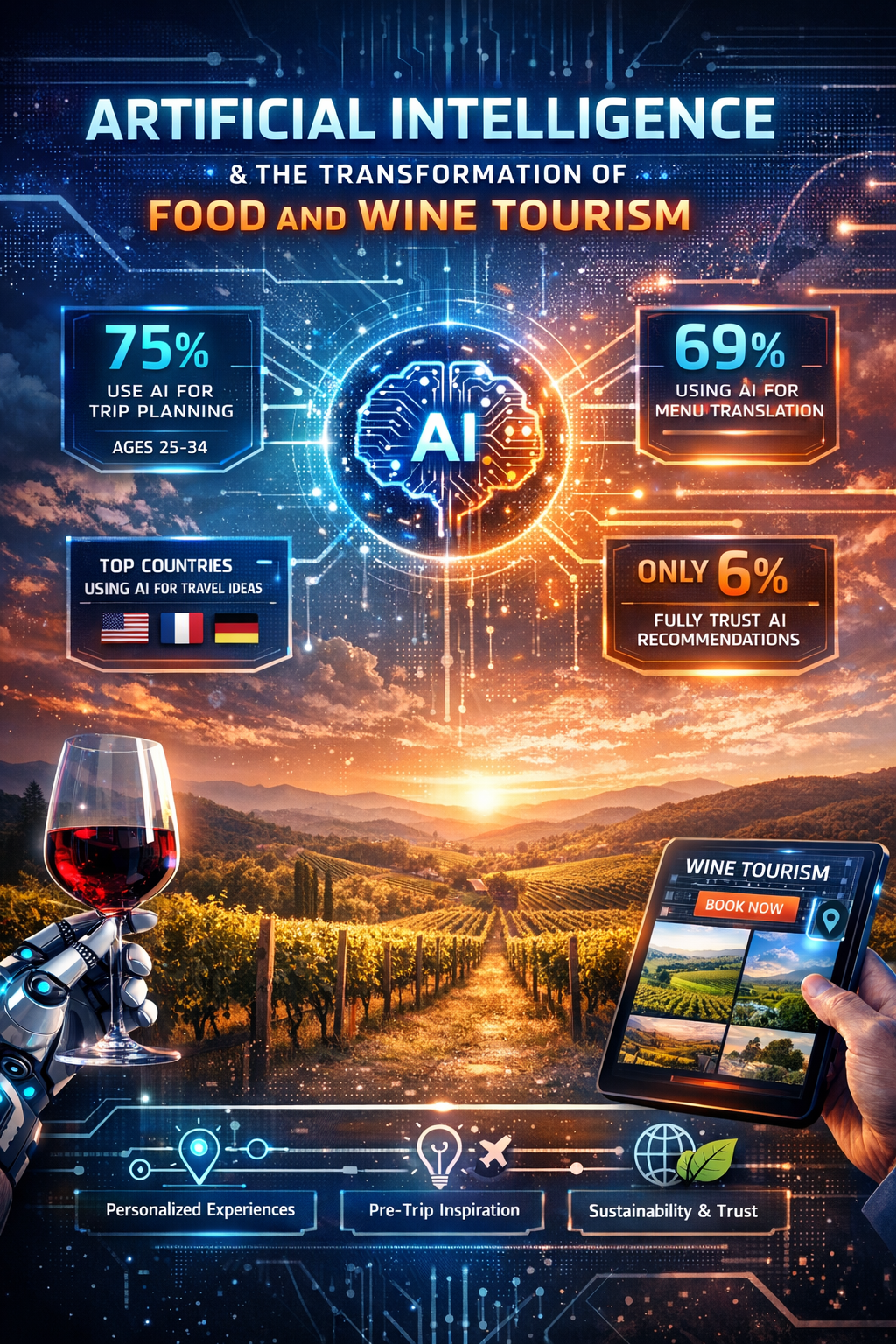
The report reveals a significant generational divide in the use of AI technologies. Seventy-five percent of travellers aged 25–34 report using AI tools to generate ideas for food and wine travel experiences, signaling a decisive shift in how destinations and experiences are discovered. Among this cohort, AI is viewed less as a novelty and more as a natural extension of digital research behaviour.
Primary Applications of AI in Travel Planning
Menu and content translation emerges as the most widespread application of AI, used by 69% of respondents overall and rising to 77% among travellers aged 25–34. This reflects the linguistic complexity of navigating regional cuisines, particularly in destinations such as Italy, where local food culture is deeply rooted in dialect and tradition.
Beyond translation, AI serves multiple planning functions:
60% of travellers use AI to generate inspiration and ideas; and
58% rely on it to search for destinations and accommodation.
These figures are notably higher among younger travellers, who integrate AI more seamlessly into their decision-making processes.
International Variations in AI Usage
AI adoption in food and wine tourism varies significantly across markets. The United States leads in the use of AI for food and wine inspiration, with 21% of travellers reporting active use, followed by France (18%) and Germany (16%). Adoption is comparatively lower in the United Kingdom, Austria, and Switzerland, where usage averages around 13%.
Trust levels follow a similar pattern. American travellers exhibit the highest confidence in AI-driven destination recommendations at 15%, compared with just 10% in Austria and Switzerland. Across all markets, however, AI functions primarily as a source of preliminary inspiration rather than a final authority.
Traditional sources remain dominant, with recommendations from friends and family commanding trust levels between 38% and 50%.
Changing Perceptions of Risk and Rising Expectations
The report notes a marked improvement in attitudes toward AI compared to previous years. Perceived risk is declining, particularly among younger travellers. 29% of individuals aged 18–24 believe the risks of AI outweigh its benefits, compared with 49% among those aged 35–44, suggesting that familiarity and repeated use foster confidence.
Travellers articulate clear expectations for AI-based services:
Ease of use (60%);
Strong data privacy protection (55% overall; 71% among 18–24-year-olds);
and
Accuracy and reliability of information (49%).
Looking ahead, respondents express strong interest in advanced AI functionalities, particularly automatic menu translation (46%) and personalized itinerary creation (36%). Younger and more experienced travellers also value detailed recommendations for food, wine, and beer pairings. Sustainability is an increasingly important factor, with approximately one-third of participants seeking low-impact routes and environmentally responsible experiences.
The Persistent Trust Gap
Despite rising usage, complete trust in AI remains limited. Only 6% of respondents report full confidence in algorithmic recommendations, though trust is higher among high-income and frequent travelers. Awareness of AI’s limitations, such as potential inaccuracies, opaque processes, and algorithmic bias, leads many users to cross-reference AI-generated suggestions with traditional sources, including personal networks and expert reviews.
Future Directions and Strategic Implications
The report identifies three key trajectories shaping the future of AI in food and wine tourism:
Growing demand for seamless and highly personalized experiences;
Increased emphasis on pre-trip inspiration rather than on-site assistance; and
The need to build trust through relevance, authenticity, and demonstrable value.
As AI becomes more deeply integrated into reservation systems and digital platforms, intelligent agents are expected to support customized, on-site experiences. For destinations and tourism operators, success will depend on providing high-quality, transparent data, particularly related to sustainability, local authenticity, and cultural integrity, which will ultimately influence how AI ranks, recommends, and promotes experiences.
As digital technologies continue to evolve, the future of food and wine tourism will be shaped by a dynamic interplay between advanced AI tools and trusted human expertise, redefining how travellers engage with culinary and wine landscapes worldwide.
