Report: AI Revolutionizes Food and Wine Tourism

AI is fundamentally reshaping how travellers discover, plan, and experience food and wine tourism. This transformation is particularly pronounced among younger generations, as evidenced by findings from the Italian Food and Wine Tourism Report 2025.

This report, published by the Italian Association of Food and Wine Tourism (AITE) and curated by Professor Roberta Garibaldi, highlights AI’s growing role as a core decision-support tool for travellers seeking inspiration, personalization, and efficiency in trip planning. For many younger tourists, AI is no longer perceived as innovative or experimental, but rather as an integral and routine part of travel preparation.

Generational Shifts in AI Adoption

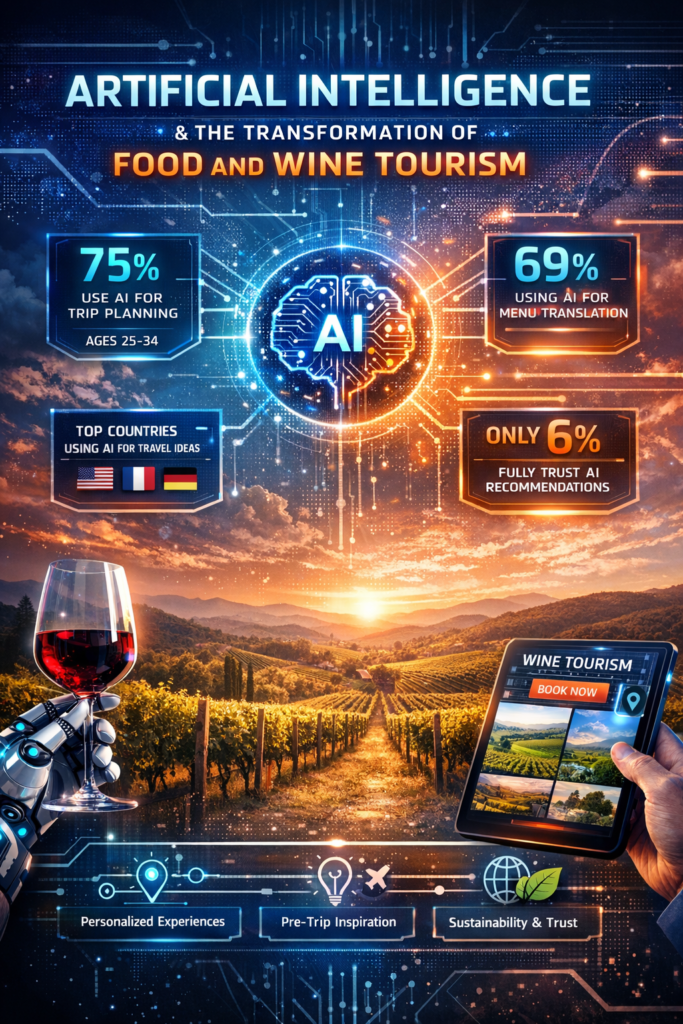
The report reveals a significant generational divide in the use of AI technologies. Seventy-five percent of travellers aged 25–34 report using AI tools to generate ideas for food and wine travel experiences, signaling a decisive shift in how destinations and experiences are discovered. Among this cohort, AI is viewed less as a novelty and more as a natural extension of digital research behaviour.

Primary Applications of AI in Travel Planning

Menu and content translation emerges as the most widespread application of AI, used by 69% of respondents overall and rising to 77% among travellers aged 25–34. This reflects the linguistic complexity of navigating regional cuisines, particularly in destinations such as Italy, where local food culture is deeply rooted in dialect and tradition.

Beyond translation, AI serves multiple planning functions:

60% of travellers use AI to generate inspiration and ideas; and

58% rely on it to search for destinations and accommodation.

These figures are notably higher among younger travellers, who integrate AI more seamlessly into their decision-making processes.

International Variations in AI Usage

AI adoption in food and wine tourism varies significantly across markets. The United States leads in the use of AI for food and wine inspiration, with 21% of travellers reporting active use, followed by France (18%) and Germany (16%). Adoption is comparatively lower in the United Kingdom, Austria, and Switzerland, where usage averages around 13%.

Trust levels follow a similar pattern. American travellers exhibit the highest confidence in AI-driven destination recommendations at 15%, compared with just 10% in Austria and Switzerland. Across all markets, however, AI functions primarily as a source of preliminary inspiration rather than a final authority.

Traditional sources remain dominant, with recommendations from friends and family commanding trust levels between 38% and 50%.

Changing Perceptions of Risk and Rising Expectations

The report notes a marked improvement in attitudes toward AI compared to previous years. Perceived risk is declining, particularly among younger travellers. 29% of individuals aged 18–24 believe the risks of AI outweigh its benefits, compared with 49% among those aged 35–44, suggesting that familiarity and repeated use foster confidence.

Travellers articulate clear expectations for AI-based services:

Ease of use (60%);

Strong data privacy protection (55% overall; 71% among 18–24-year-olds);
and

Accuracy and reliability of information (49%).

Looking ahead, respondents express strong interest in advanced AI functionalities, particularly automatic menu translation (46%) and personalized itinerary creation (36%). Younger and more experienced travellers also value detailed recommendations for food, wine, and beer pairings. Sustainability is an increasingly important factor, with approximately one-third of participants seeking low-impact routes and environmentally responsible experiences.

The Persistent Trust Gap

Despite rising usage, complete trust in AI remains limited. Only 6% of respondents report full confidence in algorithmic recommendations, though trust is higher among high-income and frequent travelers. Awareness of AI’s limitations, such as potential inaccuracies, opaque processes, and algorithmic bias, leads many users to cross-reference AI-generated suggestions with traditional sources, including personal networks and expert reviews.

Future Directions and Strategic Implications

The report identifies three key trajectories shaping the future of AI in food and wine tourism:

Growing demand for seamless and highly personalized experiences;

Increased emphasis on pre-trip inspiration rather than on-site assistance; and

The need to build trust through relevance, authenticity, and demonstrable value.

As AI becomes more deeply integrated into reservation systems and digital platforms, intelligent agents are expected to support customized, on-site experiences. For destinations and tourism operators, success will depend on providing high-quality, transparent data, particularly related to sustainability, local authenticity, and cultural integrity, which will ultimately influence how AI ranks, recommends, and promotes experiences.

As digital technologies continue to evolve, the future of food and wine tourism will be shaped by a dynamic interplay between advanced AI tools and trusted human expertise, redefining how travellers engage with culinary and wine landscapes worldwide.

Miller Family Wine Company (California) Unveils AI-Powered Sommelier Technology

The Miller Family Wine Company recently introduced AI-powered sommelier technology on its website. This advancement underscores the company’s digital vision and solidifies its role as a pioneer in the application of artificial intelligence within the wine industry.

MFWC’s AI Sommelier represents a transformative development, fundamentally altering how consumers browse and purchase wine. Utilizing state-of-the-art autonomous AI-powered agents, the AI Sommelier provides fast, personalized recommendations tailored to individual palates. It delivers detailed tasting notes, comprehensive accolades, and expert reviews directly to users. Available 24/7, this innovative tool offers an unparalleled shopping experience, enabling wine enthusiasts to explore and acquire wines with unprecedented ease and confidence.

“We are thrilled to announce the launch of our AI-powered sommelier—the fastest, most intuitive way to learn and shop for wines,” shares Nicholas Miller, Chief Sales and Marketing Officer at MFWC. “Using advanced technology, the AI Sommelier takes the complexity out of choosing the perfect wine, providing detailed comparisons, reviews, tasting notes, and even pairing suggestions so everyone can make informed decisions effortlessly—anytime, anywhere. It’s primed to set a new standard for digital wine retail, and we couldn’t be more excited to share this innovative technology with consumers.”

MFWC’s AI Sommelier is available online at www.millerfamilywinecompany.com, accessible via the small icon in the bottom right corner.

Wine of Moldova offers a glimpse of the future with its game-changing AI tool

The Moldovan wine industry, following its reception at ProWein, has entered a critical juncture. After the successful unveiling of two wines produced with the support of Artificial Intelligence, key stakeholders will seek further collaboration with the nation’s burgeoning tech and design sectors in the coming years, using innovation to strengthen their global competitiveness.

According to Wine of Moldova, this new landmark AI project involves a strategic partnership between several institutions: the National Office of Vine and Wine, the creative media technology hub, Mediacor, and the Technical University of Moldova. The goal is to set a global precedent for the unification of Artificial Intelligence and human expertise, in addition to facilitating ongoing development via the use of new technologies; $500 million has been earmarked for vineyard expansion, technological innovation, and production capacity.

Robert Joseph, consultant and author, commented: “A changing climate – which means far greater vintage variation as well as higher temperatures – requires innovative solutions. This project gives wine producers access to the nation’s growing AI expertise that could be a game-changer.”

At ProWein this year, a white blend of Feteasca Alba, Feteasca Regala and Viorica and a red wine Feteasca Neagra were presented to an international audience, both created with the assistance of Artificial Intelligence.

The wine industry is essential to Moldova’s economy, contributing around 3% of GDP and 8% of total exports, contributing to the livelihoods of over 50,000 families in rural areas. Premium labels are exported to 72 different countries – 55 percent of the country’s total exports are shipped to the EU.

“Moldova boasts a growing number of small new wineries, with young winemakers, while its larger ones are investing in vineyards and cellar equipment to produce more premium wines,” said Diana Lazar, AI Wine project lead.

Like every other wine-producing country, Moldova faces a range of challenges. However, stakeholders are in a strong position to meet these difficulties head on, taking full advantage of the solutions presented by future tech. A new era of cooperation between winegrowers and digital innovators has begun as Moldova offers valuable lessons for the rest of the world.

Video – https://www.youtube.com/watch?v=uCDUwK3Nv7A

Source: Wine of Moldova

Wine Grounds Launches Machine Learning-Based Vintage Scores

Wine Grounds announced this week a revolutionary new vintage quality feature to their food and wine pairing app, Grape Base. Their data-driven approach to determining the quality of a vintage allows industry professionals and consumers to see scores for any wine-growing region in the world. By utilizing machine learning and a proprietary weather model, Grape Base can instantly predict the overall quality of a vintage based on the weather during the growing season, at harvest and throughout the winter.

Grape Base is taking a hyper-local approach to vintage quality and creating scores for the top varietals grown in every officially recognized region, district and or appellation across the globe. Vintage scores will be continually expanded on and made available after the end of harvest in the northern and southern hemispheres. Industry professionals can use the data to make purchasing decisions and project trends in consumer buying habits.

Wine Grounds Founder Chris Hall states, “By tracking and evaluating the weather of a specific region and comparing that to the ideal conditions for the grapes grown there, we can predict the quality of the vintage for those grapes. You can then use those scores to pick the best vintage in a wine shop, from your own rack or out to eat. Somms can ahead on building wine programs that showcase varietals at their very best. It is absolute revolution in wine tech.”

Highlights Include:

  • Weather model can be applied to any region in the world for any grape and it is continuously learning and improving
  • 75+ regions available with scores for the past ten years
  • Search allows users to find scores by region or grape varietal
  • Monthly subscriptions start at US $1.99 after a one-month free trial
  • Grape Base is available in the Apple Store and on Google Play

#wine #winewednesday #wednesday #winetrends #businessofwine #tech #winegrounds #machinelearning #vintagewines #vintagescores #foodandwineapp #somms #wineandfoodpairing #app #AI #winelovers #instawine #wineinstagram #winelife #winemarketing #socialmediamarketing

“Tastry” uses Chemistry + AI to Analyze Wine and Generate Flavor Profiles

A California startup that taught a computer to “taste” wine is using technology to help winemakers improve their wines and attract new customers.

Founder Katerina Axelsson says Tastry uses artificial intelligence (AI) to analyze “tens of thousands of wines a year,” generating vast reams of data to help winemakers and retailers target their products more effectively.

Ms Axelsson formed her idea as a chemistry student working at a winery, where she noticed “idiosyncrasies” in how wine was evaluated. A 100,000-gallon tank of wine would be divided in two and sold to two different brands, where it would end up in different bottles, sold at different prices and receive different scores from critics, she states

She began analyzing wine samples, identifying thousands of compounds. Using AI, she could see how these compounds interacted with each other, creating the wine’s flavor profile. She then took that profile and used machine learning to compare its flavor, aroma, texture and color with other wines in the database.

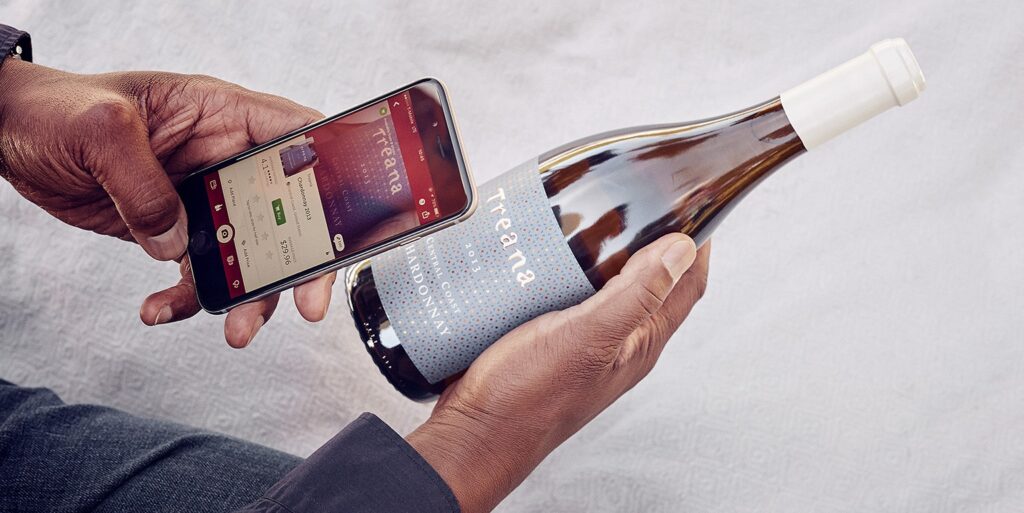
The method allowed Axelsson to develop a wine recommendation app, which was launched on screens in the wine aisles of retailers in 2019. Through a quiz, consumers could input their flavor preferences, and the software would recommend a suitable wine with 80-90% accuracy at the first attempt, she says, rising to 95% with additional input form the user. Tastry’s system now powers its BottleBird wine recommendation app.

Tastry has also begun working directly with winemakers in the United States. Brands pay to have their bottle analyzed “and in exchange they would have access to what we call an insights dashboard, where they can identify how their wine is perceived in their market of opportunity, on a store, local or regional level,” says Axelsson.

One client is O’Neill Vintners and Distillers, one of the largest wine producers in California. To produce some blends, it combines wine from “upwards of 30 different tanks” to create the desired flavor profile, according to Marty Spate, vice president of winemaking and winegrowing.

The company is using Tastry’s AI to “streamline” the blending process by suggesting which tanks to use. “[Tastry is] not a replacement for the modern winemaking team,” he says, however, “that data can be pretty powerful.”

But in an industry steeped in artisan tradition, there are some critics of its algorithmic approach.  “It’s like having a computer analyze a piece of art,” says Ronan Sayburn, master sommelier and head of wine at 67 Pall Mall, a private members club for wine lovers in London.

“I don’t know how keen people would be on following what a computer tells them to drink, based on what they had previously,” he says. “I think part of the appeal of wine is forming your own opinions.”

Sayburn concedes technology can be useful to the amateur, for recommending serving temperature, aeration time and food pairings. “But when it comes to something which is a very emotive subject, I think there’s got to be human contact,” he argues.

Axelsson agrees that Tastry is not a substitute for a sommelier. But she says the scalability of her product makes it possible to analyze more wines per year than a human could ever taste.

Her company will start offering services in Europe later this year in collaboration with an online retailer, and is already thinking beyond wine, having conducted tests for beers, spirits, coffee and fragrances.

In the meantime, she’s happy to spend time winning over the naysayers.

“It takes time to educate any industry about AI and its benefits,” she says. “But if the use case is there and the value proposition is there, I think it’s just a matter of time before people really embrace it.”

Source :CNN Business London

#Womeninwine #womeninwinebusiness #womenintech #womeninscience #womenwholead #winetrends #winenews #winelovers #wine #winelovers  #tastry#wine #wineapp #tastryai #winetasting #artificialintelligence #ai #tech #technology #science #sensoryscience #senses