OIV Releases 2025 World Wine Production First Estimates

The International Organisation of Vine and Wine (OIV) published yesterday its annual first estimates for global wine production in 2025.

The initial forecast for 2025 is between 228 and 235 million hectolitres, with a mid-range estimate of 232 million hectolitres. That is a 3% increase on the historically low 2024 harvest, but still 7% below the 5-year average.

Italy remains the world’s largest wine producer in 2025 (47.3 Mhl), ahead of France  (35.9 Mhl) and Spain (29.4 Mhl). The USA is fourth, while Australia bounces back from the smaller 2024 harvest to regain its place as the world’s fifth producer in 2025, ahead of sixth-placed Argentina, which is the biggest producer in South America.

Despite regional contrasts, the global wine market is likely to remain broadly balanced, as limited production growth will help to stabilize stocks in a context of softening demand and ongoing trade uncertainties.

These first estimates are presented in a new report available on the OIV website (World Wine Production Outlook) and will be updated according to the last 2025 consolidated data. The final data on 2025 global wine production will be announced by the OIV in the second trimester of 2026 and published in the annual OIV report: “State of the World Vine and Wine Sector”.

About the OIV
The International Organisation of Vine and Wine (OIV) The OIV is a scientific and technical intergovernmental organization, and the world reference to the vine and wine sector. The OIV currently has 51 Member States, countries producing and consuming grapes and wine, which account for 90% of the world’s vineyard surface area, 88% of global wine production and 75% of global wine consumption. Twice a year, over 500 experts come together to assess, discuss and approve by consensus resolutions on the following:

1/ Viticulture and table grapes

2/ Oenology and methods of analysis

3/ Law and economics of the vine and wine

4/ Consumer health and safety

For a century, the OIV has been at the forefront of all global vitivinicultural matters, providing standards, guidance and information for the vine and wine sector.

OIV’s 2024 Report on the Global Wine Sector: Emphasizing Adaptation and Multilateral Cooperation

The International Vine and Wine Organisation (OIV) reinforced the importance of multilateral cooperation and adaptation to changing conditions, as global data on the wine sector in 2024 was released at its online Press Conference April 15th,2025.

The OIV also released statistics on production, consumption and trade from all producing and consuming nations (over 180) to create a snapshot of the sector in the 2024 calendar year.

The data highlights the effects of climate change, shifting consumer preferences and geopolitical uncertainty upon the sector.

OIV Director General, John Barker, said that these impacts present a challenge of adaptation for the wine sector, but that successful adaptation would bring opportunities.

“Working together to develop solutions to climate change and making wine a beacon of sustainability; investing in research on new audiences so that we can see wine through their eyes; reinforcing our commitment to multilateralism and global trade: these are the elements that will lead the wine sector forward.

The OIV has a key role as the global reference for vine and wine, uniting 51 countries to promote cooperation, harmonization and knowledge sharing around the key challenges and opportunities for the sector.”

KEY DATA AND INSIGHTS

Decrease in global vineyard area slows

The global vineyard surface area has been decreasing for the past four years. A contraction of 0.6% to 7.1 million hectares in 2024 showed a slower rate of decrease. The downward trend is driven by vineyard removals across major vine growing regions, but a few countries are showing a dynamic of expansion of their vineyards.

World wine production faces climate change

Global wine production in 2024 is estimated at 226 million hectolitres, the lowest in over 60 years, down 5 % compared to 2023. This is largely due to unpredictable and extreme weather events in both Northern and Southern Hemispheres caused by climate change.

New consumption patterns and diversity of the markets

In 2024, global wine consumption is estimated at 214 million hectolitres (mhl), a 3.3% decrease compared to 2023. If confirmed, this would represent the lowest global consumption level since 1961.  This is due to an intersection of economic and geopolitical factors generating inflation and creating uncertainty, as well as a decline in mature markets shaped by evolving lifestyle preferences, shifting social habits and generational changes in consumer behaviour.  However, across 195 countries, wine has never been so widely consumed worldwide. It has also been recalled that a number of countries that combine strong overall consumption with very large populations still offer significant growth potential.

Equilibrium between production and demand

Despite ongoing declines in both production and consumption, global market equilibrium is expected to hold in 2024, as production is unlikely to exceed demand_ continuing the trend seen with the small 2023 harvest. Two consecutive years of low output may help stabilize the market, though stock levels are likely to remain uneven across regions.

International trade holds volumes and value

Export volumes held steady at 99.8 million hectolitres (mhl). Export value slightly declined by 0.3% to 36 billion EUR, but remains at a historically high average export price of 3.60 EUR/litre. Inflation and low supply continue to keep prices high compared to pre-pandemic years (almost 30% above).

OIV Releases 2022 Global Wine Production Projections

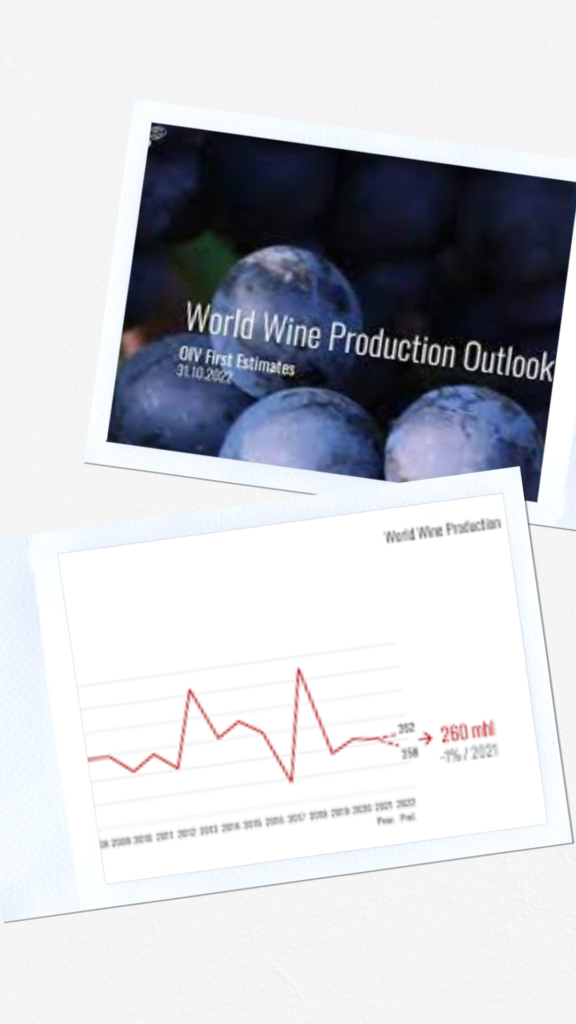
OIV releases its report on 2022 Global Wine Production Projections and here are their findings:

Severe drought and extreme heat pose a new threat to wine production.

In 2022, despite the heat wave that touched many regions of the world, global wine production volume is expected to be at a level similar to the one observed last year. This would be the fourth consecutive year where the global production level can be considered as slightly below average.

This year’s harvest has been characterized by extreme heat and record-breaking drought that sped up ripening in vineyards all over the globe. A report recently published by the Global Drought Observatory indicated that almost two-thirds of the European territory was in a state of drought or on alert due to heat waves and extremely low rainfall: this has been the worst drought in the last 500 years. And Europe was not the only region impacted: from East Africa to California, extreme temperatures have been recorded this year.

Average production volume is expected in the EU, with positive performances recorded in Italy, France, and Germany, which balanced out the low harvests expected in Spain and Greece, which were particularly affected by the heat wave during summer.

First harvest forecasts in the USA indicate that production volume will be slightly lower than in 2021.

After the record-high figures of last year, Southern Hemisphere vineyards produced average volumes, with the only exception of New Zealand that, thanks to favorable climatic conditions, records the largest production ever.

Full Report

https://www.oiv.int/press/severe-drought-and-extreme-heat-pose-new-threat-wine-production

Source OIV

#OIV #winereport #winenews #winery #wineries #wineharvest #winelovers #wine #winetrade #wineproduction #wineproducer #wineeconomics #winetrends