
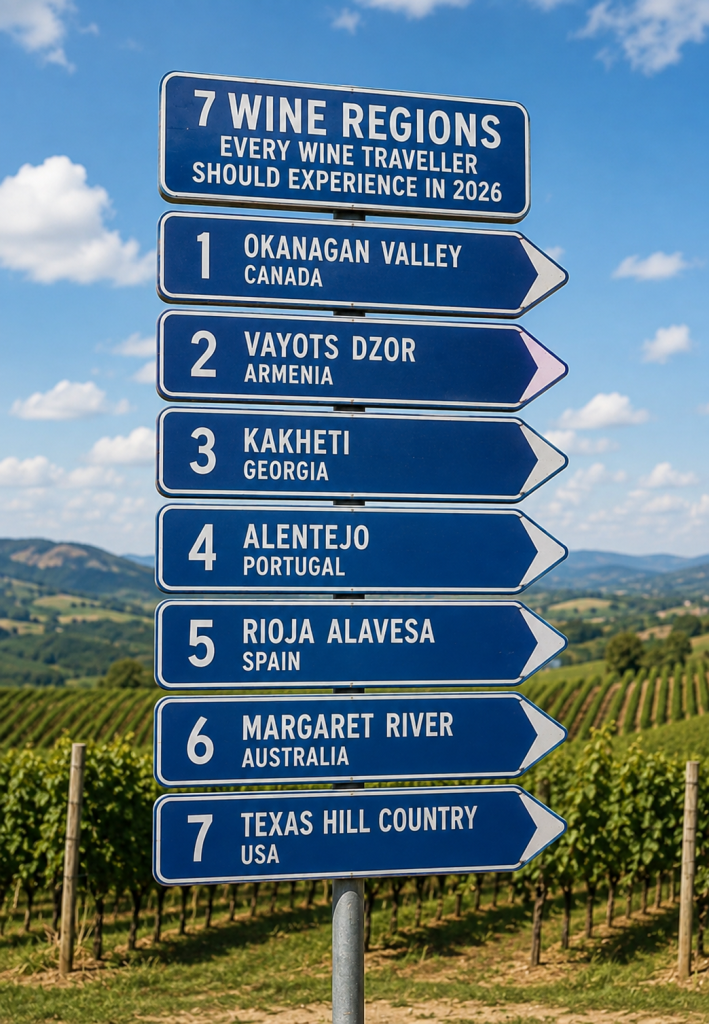
From ancient winemaking traditions and UNESCO-recognized heritage to world-class gastronomy and spectacular landscape, these seven destinations belong on the wine travel map in 2026.
Wine travel is no longer simply about moving from one tasting room to another. Today’s most memorable journeys combine exceptional wines with gastronomy, cultural heritage, landscapes and authentic connections to the people and places behind the bottle.
In 2026, some of the most compelling experiences are emerging beyond the world’s most famous appellations. From Canada and the Caucasus to Portugal, Spain, Australia and the United States, these seven regions offer what modern wine travellers increasingly seek: discovery, authenticity and a genuine sense of place.
Here are seven wine regions to experience in 2026.
1. Okanagan Valley, Canada
Wine, Gastronomy and One of Canada’s Most Spectacular Landscapes
Few Canadian wine destinations combine landscape, gastronomy and wine as naturally as British Columbia’s Okanagan Valley.
Stretching through a dramatic landscape of lakes, mountains, vineyards and orchards, the Okanagan has evolved into one of Canada’s most complete wine tourism destinations.
The region is remarkably diverse. Travelling from Kelowna south toward Osoyoos reveals changing landscapes and microclimates alongside an equally diverse range of wines, from Riesling, Chardonnay and Pinot Noir to Syrah and Cabernet Franc.
But wine is increasingly only part of the story.
A significant milestone came in October 2025 when Kelowna was designated Canada’s first UNESCO Creative City of Gastronomy.
The recognition provides an international platform for the region’s increasingly sophisticated relationship between agriculture, wine, restaurants, local producers and tourism.
For visitors, that translates into experiences combining vineyard tastings with farm-to-table dining, cycling, lake activities, luxury hospitality and visits to orchards and artisanal producers.
There is also an unmistakable geographical identity here. The contrast between vineyards, deep-blue lakes and surrounding mountains gives the Okanagan a visual character unlike almost any other North American wine destination.
Why experience it in 2026: The Okanagan is entering an important new chapter, combining an increasingly mature wine industry with international recognition for its gastronomic culture.
Don’t miss: Kelowna, Naramata Bench, Okanagan Falls, Oliver and Osoyoos.
2. Vayots Dzor, Armenia
Travel Back to the Origins of Wine
For wine travellers fascinated by history, Armenia offers something extraordinary.
Wine has been produced in this part of the world for thousands of years, and Vayots Dzor provides one of the most tangible connections between ancient wine culture and contemporary winemaking.
The region is home to the remarkable Areni-1 cave complex, where archaeological discoveries revealed evidence of a winemaking facility dating back thousands of years.
Today, vineyards grow amid dramatic mountains and valleys, while a new generation of Armenian producers is bringing international attention to indigenous grape varieties and the country’s ancient wine heritage.
The signature red grape Areni Noir is particularly important, producing elegant wines that are increasingly attracting attention beyond Armenia.
But Vayots Dzor’s appeal extends far beyond the glass.
Wine journeys here can combine vineyards and wineries with monasteries, archaeological sites, mountain scenery, villages and Armenian gastronomy. Noravank Monastery, surrounded by towering red cliffs, is among the region’s most memorable cultural landmarks.
Why experience it in 2026: To explore one of the world’s oldest wine cultures at a moment when contemporary Armenian wine is gaining greater international recognition.
Don’t miss: Areni, Areni-1 Cave, Noravank Monastery, Areni Noir and traditional Armenian cuisine.
3. Kakheti, Georgia
Where Wine Is Still a Way of Life
If there is one destination capable of changing the way a traveller thinks about wine, it may be Georgia.
Georgia’s winemaking culture stretches back thousands of years, but what makes the country particularly compelling is that many of its ancient traditions remain part of everyday life.
At the heart of this culture is the Qvevri.
These large earthenware vessels are traditionally buried underground and used for fermenting and ageing wine. In 2013, UNESCO inscribed the ancient Georgian traditional Qvevri winemaking method on its Representative List of the Intangible Cultural Heritage of Humanity.
Kakheti is Georgia’s principal wine region and one of the best places to experience this living heritage.
Travelling through the region can involve visiting family wineries, tasting directly from Qvevri, walking vineyards, exploring monasteries and discovering indigenous grape varieties such as Saperavi and Rkatsiteli.
Then there is the Georgian table.
The traditional supra – an elaborate feast built around food, wine, hospitality and ritualized toasts – demonstrates something fundamental about Georgian wine culture: wine here has always been about community.
Visitors can also participate in harvest traditions, food preparation and other activities that provide direct contact with local customs.
Why experience it in 2026: Kakheti offers something increasingly rare in international wine tourism – an ancient wine culture that remains a living tradition rather than a reconstructed visitor attraction.
Don’t miss: Sighnaghi, Telavi, traditional Qvevri wineries, Saperavi, Rkatsiteli and a Georgian supra.
4. Alentejo, Portugal
Slow Wine Travel at Its Best
There are wine regions that encourage you to see more.
Alentejo encourages you to slow down.
Stretching across a vast area of southern Portugal, the region is defined by rolling plains, cork oak forests, vineyards, olive groves, hilltop villages and brilliant white towns.
Its wine culture is equally distinctive.
Alongside modern wineries, Alentejo has preserved the tradition of producing wine in large clay vessels known as talhas – a winemaking practice with ancient roots.
The region has also emerged as an important leader in sustainable wine production through the Wines of Alentejo Sustainability Programme, launched by the regional wine commission in 2013.
For wine travellers, however, the greatest luxury may simply be space and time.
A journey through Alentejo can combine winery visits with historic villages, regional cuisine, olive oil, cork landscapes and stays in restored estates or rural properties.
Évora, a UNESCO World Heritage city, provides an exceptional cultural anchor for exploring the region.
This is also a destination where food and wine remain deeply connected. Local dishes, cheeses, olive oils, breads and traditional ingredients provide context for the wines in a way that a tasting room alone never could.
Why experience it in 2026: For slow, immersive wine travel combining vineyards, sustainability, ancient traditions, gastronomy and one of Europe’s most atmospheric rural landscapes.
Don’t miss: Évora, Monsaraz, Estremoz, traditional talha wines and the region’s cork oak landscapes.
5. Rioja Alavesa, Basque Country, Spain
Where Medieval Wine Heritage Meets Modern Architecture
Few wine destinations make centuries-old cellars and avant-garde architecture feel equally at home.
Rioja Alavesa does.
Situated in the southern Basque Country beneath the Sierra de Cantabria, the region combines vineyard landscapes, medieval towns, historic underground cellars and some of Europe’s most distinctive contemporary winery architecture.
Laguardia is an essential starting point.
The walled medieval town sits above an extraordinary network of underground cellars, creating a physical connection between the community and centuries of wine culture.
Then there is the contemporary side of Rioja Alavesa.
In Elciego, Frank Gehry’s spectacular design for Marqués de Riscal has become one of the most recognizable architectural landmarks in the international wine world.
Across the region, traditional wineries coexist with ambitious contemporary architecture, creating an intriguing dialogue between heritage and innovation.
Add Basque gastronomy, vineyard hotels, cycling, historic villages and access to northern Spain’s celebrated culinary culture, and Rioja Alavesa becomes much more than a tasting itinerary.
Why experience it in 2026: For one of Europe’s strongest combinations of wine, architecture, gastronomy and cultural heritage.
Don’t miss: Laguardia, Elciego, underground cellars, vineyard architecture and Basque gastronomy.
6. Margaret River, Western Australia
Where World-Class Wine Meets the Indian Ocean
Imagine beginning the morning walking along a spectacular stretch of coastline and spending the afternoon tasting Chardonnay and Cabernet Sauvignon among vineyards and forests.
That is the appeal of Margaret River.
Located in the southwest corner of Western Australia, the region has built an international reputation for premium wine despite producing only a relatively small proportion of Australia’s total wine.
Its natural environment is central to the experience.
Vineyards coexist with towering forests, caves, surf beaches and dramatic Indian Ocean coastline, allowing travellers to combine serious wine exploration with nature and adventure.
Margaret River’s international wine tourism credentials were further reinforced when the region hosted The World’s 50 Best Vineyards 2025 awards ceremony.
Its visitor offering continues to evolve through sophisticated cellar doors, winery restaurants, culinary experiences and destination events.
The diversity is particularly attractive for travellers who do not want every day of a wine journey to look the same.
One morning can involve a coastal walk or cave experience; lunch can take place overlooking vineyards; the afternoon can be devoted to Cabernet Sauvignon and Chardonnay; and sunset can be watched over the Indian Ocean.
Why experience it in 2026: Margaret River demonstrates how successfully world-class wine can be integrated with nature, gastronomy and outdoor experiences.
Don’t miss: Cabernet Sauvignon, Chardonnay, winery lunches, coastal drives, caves, forests and an Indian Ocean sunset.
7. Texas Hill Country, United States
America’s Wine Destination to Watch
California, Oregon and Washington have traditionally dominated international conversations about American wine tourism.
Texas is changing that conversation.
Texas Hill Country, centred around destinations such as Fredericksburg, has developed into one of the country’s most dynamic emerging wine tourism regions.
The attraction is partly wine — but equally the distinctive identity surrounding it.
Vineyards and tasting rooms sit within a landscape of ranches, small towns and rolling hills, while German-American heritage, regional gastronomy, music and unmistakable Texas hospitality give the destination a personality entirely its own.
Fredericksburg has become a natural hub for exploring the region, offering accommodation, restaurants and easy access to numerous wineries.
The region’s increasing popularity is also encouraging investment in winery architecture, hospitality and more sophisticated visitor experiences.
That evolution makes Texas Hill Country particularly interesting in 2026.
Why experience it in 2026: To discover an emerging American wine destination while its international identity is still being shaped.
Don’t miss: Fredericksburg, Texas-grown wines, regional gastronomy, live music and a drive through the Hill Country landscape.
What Makes a Great Wine Journey in 2026?
These seven regions could hardly be more different.
Yet they share something important.
Each offers visitors a reason to travel beyond what is poured into the glass.
In Armenia and Georgia, that reason is thousands of years of wine culture.
In Alentejo, it is the relationship between sustainability, landscape and traditional rural life.
In Rioja Alavesa, architecture and medieval heritage transform the wine journey.
Margaret River brings together fine wine and extraordinary nature.
The Okanagan increasingly connects wine with gastronomy and a distinctive Canadian landscape.
And Texas Hill Country captures the excitement of discovering a wine destination while its identity is still evolving.
The world’s iconic wine regions – Champagne, Bordeaux, Burgundy, Tuscany and Napa Valley will always be essential destinations. But today’s wine travellers are increasingly seeking something more: discovery, authenticity and connection.
They want to meet the winemaker, walk the vineyards, discover indigenous grapes, experience regional cuisine and understand the culture and landscape behind the wine.
Whether established or emerging, these seven regions offer exactly that: the opportunity not simply to taste a wine, but to experience the place that made it possible.
Sources and Further Reading
UNESCO / Canadian Commission for UNESCO — Kelowna’s designation as Canada’s first UNESCO Creative City of Gastronomy and the UNESCO Creative Cities Network.
Tourism Kelowna — Okanagan Valley wine tourism, gastronomy and regional visitor experiences.
Armenia Travel — Vayots Dzor, Areni, Armenian wine tourism and wine-related cultural experiences.
UNESCO Intangible Cultural Heritage — Ancient Georgian traditional Qvevri wine-making method.
Georgia Travel — Kakheti, Georgian wine culture, gastronomy and Qvevri experiences.
Wines of Alentejo / Comissão Vitivinícola Regional Alentejana — Wines of Alentejo Sustainability Programme and regional wine information.
Basque Country Tourism / Basquetour — Rioja Alavesa, Laguardia, wine tourism and the Basque Country Grand Tour.
Tourism Western Australia — Margaret River wine, gastronomy, nature and tourism experiences.
The World’s 50 Best Vineyards — Margaret River and the 2025 World’s 50 Best Vineyards programme.
Travel Texas — Texas wineries, Fredericksburg and Texas Hill Country wine tourism.