The Michelin Guide Expands Its Expertise in Recommendations and Introduces a New Distinction in the World of Wine

For 125 years, the MICHELIN Guide has celebrated places and talents that embody excellence in gastronomy and hospitality, with the MICHELIN Stars introduced in 1926 and the MICHELIN Keys launched in 2024. This expertise now naturally extends to wine, a key reference in the gastronomic experience. The MICHELIN Guide has long highlighted exceptional wine lists and sommeliers, notably through the ‘wine’ pictogram created in 2004 to distinguish outstanding food and wine pairings. In 2019, the MICHELIN Sommelier Award was introduced to honour professionals whose expertise enhances the guest experience through exemplary mastery of wine selection and service.

The MICHELIN Grape, MICHELIN Guide’s new distinction, will now spotlight wine estates across different regions of the world. It will assess their overall excellence based on five universal criteria applied consistently.

Gwendal Poullennec, International Director for the MICHELIN Guide, explains:

” After having oriented wine-lovers towards the finest tables in more than 70 destinations and to the world’s most elegant hotels, the MICHELIN Guide is delighted to open a new chapter with the world of wine. This new reference is designed for both the curious amateur and the most ardent expert – it rewards the men and women who are building the most demanding vineyards around the world.” 

The MICHELIN Grapes: a new reference for discovering and showcasing wine-growing talent

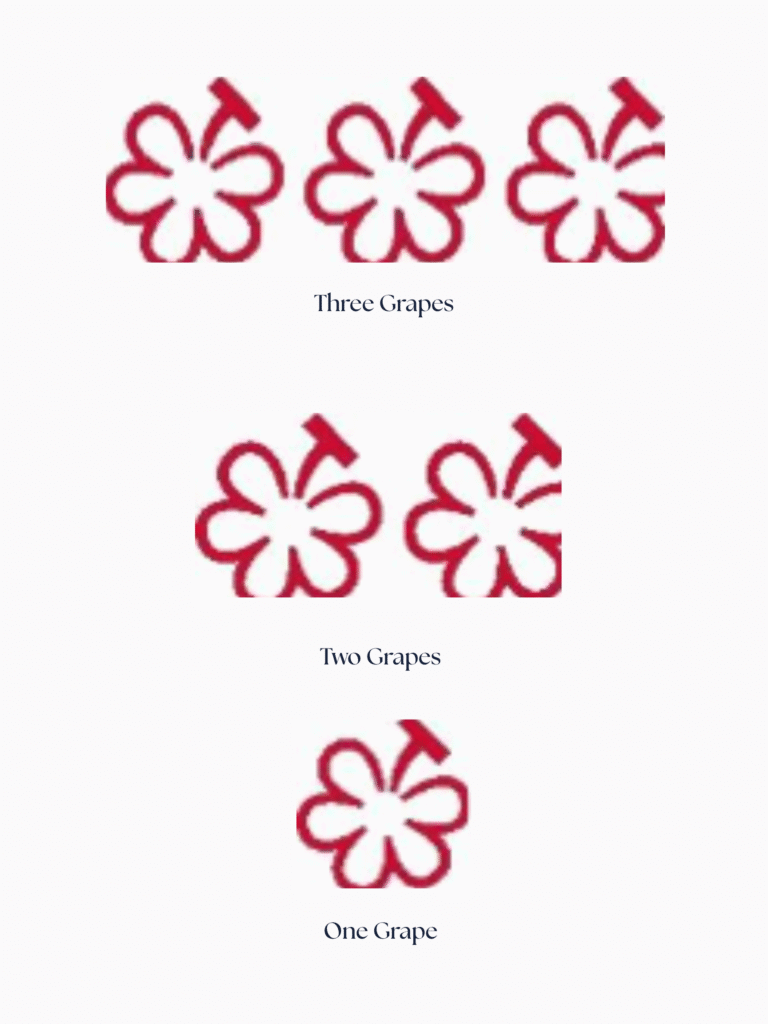
In the world of wine, the MICHELIN Guide rewards not only the vineyards but also the men and women who personify them. With this new distinction, the Guide will be using a strict and independent methodology – it will also provide wine-lovers with a trusted benchmark: Grapes 1, 2 or 3 and, additionally, a selection of recommended vineyards.

  Three Grapes

Exceptional producers. Whatever the vintage, wine lovers can turn to the estate’s creations with complete confidence.

  Two Grapes

Excellent producers who stand out as exceptional within their peer group and region for both quality and consistency.

One Grape

Very good producers who craft wines of character and style, especially in the best vintages.

Selected 

Dependable producers who have been chosen for regular review, producing well-made wines that deliver a quality experience.

Here is the methodology based on 5 criteria: 

For its new distinction, true to its fundamental values of excellence and independence, the MICHELIN Guide applies five criteria uniformly and wherever it may be.

  1. The quality of agronomy
    The assessment evaluates the vitality of the soil, the balance of the vine stocks, as well as the care provided for the vines. All essential factors that directly influence wine quality.
  2. Technical mastery
    The evaluation focuses on the technical skills in the wine-making process. Our inspectors are seeking precise and rigorous wine-making processes producing well-developed wines which reflect the terroir and the vine types, without any distracting flaws.
  3. Identity
    The Guide will highlight winemakers who craft wines that express the personality, the sense of place, and the culture behind them.
  4. Balance
    Evaluation of the harmony between acidity, tannins, oak, alcohol, and sweetness.
  5. Consistency 
    Wines will be evaluated across multiple vintages to ensure unwavering consistency in quality, even in the most challenging years. The Guide celebrates wines that reveal greater depth and excellence as time goes by.

    Expertise at the heart of the assessments 

Future selections will rely on the expertise of dedicated wine inspectors, all professionals employed by the Michelin Group. This team, which makes its recommendations collectively and with complete independence, will bring together seasoned wine specialists and newly recruited inspectors.

All team members have been selected not only based on their qualifications, but also on their ability to assess a vineyard with rigour and integrity. They are all seasoned professionals in the sector, i.e., former sommeliers, specialized critics or production experts, all bringing concrete and in-depth experience of the wine-producing world to the team.

Their assessments follow a rigorous methodology, including a panel review process and editorial supervision.

In 2026, the MICHELIN Grapes adventure will be writing its initial chapter in the heart of two mythical French wine-producing areas: Burgundy and the Bordeaux region

The MICHELIN Grapes project will start with two regions among the most emblematic in the worldwide wine-producing landscape: Burgundy and the region around Bordeaux. A compelling choice, celebrating the diversity, the historical intensity and the cultural richness of wine à la française.

Over the centuries, Bordeaux has established itself as a historic force in the world of wine. Its distinguished vineyards and their reputation go far beyond our borders.  The entire prestigious Bordeaux region is renowned throughout the world for its innovations and its traditions.

Burgundy, for its part, differentiates itself by its approach, deeply rooted in the local heritage. Its human-sized, family-owned vineyards reflect rigorous traditions and care imposed at each stage in the production process. From generation to generation, legacies have curated the local identity and forged the worldwide reputation of Burgundy.

Stay tuned in 2026 for the very first selections of the MICHELIN Grapes.

The Opus One Experience: Napa’s Crown Jewel of Wine Tasting

History and Vision

The story of Opus One is not simply that of a winery; it is the embodiment of a groundbreaking partnership that transformed American winemaking. Conceived in 1978 and officially founded in 1980, Opus One was born from the visionary alliance between two legendary figures: Baron Philippe de Rothschild of Château Mouton Rothschild in Pauillac and Robert Mondavi, the pioneering force behind Napa Valley’s global reputation.

Their bold ambition was to create a single, world-class Bordeaux-style wine from Napa terroir, one that could stand alongside France’s First Growths. Initially dubbed Napamédoc, a name that reflected the transatlantic partnership, the winery adopted the name “Opus One” in 1982. This new name symbolized a harmonious blend of classical artistry and enological mastery. The debut vintages, 1979 and 1980, were jointly released in 1984 to great acclaim, priced at $50 per bottle, an unprecedented figure for a California wine at the time.

Architectural Grandeur

Nestled on the west side of Oakville’s iconic Highway 29, directly across from the original Robert Mondavi Winery, the Opus One estate is a stunning fusion of neoclassical elegance and Californian modernism. Completed in 1991, the architecture reflects the winery’s ethos, timeless, balanced, and quietly majestic.

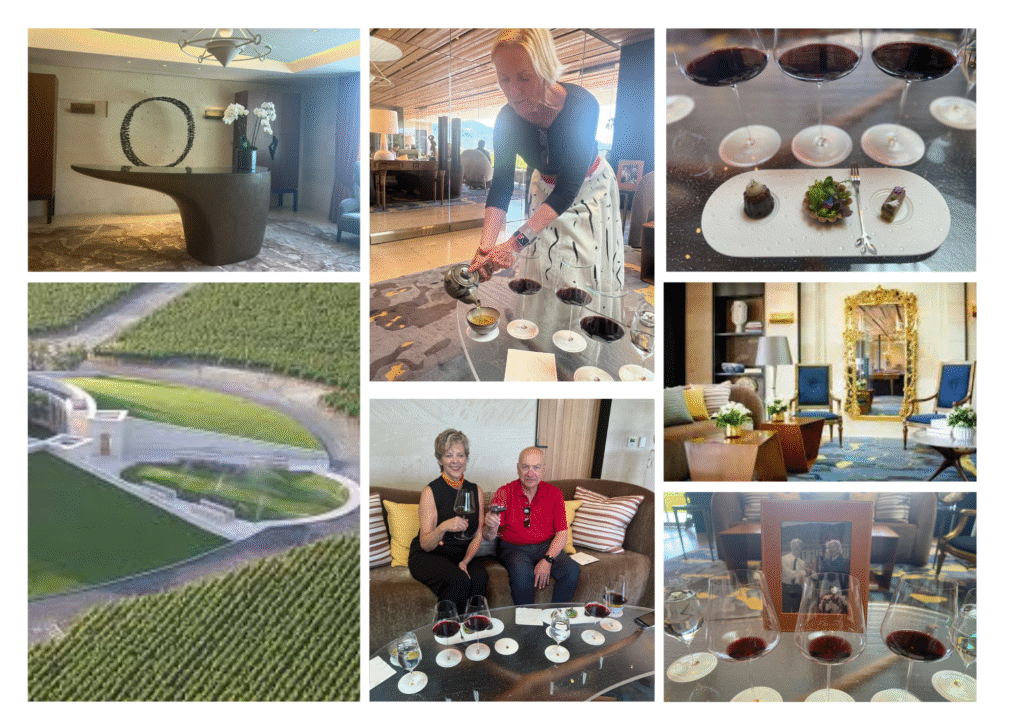
From above, the estate takes the shape of a wine glass, a subtle nod to the artistry within. Inside, a sweeping spiral staircase and a luminous central atrium create a sense of reverence, much like entering a European museum.

The Partners’ Room

My tasting was held in the exclusive Partners’ Room, a glass-encased sanctuary offering sweeping 180-degree views of northern Napa Valley. Designed with understated luxury, the room captures the spirit of Opus One, refined, thoughtful, and rooted in precision. Reserved for private tastings, including verticals of rare library vintages, the space is adorned with archival photographs that honour the legacy of Rothschild and Mondavi. Here, architecture, landscape, and wine coalesce in a seamless tribute to partnership and vision.

A Philosophy of Precision

Opus One’s approach to winemaking is resolutely singular: to craft one exceptional wine from each vintage. Under the stewardship of winemaker and viticulturist Michael Silacci, every step of the process is carried out with painstaking attention to detail.

Grapes are harvested and sorted by hand, and gravity-flow systems are employed to preserve fruit integrity. Fermentation takes place in small stainless-steel tanks, allowing for extended maceration and maximum extraction of colour, structure, and aromatics. The result is a wine that is both powerful and elegant, a reflection of terroir and time.

The Opus One Tasting Experience

Guests are guided through curated tastings by Estate Ambassadors, who offer in-depth insights into the winery’s history, viticulture, and winemaking philosophy.

During my recent visit, I experienced an unforgettable vertical tasting in the Partners’ Room, hosted by the knowledgeable and gracious Therese Keating, Estate Ambassador. Ms Keating previously provided us with an in-depth insight into the Opus One’s history, viticulture and winemaking philosophy. Against a backdrop of breathtaking vineyard views, we explored three vintages: 2015, 2019, and 2021, each paired with meticulously crafted amuse-bouches.

2015 Opus One

Blend: Cabernet Sauvignon 81%, Cabernet Franc 7%, Merlot 6%, Petit Verdot 4%, Malbec 2%
Skin Contact: 21 days
Barrel Aging: 18 months in new French oak

Tasting Notes: A warm vintage showing opulence and depth. Aromas of dark plum, violet, and tea leaf give way to a lush palate of blackberry, cocoa, and baking spices. Creamy texture, fine tannins, and great balance.

Drink Window: 2025–2040

2019 Opus One

Blend: Cabernet Sauvignon 78%, Merlot 8%, Petit Verdot 6%, Malbec 2%
Skin Contact: 22 days
Barrel Aging: 19 months in new French oak

Tasting Notes: A composed and classic vintage. Notes of black currant, rose petal, and graphite lead into layers of espresso, dark chocolate, and savoury herbs. Silky texture, bright acidity, and a lingering finish.

Drink Window: 2025–2045

2021 Opus One

Blend: Cabernet Sauvignon 93%, Cabernet Franc 4%, Petit Verdot 2%, Merlot 0.5%, Malbec 0.5%
Skin Contact: 19 days
Barrel Aging: 19.5 months in new French oak

Tasting Notes: From one of the driest growing seasons on record, this vintage is defined by purity and finesse. Aromas of cassis, violet, and black cherry evolve into a palate of elegant tannins and a finish marked by truffle, vanilla, and spice.

Drink Window: 2029–2049

Each wine was paired with exquisite culinary expressions, from bacon and Roquefort canelés to truffle-scented morel gâteau, amplifying the sensory journey. This rare opportunity to observe how the estate’s wines evolve in character and structure over time was both intellectually stimulating and emotionally resonant.

Final Reflections

Opus One is more than a wine estate; it is a living philosophy, where tradition and innovation are intertwined with purpose and grace. Every detail, from grape to glass, reflects a pursuit of perfection rooted in legacy and collaboration. For connoisseurs and collectors, a visit to Opus One is nothing short of a pilgrimage, an invitation to experience the art of fine winemaking at its most refined.

The most unique wine tasting experience in Napa is at Opus One. Uncover the art of Bordeaux blends, breathtaking architecture, and a wine experience like no other.” Liz Palmer

Opus One Winery

📍 7900 St. Helena Highway, Oakville, CA
🌐 https://en.opusonewinery.com

Enroute to the Vinho Verde Region [Portugal]

Heading northwest to the Vinho Verde region today. This regions spans from the Atlantic coast to the mountainous interior and iis shaped by a cool, wet climate and granitic soils that give rise to wines with distinct freshness and character.
 
Geography and Sub-Regions
Vinho Verde lies within the broader Minho region and borders the Douro Valley and Trás-os-Montes to the East, and the Dão & Lafões region to the South. The region is segmented into nine sub-regions, each contributing its own microclimatic influence and grape-growing identity:


·       Monção and Melgaço
·       Lima
·       Basto
·       Cávado
·       Ave
·       Amarante
·       Baião
·       Sousa
·       Paiva

From coastal vineyards to inland hills, these areas showcase incredible diversity in soil, elevation, and style.

Wine Styles: From Classic to Cutting-Edge
Vinho Verde is traditionally celebrated for its crisp, low-alcohol white wines, often lightly effervescent and youthful in spirit. These wines, especially those made from Alvarinho, Loureiro, and Arinto are the perfect companions for fresh seafood.
Yet today’s Vinho Verde is far from one-dimensional. Winemakers are pushing boundaries, crafting orange wines, pet-nat sparklers, and oak-aged whites that rival more established categories. This evolution reflects the region’s balance of deep-rooted heritage and dynamic innovation.

What’s in a Name?
“Vinho Verde” translates to “green wine,” but the term doesn’t refer to the color, instead, it captures the region’s essence: youthful, vibrant, and fresh. It’s a style that’s alive with acidity and minerality, echoing the region’s verdant landscape and Atlantic breezes.

Dievole Wine Resort: A Benchmark in Tuscan Wine Tourism Excellence

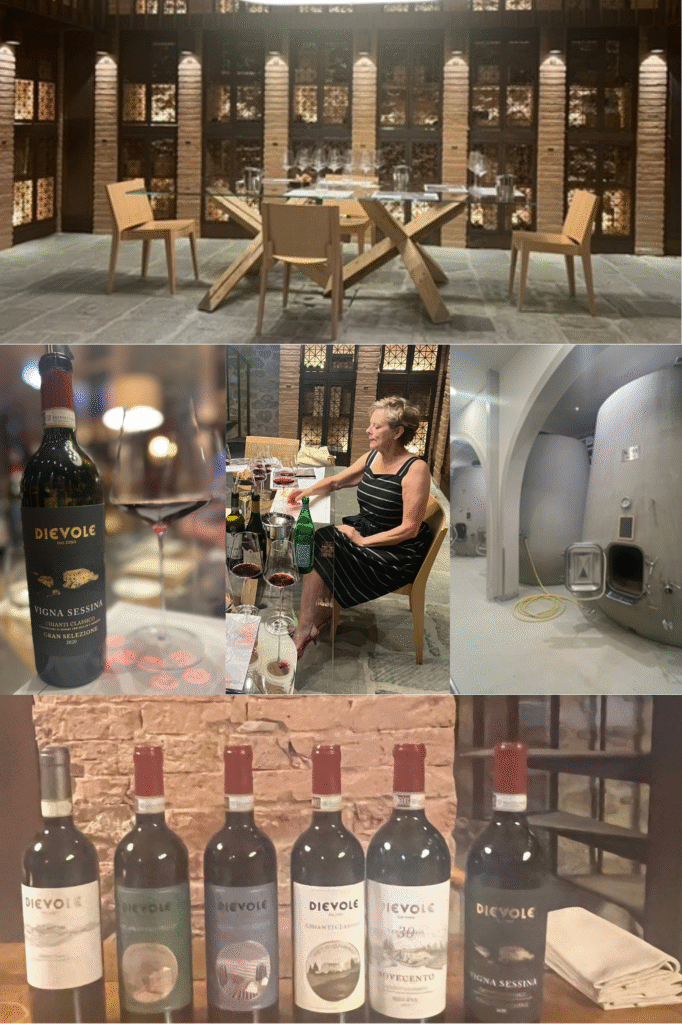
During my recent visit to Dievole Wine Resort, I conducted an in-depth exploration of the estate’s integrated wine tourism program, encompassing guided vineyard tours, curated gastronomic experiences, and a structured tasting of the estate’s wine portfolio. Here are my findings.

The Dievole Wine Resort exemplifies an exceptional model of integrated wine tourism, where viticulture, gastronomy, and heritage converge in the heart of Tuscany’s Chianti Classico region. Encompassing over 600 hectares of vineyards, olive groves, woods, and gardens, the estate is not merely a destination, but a deeply immersive cultural experience rooted in centuries of winemaking tradition.

At the core of Dievole’s enotourism strategy is its commitment to educating and engaging visitors through meticulously curated experiences. The Dievole Grand Tour offers a comprehensive exploration of the estate’s unique terroir and its state-of-the-art winemaking facilities, including the visually striking circular Fidelio vineyard, cellar tours, and tutored tastings of flagship wines paired with regional specialties. For the oenologically curious, the Novecento Vertical Tasting delivers an analytical lens through which to examine vintage variation and the aging trajectory of Dievole’s iconic Chianti Classico Riserva Novecento, a wine steeped in historical significance and viticultural precision.

Complementing these in-depth offerings is the Classic Wine Tour, which provides a balanced introduction to Dievole’s core wines and acclaimed extra virgin olive oils. This dual focus on wine and oil underscores the estate’s broader philosophy of sustainable and diversified agriculture. These tastings are frequently followed by meals at the Novecento Restaurant, where seasonal Tuscan cuisine is prepared with elegant simplicity and paired with Dievole’s wines in a refined, rustic setting.

A Distinctive Hospitality Offering

Accommodation at Dievole is housed within beautifully restored 18th-century stone buildings. The suites, featuring traditional Tuscan textiles, exposed wooden beams, and terracotta floors, are designed to merge rustic authenticity with modern luxury. Each suite opens to expansive views of the vineyard and surrounding olive groves, reinforcing the immersive nature of the stay.

Mornings begin with a farm-to-table breakfast, showcasing honey harvested on-site, artisanal cheeses, and freshly baked pastries, a tranquil prelude to a day of tastings, exploration, or relaxation by the pool. Evenings are reserved for gastronomic indulgence, with menu highlights such as hand-rolled pici pasta with wild boar ragù and the classic bistecca alla fiorentina.

Winemaking Excellence: Novecento Riserva 2019

Among the estate’s standout wines, the Novecento Chianti Classico Riserva 2019 emerges as a timeless representation of Sangiovese expression. First released in 1990 to commemorate Dievole’s millennium, its history traces back to a lease document dated May 1090; Novecento continues to honour its legacy with each vintage. The 2019 edition, marking its 30th harvest, offers an intricate portrait of the estate’s terroir: balsamic notes, licorice, black cherry, and violet dominate the aromatic profile, supported by firm structure and age-worthy elegance (10–15 years).

Vinified in large, tulip-shaped concrete vats and matured for 24 months in untoasted French oak, the wine balances tradition with innovation. A small percentage of Canaiolo and Colorino complements the Sangiovese core, creating layered complexity and refined restraint. With a limited production of approximately 30,000 bottles, the 2019 vintage exemplifies Dievole’s enduring pursuit of excellence.

Recommended Wines:

  • Novecento Chianti Classico Riserva, 2019
  • Vigna Sessina Chianti Classico Gran Selezione, 2020
  • Catignano Chianti Classico, 2021
  • Casanova Chianti Classico, 2021
  • Chianti Classico Petrignano, 2021
  • Chianti Classico, 2022

Tasting Highlights:
Novecento Riserva 2019

This Chianti Classico Riserva opens with a vibrant bouquet of black cherry, violet, and balsamic, with subtle tobacco notes. On the palate, it shows refined structure with ripe red currant and black cherry layered over hints of leather, anise, with some herbal notes. The oak is well-integrated without overpowering the fruit. With firm yet elegant tannins and a long, mineral-driven finish, this wine offers both immediate appeal and aging potential. A poised and expressive Riserva that captures the essence of Chianti Classico with clarity and finesse.

Score: 94/100
Liz Palmer

Aging potential: 10–15 years

Dievole Wine Resort transcends the conventional winery visit by offering a deeply holistic encounter with Tuscan culture. It is a compelling model of how wine estates can integrate storytelling, sustainability, and sensory engagement into a unified, enriching visitor experience. I found through our curated tastings, vineyard walks, gastronomic immersion, and luxurious Tuscan-style accommodations that Dievole stands as a benchmark for premium wine tourism in the Tuscany region.

Exploring the Heritage and Hospitality of Joseph Phelps Vineyards

Located in the heart of Napa Valley, Joseph Phelps Vineyards stands as a benchmark of American winemaking excellence and visionary legacy. The wine estate was founded in 1973 by Joseph Phelps, a Colorado construction magnate turned vintner. Joseph Phelps Vineyards helped shape the identity of Napa Valley wines on the global stage, most notably through “Insignia” the first proprietary Bordeaux-style blend in California.

The estate manages and cultivates 425 acres of vineyards across nine proprietary sites located in premier Napa Valley appellations, including St. Helena, Stags Leap District, Oakville, Rutherford, Oak Knoll District, Carneros, and South Napa. In its ongoing pursuit of optimal terroir for Pinot Noir and Chardonnay, the estate acquired and planted an additional 100 acres in 1999 on the western slopes of the Sonoma Coast.  The estate is also a certified Napa Green Winery and a member of the Napa Valley Land Trust.

Joseph Phelps crafts wines from a diverse portfolio of grape varieties, including Cabernet Sauvignon, Pinot Noir, Chardonnay, Merlot, Sauvignon Blanc, Syrah, and Viognier, each selected to express the distinct characteristics of their respective terroirs.

Wine tourism is an integral aspect of the Joseph Phelps experience. Upon arrival, I was warmly welcomed at their architecturally harmonious estate with a glass of the 2022 Chardonnay, Pastorale Vineyard, Sonoma. The estate offers a range of curated tastings that highlight both single-vineyard selections and flagship wines. I had the opportunity to participate in the “Vineyard Terrace Experience,” a member-only tasting, along with some long-time members. The terrace offered panoramic views of the Napa Valley, featuring vineyards, and provided a breathtaking backdrop that elevated the tasting experience with a sense of place.

Other wines tasted were the 2022 Pinot Noir Bootlegger’s Hill Vineyard, 2021 Vin du Mistral, Central Coast, 2022 Cabernet Sauvignon, Napa Valley and my favourite, the 2021 INSIGNIA, Napa Valley. I’m so thrilled to taste this one as this vintage is one of California’s most collectible Cabernet Sauvignons!

Joseph Phelps Insignia 2021

Tasting Notes:

This 2021 captivates the senses with vibrant aromas of black cherry, dark plum, and blackberry, subtly accented by wood and tobacco notes. On the palate, rich fruit and savoury undertones. Beautiful tannins, a great mid-palate, and outstanding length.  This wine will express beautifully for years to come.

98 Points
Liz Palmer

Today, Joseph Phelps Vineyards forms an integral part of the LVMH portfolio, reinforcing its stature as a globally recognized benchmark of viticultural excellence. The enduring legacy of Joseph Phelps is reflected not only in the wines themselves but also in the estate’s continued pursuit of innovation, precision in craftsmanship, and its steadfast commitment to sustainable land stewardship.