CAMPANIA STORIES: AN UNFORGETTABLE EXPERIENCE DISCOVERING GREAT WINES AND DISTINCTIVE TERRITORIES – Filippo Magnani

The Campania region is well-known due to the stunning beauty of the Amalfi Coast, the authentic food of Naples, and the fascinating history of Pompeii. However, a deeper look beyond these treasures reveals a region rich in viticultural history, from the urban vineyards of Naples to the pristine nature and wild soul of Irpinia, one of the most fertile wine-growing regions in Italy.

The unique region of Irpinia was the backdrop to this year’s edition of Campania Stories.  This event must not be missed by international journalists and wine professionals each yearm who come to experience Campania’s newly released wines. Organized by the Miriade and Partners press agency and managed by Massimo Iannaccone, Diana Cataldo and Serena Valeriani, this is an integral part of their mission to promote the wines of Campania throughout the year. Their Campania stories can be followed at #campaniastories and #iobevocampano or by visiting their website www.campaniastories.com.

This year 90 wineries participated in Campania Stories 2023, which started with a wine tasting and gala dinner in the castle of Gesualdo, a charming town known as the home of several poets and the origin of the marble used to make the famed statues of the Royal Palace of Caserta. Gesualdo overlooks the valley of North Irpinia, with sweeping views that reach the dormant volcano Vulture in Basilicata and the plains of Puglia. In two days over 300 wines were sampled, both red and white, with a day of touring dedicated to visiting their producers. These visits were undoubtedly the most exciting part of the entire event.

Irpinia is home to Campania’s three DOCG’s, the internationally renowned Greco di Tufo, Fiano di Avellino and Taurasi with the key grape varieties being Greco and Fiano for the whites and Aglianico for the reds. The terroir here benefits from high-altitude hillsides and a diurnal shift in temperatures that helps ensure slow ripening and good levels of acidity in the grapes. Here you can find a mixture of volcanic, limestone, and clay soils. The vineyards are surrounded by forests and hazelnut orchards cultivated for generations.

The winemakers here let nature take control as much as possible. This is the case at the family winery Di Prisco, founded in 1994 just outside of Fontanarosa, renowned worldwide for its pink marble. The owner Michele Di Prisco works with just 15 hectares of vines. My favourite wine of the tour is the 2003 Taurasi; the 2003 vintage was a scorching and dry year that is now showing its best. The dark, deep, impenetrable colour was illuminated with orange reflections. On the nose, it showed jammy notes – blackberry jam – some tomato sauce notes and slightly bloody. On the mouth it was impressive with notes of molasses and dark fruit, earthy but with live grippy tannins.

Another important area showcased on these winery visits was the Sannio district, a hidden gem in Campania. This historical place has been cultivating the white grape Falanghina for over 2000 years. Roman buildings stand next to modern ones. The landscape is breathtaking, covered in vineyards, olive groves, steep slopes, and rivers, dominated by the imposing Taburno mountain. Formerly known as an area for bulk white wine production, Sannio producers along with the Consortium Sannio DOP have worked hard over the last decade to develop high-quality wines with complexity, many of which are suitable for aging.

A perfect example is Fattoria La Rivolta in Torrecuso. A century-old winery was founded from a family tradition of farming when the grandson and then pharmacist, Paolo Cotroneo, decided to plant vineyards in the late 90’s. With the help of his sisters Giovanna and Gabriella and their cousin Giancarlo they have built an estate that is now 60 hectares, with 30 hectares of vineyards located in Sannio and mainly on the hill of Taburno. The exposure and richness of soil is its defining characteristics. This is also the origin of their flagship wine, Falanghina Sannio DOP, Sottozona Taburno, a wine with green hues and a lot of personality. Nectarine, stone fruit flavours, a touch of floral notes, such as acacia on the nose, while in the mouth it shows a light salty taste and vibrant citrusy notes that dissipate with an almondy finish. This a clear example of the finest quality of local wines from Sannio.

I look forward to attending next year’s Campania Stories which has just been announced will be held in Sannio itself!

Anteprima della Vernaccia di San Gimignano, discovering a truly unique wine in Tuscany “The White Queen in a Land of Red Kings” – Filippo Magnani

A few weeks ago, experts, wine enthusiasts and the press gathered in the charming town of San Gimignano on February 16th to taste not only the new vintages of Vernaccia di San Gimignano, but also the reserve wines not yet released on the market. 41 wineries and 96 wines were presented to the Italian and international press at the De Grada Museum of Modern and Contemporary Art, in the historical centre of San Gimignano.

The following two weekends the wines were also presented to 200 wine trade and wine enthusiasts at the Rocca di Montestaffoli, home of the Vernaccia Wine Experience. Here we had the extraordinary opportunity to meet the “unique, noble and rebellious” White Queen Vernaccia di San Gimignano! This is the only DOCG white wine to be produced in Tuscany where illustrious reds such as Brunello, Vino Nobile di Montepulciano and Chianti Classico usually take centre stage. United by a great passion for this grape and territory, the Consortium celebrated its 50th anniversary last year. It continues to support those who are the custodians and greatest interpreters of an age-old white wine tradition.

During this year’s event, Master of Wine Gabriele Gorelli conducted a Masterclass called “Timeless Vernaccia” with a vertical tasting of vintages going back as far as 1997, which was a wonderful chance to experience the results achieved with this grape over time and appreciate the longevity of the wines. The President of the Consortium described the latest vintage as a record year due to the continuing drought and high temperatures: “These did not, however, prevent Vernaccia di San Gimignano from reacting masterfully, once again, to the year’s climatic challenges, proving that this ancient, native grape variety has evolved in perfect harmony with its terroir.”

The Ancient Hills

As the cradle of white wine production in Tuscany, San Gimigano’s territory is situated completely on hills with variable exposures and altitudes of between 200 and 400m above sea level. Its ancient soils have high concentrations of fossils, shells, calcareous sediments, and clay. This composition is ideal for producing vigorous and mineral-driven white wines, and the unique combinations of all these factors, even in such a small area, make the wines produced in this denomination extremely fascinating and complex. Vernaccia is an ancient grape that, although grown throughout Italy, thrives particularly well here in San Gimignano which has become its spiritual home.  Vernaccia di San Gimignano was the first Italian wine to be granted DOC status in 1966. It was elevated to DOCG status in 1993, confirming its role as the leading white wine in Tuscany.

San Gigmignano, An Alluring Wine Destination

Almost half of San Gimignano is dedicated to farm production (vineyards, olive groves, fruit orchards and grains). It is a place where man and nature have lived together for centuries in a mutual relationship of respect. Tucked away in the Tuscan countryside, San Gimignano warmly welcomes wine enthusiasts from all over the world. It is located almost halfway between Florence and Siena (about 60 and 45 km) and is easily reachable by car or by bus. Historically the town was a place loved by important nobles and political figures of the past who left a trace of their passage, enriching this unique place with culture and art. It is known as the “Town of Towers” because in the first centuries after 1000 AD it was embellished with seventy towers and numerous palaces, built by the many wealthy families to display their wealth and power. Today 14 towers remain to create an unmistakable silhouette overlooking the surrounding Tuscan hills.

CAMPANIA STORIES – A GREAT OPPORTUNITY TO DISCOVER CAPTIVATING WINES AND UNIQUE TERRITORIES – Filippo Magnani

Campi Flegrei – how fire and sea shape the wines

It is not a coincidence that the ancient Romans identified a desertic area Northwest of Naples, Italy as “Hell’s Door” in the vicinity of the active volcano Vesuvio. The lunar region of Campi Flegrei is a breath-
taking place also literally because of the sulfur in the air.

This volcanic region dates back 15,000 years and it is made up of active volcanos, and thermal water springs – where the grey of the local volcanic rocks dominates.

For centuries this has been the main backdrop of legends, like the meeting of Aenea with his father; it was also described as one of the most prodigious places in the world by Goethe. He was not wrong, with its enchanting and scary landscape, Campi Flegrei overlooks the bay of Naples, the island
of Procida, the Cultural Capital and the island of Ischia, famous for its warm water springs.

Fire, water, land and air: these are the main elements of Campi Flegrei – translated as burning fields; a region that is living a renaissance lately, with special thanks to the strong network of the local consortium, producers and tourists taking key roles. July and August 2022, Campi Flegrei registered over 120,000 visitors and an increase of 15% of visitors to the area, producing an income in two months of over 1 million euros.

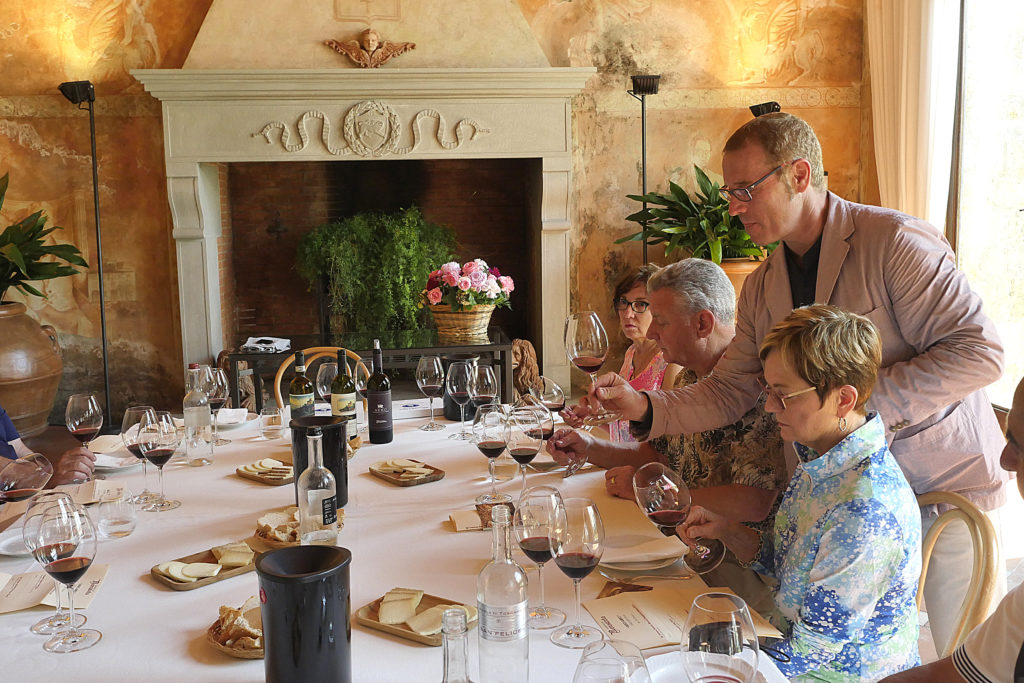
Campi Flegrei, with its wild beauty, was also the backdrop of the 2022 Campania Stories – Special Edition. This is a yearly wine event for press and trade professionals; an unmissable occasion to taste special vintages, and wines and meet the producers. Diana Cataldo and Massimo Iannaccone, ideators and directors of Campania Stories, did their very best with this event, not only by arranging a comprehensive wine tasting but also, with visits and tours to the producers.

The hosting region of this press trip, Campi Flegrei, is well known for the white grape varietal Falanghina. Campi Flegrei has enjoyed the DOC appellation with the Falanghina grape since 1994, but also, with the red grape varietal Piedirosso or Per’e Palummo. While Falanghina is known for being grown almost only in the Sannio region, needless to say, the grapes from Campi Flegrei are a different clone, a thinned bunch, lighter and with a distinguish saltiness.

The wineries are concentrated in 7 towns, including Naples, which is why, sometimes for this appellation we might talk of “Metropolitan Vineyards”, which are small estates nestled among tall buildings, but still enjoying the sea breeze from the Bay of Naples. Most of them have few pre-phylloxera plants, as the volcanic, powdery soil has preserved the European roots throughout the years.

A common thought is that Falanghina is an easy wine to drink and is to be consumed within a year of harvest, but there was a happy discovery during the blind wine tasting at Campania Stories – we tasted a 10-year-old Falanghina – the colour was deeply darker, the typical saltiness of Campi Flegrei area showed an incomparable crispness of this white.

La Sibilla is one of the milestone wineries of the area, which is based in Bacoli, North of Naples. The Di Meo family has run the wine business for over five generations on an estate of 10 ha. A section of the vineyards grows in an archaeological area called Villa di Cesare. There are a few plants in their vineyards that date back to more than a century, and are still on the European roots, protected by the friable grey volcanic soil. But the gem of La Sibilla is the aging cellar, an ancient tank of tuff where the Romans
collected rainwater. A naturally cool, dark place, where old single vineyard wines from Falanghina and Piedirosso keep aging. The classic Falanghina Campi Flegrei 2021 (we tasted) was straw yellow, with a herbal bouquet recalling all the herbs growing wild in the vineyards, from sage to
mint, with a touch of lemon zest. On the palate, the wine showed agility, freshness and a long-lasting saltiness – this definitely makes Falanghina a good food wine. A lovely pairing to buffalo milk mozzarella.

Another interesting producer is Agnanum, a smaller producer, run by the Moccia’s family. Their vineyards are next to the Astroni crater, which was previously a hunting reserve of the Borbons. This vineyard tried to survive the advance of concrete which is hidden by buildings and was also challenged by hungry foxes that in harvest time are tempted by the sweet juiciness of Falanghina grapes. The Moccia’s restate is in Agnano, next to a motorway- this is one of the most astonishing places in Naples: in the downtown of such a big city, the vineyard of Piedirosso is something so unexpected! So, while Raffaele Moccia is well known for being one of the authors of the Piedirosso revival, the tasting of Falanghina Campi Flegrei 2012 was not disappointing. A 10-year-old Falanghina is a big challenge, with its deep golden brilliant colour and its intense bouquet of ripe yellow fruit but still keeping its minerality (recalling wet sand and seashells}. On the mouth, the roundness and greasy taste is well balanced by the refreshing saltiness that still keeps the wine incredibly alive. A good way to enjoy the breathtaking view of the islands in the bay.

The press tour of Campania continued with a visit to Sannio, on the northern edge of the region. A historical place, where Roman ruins are side by side to modern buildings, where a stunning aqueduct, a masterpiece of architecture, stands in the middle of the plain around Benevento.
Through the years, Benevento has arisen in popularity because of the magic: legends say that it was the homeland of witches who used to reunite around the walnut trees, grown in Sannio. It’s not a coincidence,
that one of the worldwide most famous liqueurs, from this place, is named Strega – it means “witch” in Italian and whose recipe is still a secret.

Later, the big plain between Matese and Taburno mountain was mostly converted to vine and olive growing. These crops have represented the main income of the area for years, especially in the 20th century, when Sannio was sadly considered the tank of bulk wine from the white grape Falanghina, but also, from other grapes such as Barbera, Gglianico, and Piedirosso..

The average style of Falanghina is aromatic, light-bodied, and to be easily drunk in a year. Nowadays, the big surprise is a number of different styles of Falanghina have emerged, from an easy-drinking wine to a more complex wine. You would never have said it before, but this wine is now suitable for long aging. This all came out from a comprehensive tasting of local wines. One of the main producers of the area is Terre Stregate, a historic winery, run by the Iacobucci, family, who for years, have sold their grapes to other producers, and in the nineties started to invest on their own. The new
generation of the family, Filomena and Carlo, have rejuvenated the brand image, the wine line and labels, keeping the high standard of quality in the winemaking process.

Their wine, Svelato, is one of the best-known Falanghinas in Italy, rewarded by several accolades. Svelato Falanghina del Sannio 2021 is a bright straw yellow wine, with a delicate fruity bouquet, that
recalls ripe yellow fruits with a touch of exotic ones, well blended with a herbal finish. The sip is nicely refreshing, mouth-watering, warm but with a long finish. A full-bodied wine, unexpected from a grape that people considered for years a jug wine.

The estate has over 20ha and includes Falanghina and Aglianico, as well as Barbera, Piedirosso, and some olive trees for olive oil. The most interesting red was the Aglianico del Sannio DOC Manent 2019, a deep red, as expected from any Aglianico, which stands out for fruitiness and cleanness. The wine has been aged for almost a year in both steel and oak, which gives it a smoothness and spiciness, a well-balanced wine, good to drink now or to keep for some years.

@campaniastories #campaniastories #specialedition #masterclass #falanghinacampiflegrei #iobevocampano #campiflegrei #pozzuoli #naples #napoli #campania #campaniawine #tasting #winetasting #igerscampania #igerswine #winetime #degustazione #vino #wine #redwine #whitewine #winelover #winelovers #wines #madeinitaly #italianwine #travelling #winetourism #Falanghina #Aglianico #Italianwinelovers #Barbera #Gglianico, #Piedirosso


What to expect from Italy’s 2022 vintage – from Alto Adige to Sicily

Italy’s 2022 vintage has needed a great deal of tactical and strategical interventions from its winemakers to reach its peak. Filippo Bartolotta speaks to producers about what can be expected from this year’s crop.

It is that time of the year when the power of grapes to become wine is about to take place – harvest time!

For 8,000 years, mankind has been actively nursing the vine, waiting each year to ignite and assist the transition of the fruit into our beloved vino. Wine is the perfect mirror of the unique relationships among nature, grape varieties and human factors which every region manifests with a strong sense of place or what we know as terroir.

Every year though terroir’s many factors undergo a deep reshuffle due to the behaviour of that particular vintage – and the 2022 vintage in Italy has asked a great deal of tactical and strategical interventions from its winemakers to complete the annual cycle.

Forecasting a vintage is always something of a gamble at the beginning of August as anything can still happen. As I write this article, for example, Italy has started to see both drought-saving rains as well as violent water bombs and hail storms destroying much of the work done till now.

So although is still early, we can draw a pretty accurate picture of what has been happening and attempt a few outcomes.

The winter was quite regular with good annual snowpack levels in the Alpine regions and enough rains across the central and southern regions. Signs of dramatic drought only started to show with the unprecedented heat wave that had already melted the snow by the end of May and an absence of rain for over a hundred days.

But the vine and the wine world always show remarkable levels of resistance, resilience and an effective reaction to critical vintages.

Luckily, the lesson learned by wine producers from the monstrously hot 2003 vintage increased awareness of vine defence systems against heat and agronomical practices were subsequently studied included soil enrichment, foliage protection against transpiration and sun burn, vigorous rootstocks with deeper root systems and state-of-the-art irrigation methods (when allowed by the appellation and when there’s water available!).

But the best way to understand how a vintage and its harvest is going is to ask people on ground.

Alto Adige

Alto Adige was hit by the absence of rain and really high temperatures but its mountain are a secret weapon, “our great ally”, the President of the Consorzio Alto Adige Andreas Kofler says.

“The altitude is offering a high array of thermal excursions beneficial for our vines. We are hoping for a cooler September to retain acidity and freshness. This is a hot vintage with a couple of weeks of anticipation which will result quite interesting for the reds,” he said.

Kellermeister Andrea Moser of Cantina Kaltern noted that drought was managed largely through leaf management, to protect the berries from the sun during veraison to avoid the loss of anthocians, tannins, aromas and acidity. “This way we are getting to a proper phenological and technical maturation,” he said. “Some late July rains helped for a more consistent veraison and, keeping our fingers crossed, we will be harvesting at the beginning of September, a week in advance compared to 2021.”

Cantina Terlano and Cantina Andriano, overlooking each other from the two opposite sides of Val d’Adige reports a similar approach.

Rudi Kofler, head wine maker at both wineries is confident the vine has been reacting pretty well to the heat and he sees an 10 days anticipation. “We have been trimming leaves less than usual to provide coverage against the sun and we have been taking advantage of the investment in drip irrigation Alto Adige has been carrying out for many years now,” he explained. “We see healthy grapes with less yields per hectare. Thanks to the temperature drop of the recent days we are cautiously optimistic, but we still have to wait.”

Trentino

Trentino has seen a slightly different situation, with Anselmo Guerrieri Gonzaga, owner of the beautiful and historical estate of San Leonardo explaining that there was no stress for the vines.

“San Leonardo is set between mounts Baldo and Lessini and this overcasts a refreshing shade for at least four hours every day,” he explained. “This is a paramount factor to retain elegance and freshness in our wines. We are also noticing a very generous crop for an abundant harvest which should kick-off on the 10th of September.”

Anselmo Guarrieri Gonzaga

Harvest is set to start at Cembra, Cantina di Montagna, near Trento next week, where the altitude is as high as 900m above sea level.

Managing director, Ezio Dallagiacoma notes that the high temperatures bought an anticipation of maturation – and a mid-August harvest – in sight. “We are expecting to see wines with a lot of structure but still with the fresh mountain touch,” he said.

Veneto

“The almost absence of rain in winter and spring brought a late bud break and an unusual ten days early flowering of the vines,” Andrea Sartori of Sartori di Verona explains about his vineyard in Valpolicella and Soave.

“The bunches though look pretty healthy and not too compact making the selection of the best berries easier than usual. in the long run we will have to think more seriously about irrigation but so far with a little help of some scattered rains harvest 2022 looks better than expected.”

Talking to Pierangelo Tomassi of Tommasi Family Estates, which has its head quarter in Verona but farms 700 hectares across the length and breadth of Italy (the last harvest takes place in Vulture with the Aglianico) was particularly interesting, as he could provide an overview of the whole of Italy.

“Drought and heat were the common denominators of the year across the country. It was a tough vintage but where we had irrigation, we are getting far better results,” Tommasi said. “The harvest has just started, so we can’t say too much but it looks like we are going to have around 15% less in quantity overall. If the weather doesn’t go crazy this lower quantity should bring some nice wines though.”

Lombardia

Guido Berlucchi, started the harvest on the 3rd of August with the Brolo ‘clos’ of Pinot Nero. Winemaker and owner Arturo Ziliani described it as “a one-of-a-kind harvest with so much heat during the summer that it gave us good healthy grapes, although with possibly lower yields per hectare given the smaller size of the berries.”

Moving south in Oltrepò Pavese, in the Lombardia region – Italy’s most important district of Pinot Noir, with around 3,000 hectares of vines – we talked to two wine makers, Ottavia Giorgi Vistarino and Francesca Seralvo.

Ottavia Vistarino, owner of Conte Vistarino argued that despite the low rain, they didn’t experience too much stress on the vines as the ones on sandier soil. “We have been fighting drought keeping our vineyards with every either vine inter-row soil tillage and very few toppings”, he said.

Meanwhile Francesca Seralvo from Tenuta Mazzolino was unfiltered in her opinion.

Francesca Seralvo

“Hot and dry, it the vintage was worse than 2003!” she exclaimed. “We have been working hard like never before to do anything to keep the vines in balance. I’ve got to be honest that I am actually taken aback by the harmony our vines seem to have found despite the total lack of water. We are going to harvest much less than ever and yet the quality is good. We harvested already our Chardonnay – a tiny production of very juicy fruit.”

Piemonte

It was not an easy season in Piemonte. The winter was colder than in either 2020 or 2021 but it was also very dry with very little snow and the first serious rain fell at the end of May.

Up-and-coming talented wine producer Federica Boffa Pio of Pio Cesare notes that while waiting for the rain to arrive, the team worked the vineyards throughout the winter months in order to get as much nutrition for the soils as possible.

“Later on we protected the berries from the scolding sun and reduced the yields quite a bit which will result in a not very productive vintage,” he says. “Harvest should take place in a week for the whites and the end of September for the Nebbiolo.”

Tuscany

Meanwhile in Tuscany, contingency plans are going well, says Francesco Ricasoli, of Ricasoli in Brolio-Gaiole, Chianti Classico. “Right now we are still experiencing important vineyard stress particularly on the pebble-based soils where the roots do not seem to be able to push deeper in search for water,” he explains. “We had to go for special emergency irrigation for the younger vines.”

Still in Chianti Classico, but in Greve in Chianti on the Florentine side, the François family of Castello di Querceto are very happy about how the whole appellation reacted to the drought.

“The natural cooling system offers by the forest (out of 70,000 hectares of the Chianti Classico appellation only 10% is vineyards) and the good work for the water reservoirs held a lot,” Alessandro François told me. “Our vines are high on the hills and as a result they parents struggling much, but now we do need rain.”

In Castellina in Chianti, Léon Femfert of Nittardi said working the soil in winter and adding spontaneous vegetation as bedding to retain humidity in the soil had “never been more important”.

“So far our crop seems abundant with grapes full of good polyphenols anticipating a great structure Chianti Classico,” he said.

Calogero Portannese managing director of Tenuta di Trinoro in Sarteano, in the heart of Unesco site Val d’Orcia noted that it was fortunate to be between Mount Amiata and Mount Cetona. “This brings 20 degrees thermal excursion between day and night, while the godsend rain at the end of July did the rest,” he said.

Emilia Nardi, owner of Tenute Silvio Nardi in Montalcino has been doing everything possible to reduce the stress for the vines. ”Organic kaolinite (a type of white clay) was used on the leaves to reduce transpiration reflecting light away,” he explains. “We have smaller berries with a good quality so we are expecting less but good”.

Calabria

Not everything about the drought has been bad for the vine though, according to Calabria Librandi. While Paolo Librandi would have loved a little rain to ease the life of the vines and produce a bit more, he seems happy about the healthy conditions of the grapes, which have seen the least amount of treatment ever.

“We are harvesting right now quite a bit in advance. It looks like a good vintage for the quantity with some smaller grapes, more concentration, above all in the red wines. The indigenous white varieties look good with healthy grapes,” he says. “But I have to be honest that a little rain would make everyone happier and give a little more quantity. But given the drought, it is quite impressive the health conditions of the grapes all across the Cirò area with only 3/4 treatments throughout the year!”

Sicily

According to Consorzio Doc Sicilia, Sicily is likely to record almost 15% less production for 2022, than in 2021, but with an amazing quality. The Consorzio’s president Antonio Rallo notes that harvest starts this week and will finish in October, making it the longest harvest in Italy, of over 100 days.

Mount Etna producer Passopisciaro notes that despite more than two and a half months of heat wave with no rain, the vines seem ok.  “We are noticing how our single vineyards Etna DOC hundred years old vines are actually in wonderful state, a little ahead of schedule but possibly very good fruit,” managing director Vincenzo Lo Mauro says.

Resilience

The lack of water over the last few months and the high temperatures have been driving producers a little crazy and many are scared about the future outcomes if vintages continue to be as hot.  However vine growers and the wine-makers seem to be well equipped to face this threat, and in some ways it is remarkable how well the system has performed in the face of this challenge.  Of course production is likely to be smaller overall, with smaller berries and more concentration but this has meant fewer treatments needed to fight any presence of pests or moulds.

However, with harvest only just starting, this is only the beginning of the story of this hot 2022 vintage, we will have to wait until the beginning of November for its conclusion.

Sources:
Filippo Bartolotta
Drinks Business


#italianwine #winelovers #italianwinelovers #italy #vintage2022 #wine #vinto #instawine #wine #winenews #wineinfluencer

Garda Wine Stories: Exploring the Territory and Wines of Lake Garda – Filippo Magnani

From the 8th to 11th of June, the Garda DOC Consortium organized ‘Garda Wine Stories’, an event dedicated to the extraordinary peculiarities of the wine territory of Lake Garda. It was a full-scheduled press tour which included: seminars, masterclasses, in-depth analysis, guided cellar tours, and a stunning sailboat ride with tasting, aboard a cutter (equipped with the ancient trapezoidal sails). It was not only an opportunity for the Italian and international press to discuss in-depth the complex and vast territory, but also for wine lovers. On Friday, June 10th we attended a tasting with 20 producers, representing the best winemaking areas. The impeccable event was organized by the Consortium.

Discovering Garda DOC
The denomination Garda DOC was founded in 1996. It represents a large geographical area that groups in the same macro area other important Italian DOCs for a total of around 31,100 hectares under vine, of which 27,889 hectares are in the province of Verona, the outlying hectares are spread between the towns of Mantua and Brescia. Today, it has around 4,000 associated producers and a production of 21 million bottles, with a good prospect of further growth. The objective of the Consortium is to enhance the value of the varietal wines produced in these historical appellations and to give further opportunities of identification for those who grow in the outlying zones. The Consortium is playing an important role in pursuing a circular strategy that conveys all the resources that Lake Garda has, and the dialogue between the wine system, wine tourism and hospitality, sport activities, and gastronomy.

Garda – A Wine Territory around the Lake
Lake Garda is the largest body of water in Italy, extending for about 370 km2, it is encompassed by 3 Italian regions: Lombardy, Veneto, and Trentino Alto Adige. Its banks extend for 50 km from north to south and for about 17 km from east to west. In the imaginary triangle composed of the provinces of Trento (north), Brescia (south-west) and Verona (south-east), an extraordinary natural and cultural heritage is preserved. The landscape, from any point you look, is a jubilation of biodiversity, corners of extraordinary scenic beauty. Mountains, hills, and beaches are covered by the typical Mediterranean vegetation with olive trees, caper bushes, lemon and citron trees, agave plants and vines; all framed by historical and cultural sites, castles, harbours, charming villages, traces of human activities that have always influenced the appearance of Lake Garda shores.

The climate is mild in all its extension despite the northerly longitude. There are many factors that contribute to the incredible climatic conditions that make Lake Garda one of the most heterogeneous and interesting wine areas. The northern cone-shaped narrow area is surrounded by the Alps providing a shield from the cold currents from the North. The lake also plays an important mitigating action, lifting colder fogs in the mornings allowing the ventilation among the vines, and by absorbing heat and releasing it in relation to the external temperature. Winters are never harsh, and summers are hot. The daily temperature range is quite high due to the presence of a breeze blowing south in the morning and north in the afternoon, thermal excursion is an extremely important factor for the perfect ripening of the grapes.

From the gentle morainic hills of the southern basin to the extreme peaks of the Alps, the soil around Lake Garda is a puzzle of different compositions but perhaps the most distinctive and fascinating element has to do with the light. This place is glowing. The phenomenon of light refraction made possible by the size and depth of the lake is an element of great uniqueness in the territory. Here the vine finds a perfect place to grow, in a bright and lush nature, helped by the meticulous hands of brilliant winemakers. The wide area that covers Garda Doc includes countless grape varieties and many interpretations of them.

Each of the wine districts that stretch around Lake Garda bring traditions in production methods, history and, of course, the most representative vines from the different areas: Garganega, Trebbiano (Trebbiano di Soave and/or Trebbiano di Lugana), Chardonnay, Pinot Grigio, Corvina, Marzemino, and Merlot and Cabernet Sauvignon. Altogether, they constitute the backbone of Garda DOC wine production. Great importance is given to the sparkling wines using the varieties from the different wine areas: Garganega for white wines, Corvina for rosé, crémant method Chardonnay, but also Pinot Grigio, Reno, and Muller Thurgau.

The boundaries of DOC Garda embrace a wide area. Considering the extraordinary attitude of Italian wine territories to change connotations in a few meters, it’s hard to imagine how many environments coexist around the lake. The Consortium has been stimulating scientific research in order to improve the understanding of the pedoclimatic and oenological aspects of the Lake Garda territory, with the ultimate goal of proposing models with a sustainable footprint to enhance wine productions and to defend our extraordinary natural heritage.

Lake Garda: A Paradise for Wine Enthusiasts
Lake Garda is one of the most romantic locations and it represents the charm of the Dolce Vita Italiana. It is a real paradise for those who love wine, food, stunning natural scenery, sports, art and culture… in short, there is everything for everyone!  It is no coincidence, that the territory around the lake is one of the favorite destinations of lovers of our country (Italy). The road network and the water transport that connect the various areas of the lake allow wine enthusiasts and foodies to concentrate their exploration of the wines of the DOC Garda even on a short holiday.  A journey in a journey, a shining example of how wine tourism became the “art of hospitality”.  The Consorizio Garda DOC is proposed as a promoter of the territory of Lake Garda as a wine escape, collecting and communicating the infinite experiences that can be carried out and proposing them through multiple channels. Visit where official site www.gardadocvino.it  where you learn about amazing stays on these shores, in the section “experience”.

#gardadoc #staywithus #wine #gardalake #italy #italianwineregion #GardaWineStories #LakegardaItaly #italianwinelover #winelover #gastronomy #wine #vino #gardawines #wineexperience #winetasting #winetourism #sailing